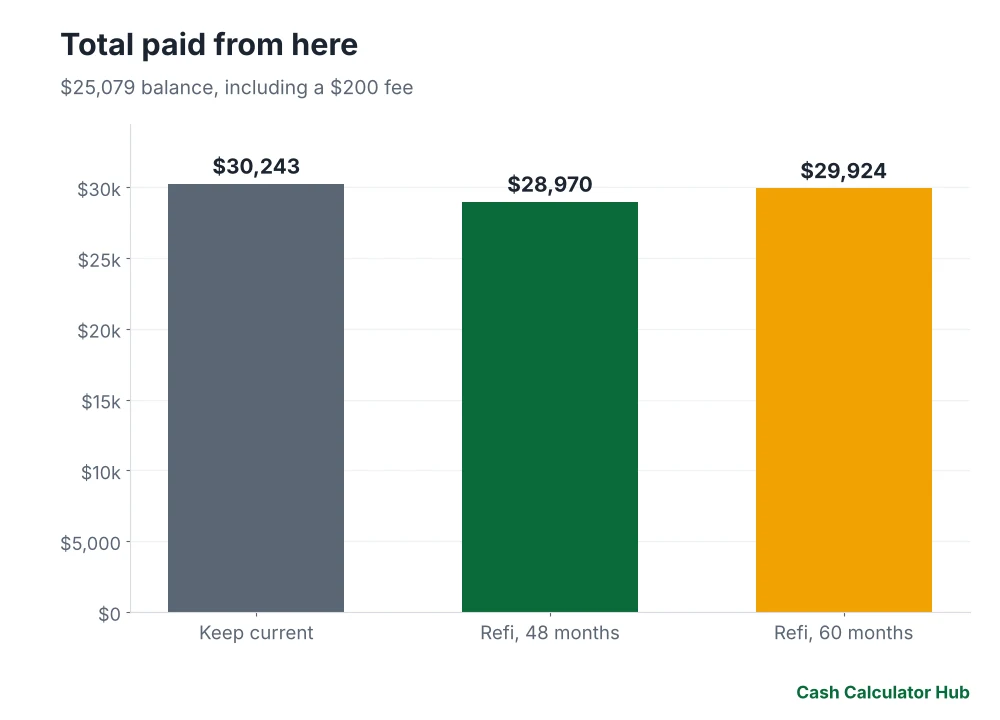
Quick answer: Refinancing a car loan pays off when you can get a rate at least 1 to 2 points lower without lengthening the term. In this example, refinancing a $25,079 balance from 9.5% to 6.9% over the same 48 months saves about $31 a month and $1,273 in total, after a $200 fee; extending to 60 months lowers the payment more but cuts the saving to $318.
Many drivers finance a car at the dealership at whatever rate is offered. A year later their credit has improved, rates may have moved, and the loan can be refinanced like a mortgage, with a much smaller cost.
The example: you borrowed $30,000 for 60 months at 9.5%. After 12 payments you owe $25,079 with 48 months left. You are offered 6.9%.
Key takeaways
- Current payment: $630. New payment on 48 months at 6.9%: $599, a saving of $31.
- Total saving over the remaining 48 months, after a $200 fee: $1,273.
- Extending to 60 months drops the payment to $495 but keeps you paying 12 months longer and the total saving falls to $318.
- Refinancing works best early in the loan, when most of the interest is still ahead.
- Check for prepayment penalties, title fees and the car’s value versus the new loan.
The comparison
| Keep current loan | Refinance, same 48 months | Refinance, 60 months | |
|---|---|---|---|
| Balance | $25,079 | $25,079 | $25,079 |
| Rate | 9.5% | 6.9% | 6.9% |
| Monthly payment | $630 | $599 | $495 |
| Remaining payments | 48 | 48 | 60 |
| Total paid | $30,243 | $28,970 | $29,924 |
| Saving | n/a | $1,273 | $318 |
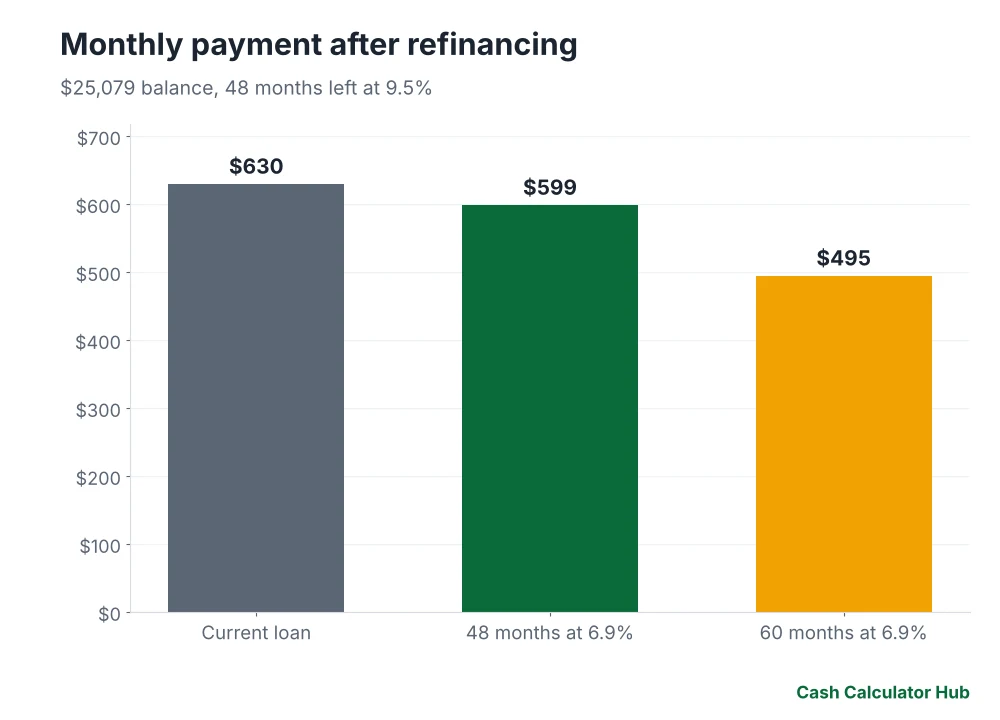
The shortest term gives the largest total saving. The 60-month version offers a lower payment, which helps cash flow, but a lot of the interest benefit goes to the extra year.
When refinancing makes sense
- Your credit score rose since you bought the car. A 50-point jump can mean a meaningfully lower rate.
- Rates dropped or the original loan came with a dealer markup.
- The loan is young. Most interest is paid early, so there is more to save.
- The loan is large and the rate high, as in the example.
When it does not
- You have less than about a year left on the loan.
- The new rate is only slightly lower, and fees eat the saving.
- The car is older or has high mileage, which many lenders limit.
- You owe more than the car is worth; see negative equity.
Costs to check
- Application, title transfer and lien fees (often $50 to $300).
- A prepayment penalty on your current loan.
- GAP or warranty products financed into the loan, which may need to be cancelled for a refund.
- Any change to the required insurance.
How to refinance
- Check your credit and the car’s value and mileage.
- Get quotes from a credit union, a bank and an online lender; many offer prequalification with a soft check.
- Compare APR and total cost, not only the payment.
- Choose the term that keeps your payoff date the same or earlier.
- Pay off the old loan and confirm the lien is released.
Use the numbers
The refinance calculator and auto loan calculator show the saving for your balance and rate. Check how credit affects pricing in the credit score guide (the same bands matter for cars). The APR calculator includes fees. More: auto calculators.
Frequently asked questions
When should I refinance my car loan?
When your credit has improved, rates are lower or your current rate is high, and you have a good amount of time left on the loan. A drop of at least 1 to 2 points is usually worth it.
Does refinancing a car loan hurt my credit?
It causes a small, temporary dip from the credit check and new account. Rate shopping within a short window counts as one inquiry.
Can I refinance a car loan with negative equity?
It is harder, since lenders want the loan to be at or below the car’s value. A down payment to cover the gap may be needed.
How much does it cost to refinance a car?
Usually little: title and lien fees of about $50 to $300 and sometimes an application fee.
Should I extend the term when I refinance?
Only if you need a lower payment. A longer term raises total interest and keeps you in debt longer.
Sources and further reading
How the numbers were made: Every figure on this page was calculated from the formulas and assumptions stated above and rounded to the nearest dollar. Rates, limits and rules are for 2026 unless noted; confirm current figures with the sources listed before acting.
Keep reading
- Cash Back or Low APR? How to Pick the Better Car Deal
- 72- and 84-Month Car Loans: Lower Payments, Higher Risk
- How Much Car Can I Afford? The 20/4/10 Rule With Real Numbers
- Gap Insurance: Do You Need It and What Does It Cover?
- Trade-In vs Private Sale: What Your Car Is Really Worth to You
- The True Cost of Owning a Car: About $11,577 a Year
This guide is general information, not financial, tax or legal advice. Figures use stated assumptions and 2026 rules and will differ from your situation; check current rules and talk to a licensed professional before you decide. Full disclaimer.