
Every guide here works through a real money decision with actual numbers, charts, sources and a link to the free calculator that runs the same math. A new guide is added every day. Browse by topic, or go straight to the full list of calculators.

How to Read Your Paycheck: Gross Pay, Withholding and Net Pay Explained
A $3,000 biweekly paycheck turns into about $2,204 after withholding and deductions. Here is what each line means and where the money goes.
APR vs APY: What’s the Difference and Why It Matters for Loans and Savings
A 24% APR compounded monthly is really a 26.8% annual cost. A savings account quoted as 4.00% APY already includes compounding. Here is how to compare.

Mortgage Recast vs Refinance: Which Lowers Your Payment Better?
Recasting keeps your rate but lowers your payment after a lump sum. Here is how a $60,000 recast compares with a refinance and with simply paying extra.

72- and 84-Month Car Loans: Lower Payments, Higher Risk
A longer car loan lowers the payment but costs more interest and leaves you owing more than the car is worth for longer. Here is the comparison for a $35,000 loan.

Payback Period and Discounted Payback: How Fast Does an Investment Return Your Money?
Simple payback is investment ÷ annual cash flow: 4.2 years. Discounting at 8% stretches it to 5.3 years.

Stocks vs Bonds: How to Choose Your Asset Allocation
More stocks mean more growth and bigger drops. Here is how five stock-bond mixes compare on long-run growth and a deep-bear-market year, and how to choose yours.

Pension Lump Sum vs Monthly Payments: How to Compare the Offers
The monthly pension pays like a bond that you cannot outlive. At age 62, $400,000 versus $2,500 a month depends on how long you live and what you could earn on the lump.

FICA Taxes Explained: Social Security and Medicare Withholding in 2026
Employees pay 7.65% of wages in FICA tax; employers match it. The Social Security part stops at $184,500 of wages, Medicare never does.

Pay Yourself First: How to Automate Saving So You Actually Do It
Automating 10% of a $60,000 salary into investments reaches about $609,985 in 30 years at 7%. Here is how to set it up without relying on willpower.

Do Your Raises Keep Up With Inflation? How to Calculate Your Real Raise
A 3% raise in a year with 4% inflation is a real pay cut of about 1%. Here is the formula, a table of raises needed and what to do when you fall behind.

Closing Costs Explained: What You Pay and How to Lower It
Closing costs typically add 2% to 5% of the price to what you pay at the table. Here is every major fee, which are negotiable and how to cut the total.

Credit Score Factors: What Moves Your Score and by How Much
Payment history (35%) and amounts owed (30%) make up about two-thirds of a FICO score. Here are the five factors and practical ways to improve each.

Break-Even Analysis: How Many Units or How Much Revenue You Need to Cover Costs
Break-even units = fixed costs ÷ (price − variable cost). Here that is 667 units or $26,667 of revenue a month.

Index Fund vs ETF vs Mutual Fund: Differences, Costs and Taxes
An index fund is a strategy; ETFs and mutual funds are wrappers. Here is how they differ in cost, trading, minimums and taxes, and which one suits which investor.

How Much Should You Have Saved for Retirement by Age? Benchmarks for 30 to 67
Salary multiples give you a quick check: 1× by 30 up to 10× by 67. Here are the dollars at three incomes, what to do if you are behind and why savings rate matters most.

New vs Used Car: The Five-Year Cost Comparison
Depreciation, interest, insurance and repairs add up differently for new and used cars. In this example the used car saves about $8,486 over five years.
W-2 vs 1099: How Much More You Must Charge to Match an Employee Salary
To match an $80,000 salary after tax, a 1099 contractor needs about $86,023, before counting benefits. Here is how the numbers work.

ARM vs Fixed-Rate Mortgage: What a 5/1 ARM Really Costs
A 5/1 ARM saves about $10,523 over its fixed period on a $350,000 loan. The risk is the reset. Here are the payments at three rate outcomes.
Sinking Funds: How to Save for Irregular Expenses Without Wrecking Your Budget
Annual costs add up to $6,540 in this example, which is $545 a month. Sinking funds turn surprise bills into planned ones.

Balance Transfer Cards: Are They Worth the 3% to 5% Fee?
A 3% fee on $6,000 is $180, but 18 months at 0% can save $1,180 compared with staying at 24%. The key is paying it off before the promotion ends.

Gross Margin vs Operating Margin vs Net Margin: What Each Tells You
Revenue $500,000 turns into $200,000 of gross profit, $80,000 of operating profit and $52,500 of net profit. Each margin answers a different question.
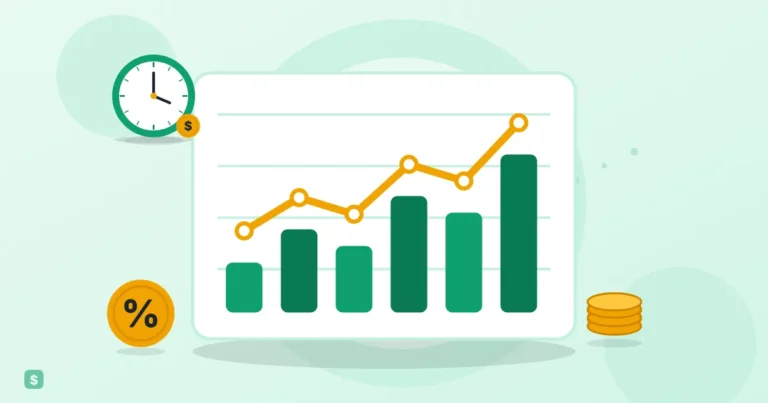
Dollar-Cost Averaging vs Lump Sum: Which Is Better for $120,000?
If you have a lump sum, should you invest it all now or in 12 monthly pieces? The math favors investing at once most of the time, but there are good reasons to average in.

Backdoor Roth IRA Explained: Steps, the Pro-Rata Rule and Pitfalls
A backdoor Roth works around the Roth IRA income limit. The catch is the pro-rata rule: with $92,500 in a traditional IRA, converting $7,500 is 92% taxable.
Self-Employment Tax Explained: The 15.3% Tax and How to Estimate It
On $100,000 of net profit, self-employment tax is about $14,130, double the $7,650 an employee pays. Here is the formula, the deduction and quarterly payments.