Quick answer: A $3,000 rebate or 1.9% financing on a $35,000 car? The low rate wins by $1,756 here, but the answer flips with smaller loans or cheaper outside financing.
You will see the offer in ads: “$3,000 cash back or 1.9% APR financing for 60 months.” The fine print says you cannot have both. This is a good example of a decision that sounds like marketing and is actually just arithmetic.
What you are really comparing
- Option A: take the rebate. It reduces the amount you finance (or you take the cash). You then borrow at whatever rate you can get from a bank, credit union or the dealer’s standard financing.
- Option B: take the promotional rate. You finance the full price at the low rate.
Both are loans with a total cost. The winner is the one with the lower total of payments.
A worked example
A $35,000 car, 60 months. A $3,000 rebate, or 1.9% financing. Your credit union offers 7.5%.
| Rebate + 7.5% loan | 1.9% APR | |
|---|---|---|
| Amount financed | $32,000 | $35,000 |
| Monthly payment | $641 | $612 |
| Total of payments | $38,473 | $36,716 |
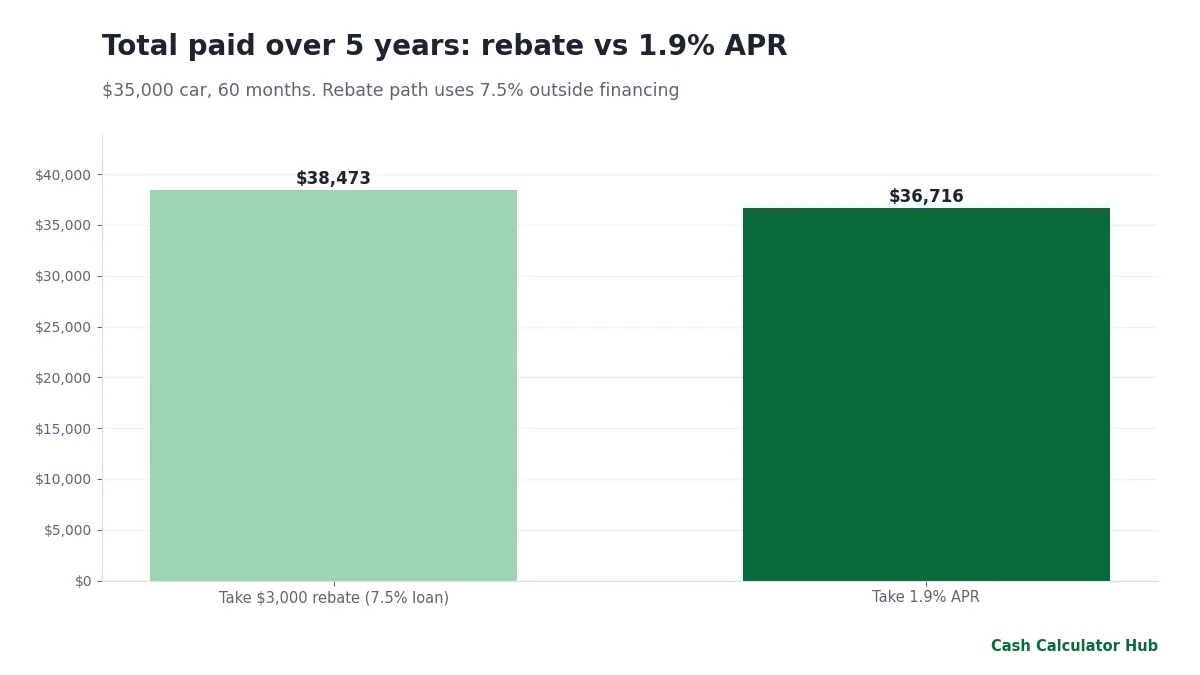
The low APR saves $1,756 and also carries a lower payment, by $29 a month. This is the typical pattern for a larger loan at a long term with a good promotional rate. The rate difference (5.6 points) is doing more work than the $3,000 rebate.
When the rebate wins
Change two things, and the answer reverses.
- A larger rebate. At a $5,000 rebate and the same rates, the rebate path costs $36,068 against $36,716 for the 1.9% loan.
- A cheaper outside loan. If you can borrow at 5% instead of 7.5%, the rebate path total is $36,233, which is lower than the 1.9% total.
The break-even promotional rate is the highest dealer rate that still beats the rebate:
| Rebate | Break-even APR (outside rate 7.5%) |
|---|---|
| $1,000 | 6.28% |
| $2,000 | 5.05% |
| $3,000 | 3.79% |
| $4,000 | 2.50% |
| $5,000 | 1.19% |
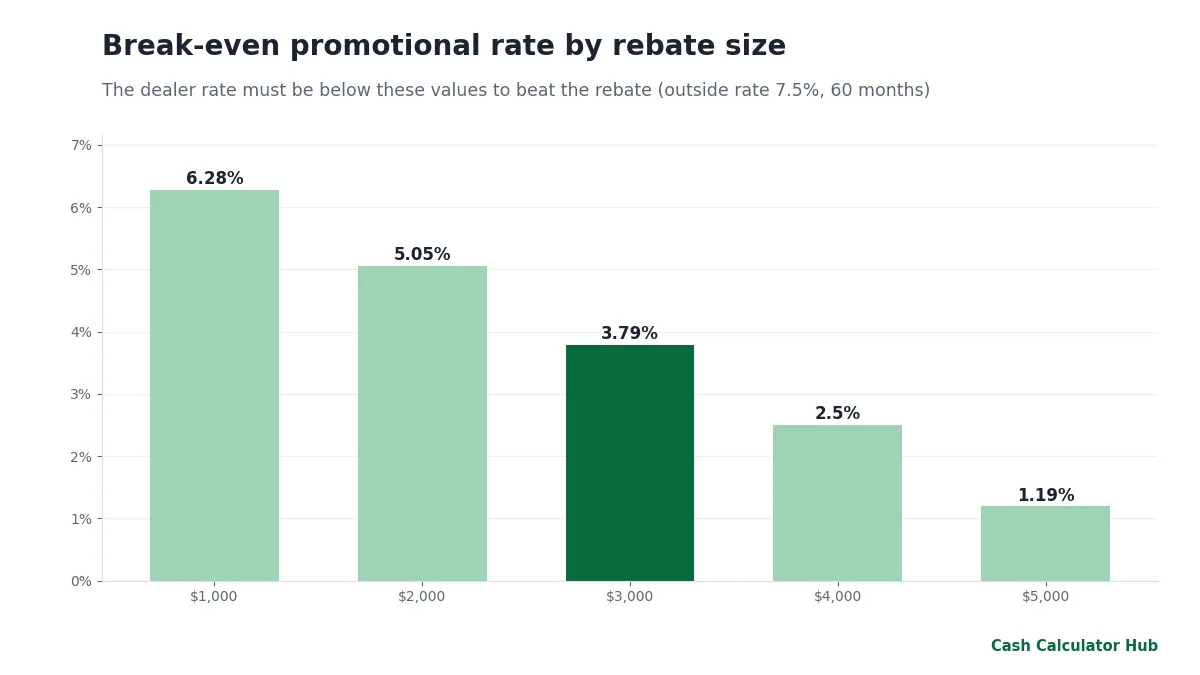
Read it like this: with a $3,000 rebate, the dealer’s rate needs to be about 3.8% or lower for the low-APR option to win. A 1.9% offer clears that easily.
Rules of thumb that hold up
- Short loan, small amount, big rebate: take the rebate. There is little interest to save.
- Long loan, large amount, rate near zero: take the low rate.
- Always get a pre-approval first. A bank quote turns a vague decision into a number you can plug in.
- Check the 0% fine print. Promotional rates usually require excellent credit, and the offer may apply only to certain terms (often 36 or 48 months, which means a higher payment).
- Negotiate the price before you mention financing. A rebate or rate does not make the price lower; separate the conversations.
Other things that change the answer
Sales tax. In most states tax is calculated on the price before the rebate. In some it is calculated after. Ask which applies, because it changes your amount financed.
Early payoff. If you plan to pay off the loan in two years, the low rate matters less and cash up front matters more.
Taking the rebate as cash. You can use it as a down payment, which also reduces the amount borrowed.
Run it yourself
The cash back or low interest calculator compares both offers side by side. Test the loan pieces in the auto loan calculator and learn how much car fits your budget in our car affordability guide. For how loan length compounds the cost, use the loan calculator. The rest of the auto category has lease tools too.
A negotiation order that protects you
- Settle the out-the-door price first. That includes tax, title, registration and dealer fees. Do not discuss financing or trade-in until this number is in writing.
- Bring a pre-approval. A bank or credit union quote gives you a rate to compare with the dealer’s promotional offer and a fallback if the incentive requires a very high credit score.
- Ask which incentives can be combined. Some offers stack (loyalty rebate plus a college-grad bonus), and some exclude each other. Get the combinations in writing.
- Keep the trade-in separate. Get a quote from an online buyer or another dealer so you know what the car is worth.
- Read the finance contract before you sign. Make sure the APR, term and amount financed match what you agreed, and decline add-ons such as extended warranties you did not ask for, or at least price them separately.
One more factor: the term
Promotional rates often come with shorter terms. A 1.9% rate for 36 months means a higher payment than a 7.5% loan for 60 months, even though it costs less in total. Make sure the payment fits your budget before you choose the “cheaper” option. If it does not, a rebate and a longer standard loan may be the more sustainable choice. Use the auto loan calculator with different terms to see both payments.
Is 0% financing really free?
The interest is zero, but you give up any rebate and often need top credit. It is a good deal only if you would not have gotten a better price elsewhere.
Can I get both the rebate and the low rate?
Sometimes, but usually not. Ask the dealer in writing.
Does taking the rebate hurt my credit?
No. The loan you take is what matters, either way.
Which is better for a used car?
Promotional rates and rebates are mostly for new cars. For used cars, compare lender rates directly.
Sources and further reading
How the numbers were made: Every figure on this page was calculated from the formulas and assumptions stated above and rounded. Rates, limits and rules are for 2026 unless noted; confirm current figures with the sources listed before acting.
Keep reading
This guide is general information, not financial, tax or legal advice. Figures use stated assumptions and 2026 rules and will differ from your situation; check current rules and talk to a licensed professional before you decide. Full disclaimer.