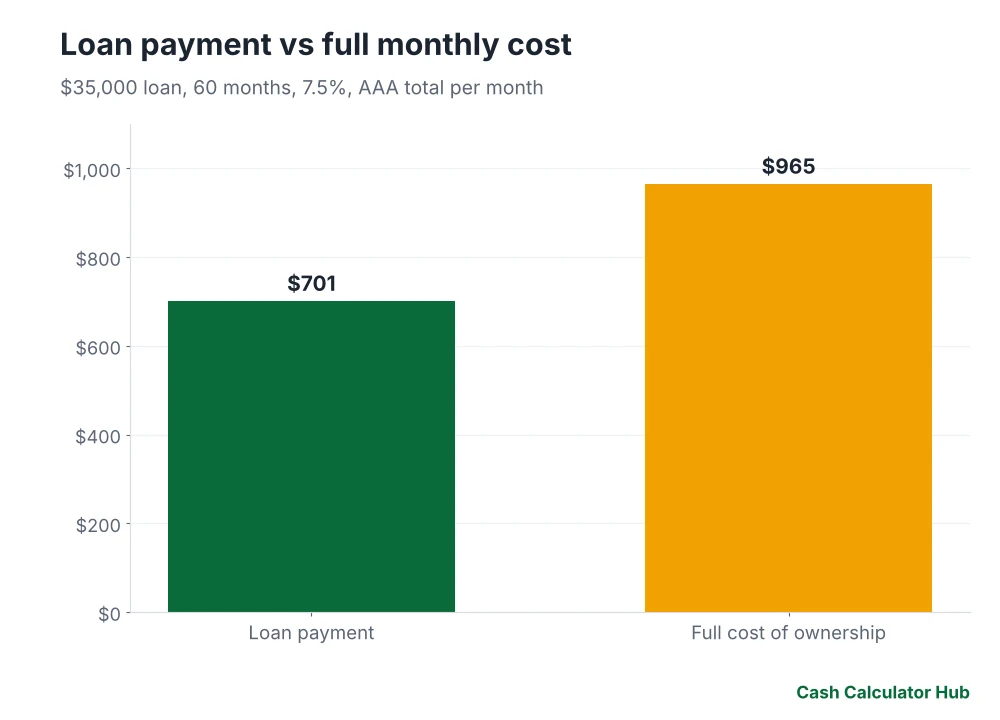
Quick answer: AAA’s 2025 Your Driving Costs study estimates that owning and operating a new vehicle costs about $11,577 a year, roughly $965 a month or 77 cents a mile at 15,000 miles. Depreciation alone is about $4,334 a year and finance charges about $1,131, so the car loan payment is only a portion of the real monthly cost.
Most people budget a car as a loan payment and a tank of gas. The full cost of ownership includes depreciation, insurance, maintenance, tires, registration and interest, and those costs continue after the loan is paid.
The anchor figure comes from AAA’s 2025 Your Driving Costs study, which covers 15,000 miles a year over five years of ownership for popular mid-priced models. Your car and region will differ, so use the structure rather than the exact figure.
Key takeaways
- Estimated yearly cost of a new vehicle: $11,577 (AAA, 2025).
- Depreciation is the largest known piece at about $4,334 a year, then fuel at about $1,950 and finance charges at about $1,131.
- Insurance, maintenance, tires, license, registration and taxes make up the remaining $4,162.
- Costs per mile run about 77 cents at 15,000 miles a year.
- At a 15% transportation target, a take-home income of about $77,000 a year supports this level of cost.
Where the money goes
| Category | Per year | Note |
|---|---|---|
| Depreciation | $4,334 | Loss in value; largest single cost |
| Finance charges | $1,131 | Interest on the loan |
| Fuel | about $1,950 | About 13 cents a mile |
| Insurance, maintenance and repair, tires, license, registration and taxes | about $4,162 | Combined in this view |
| Total | $11,577 | About $965 a month |
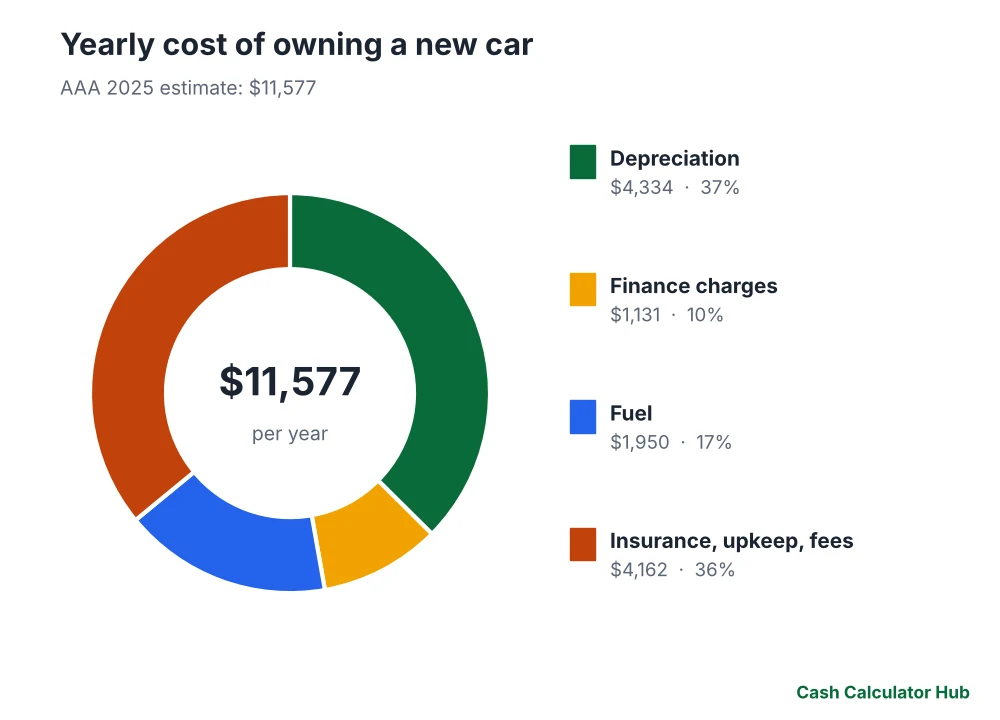
These are AAA’s 2025 averages for new vehicles; a used car shifts the balance toward repairs and away from depreciation. See new versus used.
What the payment hides
Say you finance $35,000 for 60 months at 7.5%. The payment is about $701. Add insurance, fuel and upkeep and your real monthly cost is far more than the payment. Depreciation is invisible because it is not a bill, but it hits you when you sell.
How much of your income should a car take?
A common target is 15% of take-home pay or less for all transportation costs, including payment, insurance, fuel and maintenance. The 20/4/10 rule (see how much car you can afford) keeps the loan within that range. For a car costing the AAA average:
| Gross income | Take-home per month (approx.) | Car cost as share of take-home |
|---|---|---|
| $40,000 | $2,567 | 38% |
| $60,000 | $3,850 | 25% |
| $80,000 | $5,133 | 19% |
| $100,000 | $6,417 | 15% |
At lower incomes the same car consumes a much larger share; that is a signal to choose a cheaper car or keep an older one longer.
Ways to lower the cost
- Buy used and avoid the steepest depreciation.
- Keep cars longer. Cost per year declines as the car ages, if it is reliable.
- Shop insurance every year. Rates vary widely among companies for the same driver.
- Choose fuel-efficient models. Fuel at 13 cents a mile is about $1,950 a year; a model that saves 20% saves about $390.
- Maintain on schedule. Skipping oil changes and tire rotations raises repair costs.
- Drive less or share trips where possible.
- Pay down the loan faster to cut interest; see why shorter loans cost less.
Your annual cost sheet
Build your own list: payment, insurance, fuel, maintenance, tires, registration, parking and tolls. Divide by 12. Compare it with the national figure and with alternatives like leasing (lease versus buy) or an electric car (EV versus gas).
Use the calculators
Run the payment in the auto loan calculator, the loss in value in the depreciation calculator, and build the overall plan in the budget calculator. More: auto calculators.
Frequently asked questions
How much does it cost to own a car per month?
AAA’s 2025 figure for a new vehicle is about $965 a month, including depreciation, insurance, maintenance, fuel, finance charges and fees.
What is the cost per mile of driving a car?
About 77 cents per mile in AAA’s 2025 study at 15,000 miles a year. Fuel alone is about 13 cents.
Is it cheaper to keep an old car?
Often, because depreciation and finance costs drop. Older cars cost more in repairs, so compare against a realistic repair budget.
What percentage of income should go to a car?
A common guideline is 15% of take-home pay or less for all car costs, and 10% for the payment alone.
Why is my car more expensive than the average?
Higher-priced vehicles, expensive insurance areas, longer commutes and higher interest rates all raise costs.
Sources and further reading
How the numbers were made: Every figure on this page was calculated from the formulas and assumptions stated above and rounded to the nearest dollar. Rates, limits and rules are for 2026 unless noted; confirm current figures with the sources listed before acting.
Keep reading
- How Much Car Can I Afford? The 20/4/10 Rule With Real Numbers
- Car Depreciation: How Fast Cars Lose Value, Year by Year
- New vs Used Car: The Five-Year Cost Comparison
- Auto Loan Refinance: When Does It Pay Off?
- Gap Insurance: Do You Need It and What Does It Cover?
- Trade-In vs Private Sale: What Your Car Is Really Worth to You
This guide is general information, not financial, tax or legal advice. Figures use stated assumptions and 2026 rules and will differ from your situation; check current rules and talk to a licensed professional before you decide. Full disclaimer.