Quick answer: A longer car loan lowers the monthly payment but raises total interest and prolongs negative equity, owing more than the car is worth. On a $35,000 loan at 8%, an 84-month term costs $546 a month versus $854 for 48 months, adds $4,810 in interest, and leaves you underwater for about 4 years.
Average new-car prices have pushed many buyers toward 72-month and even 84-month loans, because stretching the term is the easiest way to hit a monthly payment target. The convenience has a price, and the biggest risk is not the interest but being underwater when something goes wrong.
The example: a $32,000 car plus about $3,000 of sales tax, title and fees, all financed with no down payment, so the loan is $35,000 at 8%. Car value follows the typical curve (20% loss in year one, about 11% a year after).
Key takeaways
- Payment falls from $854 at 48 months to $546 at 84 months.
- Total interest rises from $6,014 to $10,823.
- With nothing down you would be underwater for about 1.2 years on a 48-month loan and 3.8 years on an 84-month loan.
- Negative equity matters if the car is totaled, stolen or you need to sell.
- The 20/4/10 rule caps the term at 4 years for a reason.
Payment and interest by term
| Term | Monthly payment | Total interest | Total paid |
|---|---|---|---|
| 48 months | $854 | $6,014 | $41,014 |
| 60 months | $710 | $7,580 | $42,580 |
| 72 months | $614 | $9,184 | $44,184 |
| 84 months | $546 | $10,823 | $45,823 |
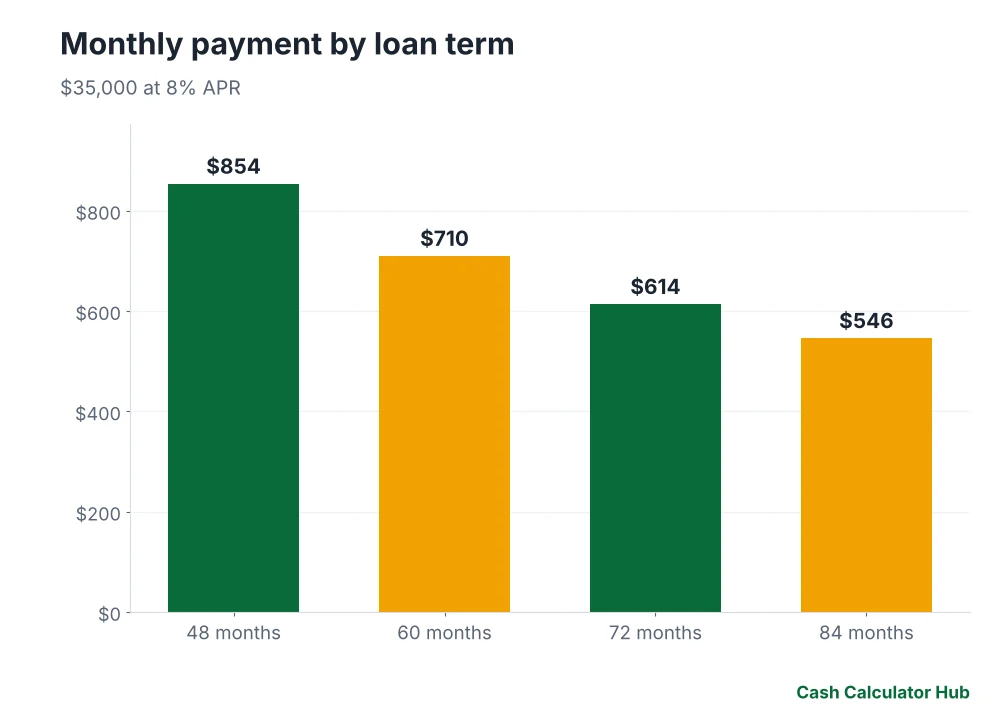
Going from 48 to 84 months drops the payment by $309 a month, a 36% cut, but the extra interest is $4,810.
Negative equity: the bigger problem
You have negative equity when you owe more than the car is worth. Because new cars lose value fastest in the first years, long loans with small down payments run underwater for a long time:
| Term | Months underwater (no down payment) |
|---|---|
| 48 months | about 15 months (1.2 years) |
| 60 months | about 23 months (1.9 years) |
| 72 months | about 33 months (2.8 years) |
| 84 months | about 45 months (3.8 years) |
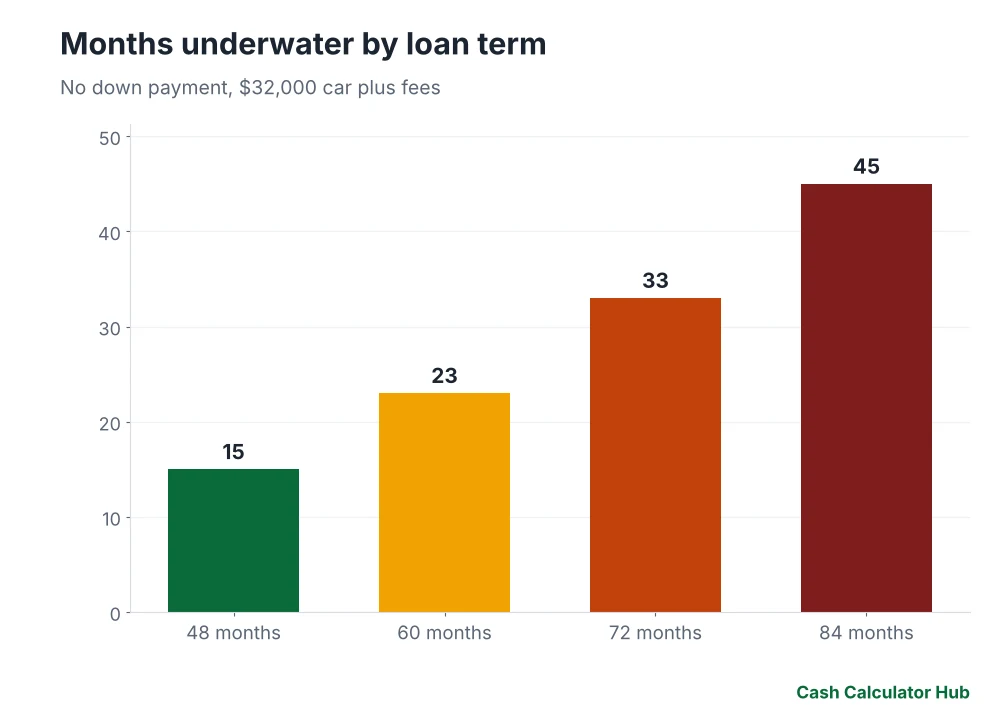
If the car is totaled while you are underwater, insurance pays its market value, not your loan balance. You owe the difference. That is why the lender may require gap coverage; see the gap insurance guide.
The trade-in trap
When you trade in a car with negative equity, the dealer can roll the balance into your next loan. That makes the new loan larger than the new car’s value, and the cycle repeats. A buyer who starts with $4,000 of negative equity and borrows 84 months for the next car begins even deeper.
How to avoid it
- Put at least 10% to 20% down. Each extra dollar down reduces the balance from day one. See how much to put down.
- Choose the shortest term you can afford, ideally 48 to 60 months. Use the 20/4/10 rule.
- Buy a less expensive or a slightly used car so the payment fits a short term. See the new versus used comparison.
- Make extra payments on a longer loan. Paying the 48-month amount on an 84-month loan clears it faster.
- Avoid rolling negative equity into a new loan.
When a longer term can be reasonable
A 72-month loan with a large down payment, a low promotional rate and a car with strong resale value can be fine. The risk is the combination of a long term, high rate and small down payment.
Refinancing a long loan
If your credit has improved or rates have dropped, refinancing can lower the rate, but extending the term again can cost more. See auto loan refinance.
Run your numbers
The auto loan calculator shows the payment and interest for each term. Use the loan calculator to test extra payments. More: auto calculators.
Frequently asked questions
Is a 72-month car loan a bad idea?
It is riskier than a shorter loan because it costs more interest and keeps you underwater longer. It can be acceptable with a large down payment and a low rate.
What is negative equity on a car?
It means your loan balance is higher than the car’s market value. If you sell or the car is totaled, you owe the difference.
How much more interest does an 84-month loan cost?
On a $35,000 loan at 8%, an 84-month term costs about $4,810 more in interest than a 48-month term.
What is the best car loan term?
The shortest term that fits your budget, typically 48 to 60 months. The 20/4/10 rule suggests four years.
Can I pay off a long car loan early?
Usually yes. Check for prepayment penalties, which are rare, and make sure extra payments go to principal.
Sources and further reading
How the numbers were made: Every figure on this page was calculated from the formulas and assumptions stated above and rounded to the nearest dollar. Rates, limits and rules are for 2026 unless noted; confirm current figures with the sources listed before acting.
Keep reading
This guide is general information, not financial, tax or legal advice. Figures use stated assumptions and 2026 rules and will differ from your situation; check current rules and talk to a licensed professional before you decide. Full disclaimer.