Quick answer: Rebalancing means selling what has grown beyond your target and buying what has lagged, to restore your intended stock-bond mix. Without it, a 60/40 portfolio drifts to about 70% stocks after 10 years and 75% after 15, which raises the loss in a bear market. Annual or 5-point-band rebalancing is enough for most investors.
Your target allocation is a risk decision. Over time, winners grow into a larger share, so the portfolio you own is riskier than the one you chose. Rebalancing is the maintenance that restores your risk level.
The example: $100,000 in a 60% stock, 40% bond portfolio. Stocks return 10% a year and bonds 5%, with no contributions or withdrawals.
Key takeaways
- Drift: stocks grow from 60% to 65% at year 5, 70% at year 10 and 75% at year 15.
- Drift increases the loss in a market crash.
- Rebalancing once a year, or when an asset class is 5 percentage points off target, captures most of the benefit.
- In a taxable account, rebalance with new contributions or inside tax-advantaged accounts to avoid taxes.
- Rebalancing does not raise returns on average; it controls risk.
What drift looks like
| Year | Stock share, no rebalancing | Portfolio value |
|---|---|---|
| 5 | 65% | $147,682 |
| 10 | 70% | $220,780 |
| 15 | 75% | $333,792 |
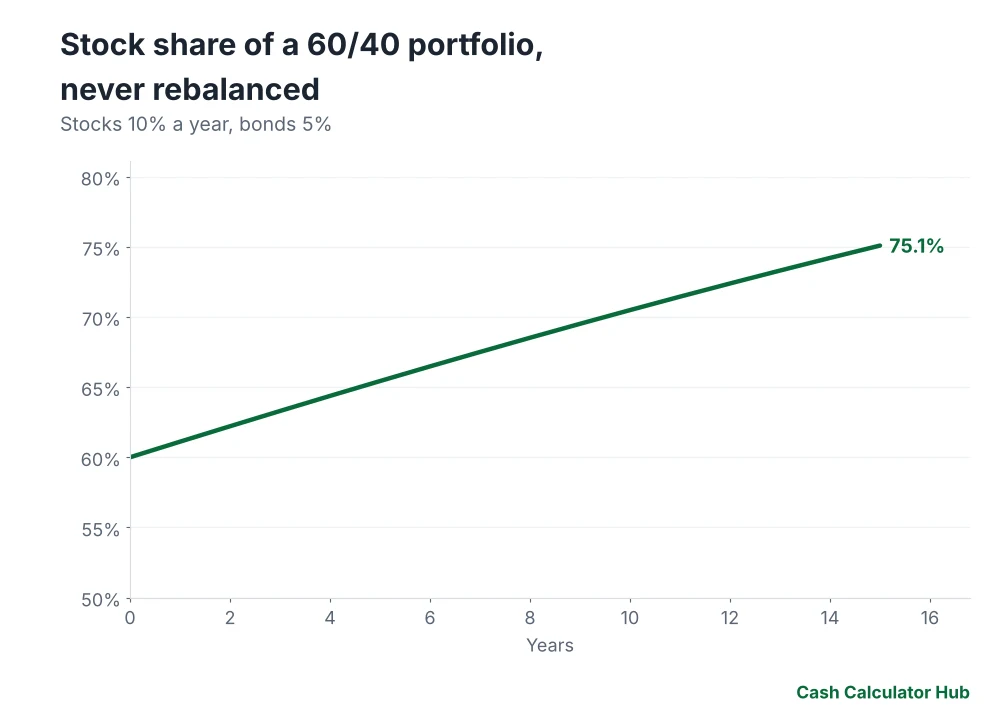
By year 10 the portfolio is about 70% stocks, which is closer to an aggressive mix than the balanced one you started with.
Why it matters in a crash
Suppose a −37% stock year (with bonds +5%) hits at year 15.
| Stock share before | Loss in the year | |
|---|---|---|
| Never rebalanced | 75% | $88,577 (27%) |
| Rebalanced annually | 60% | $64,078 (20%) |
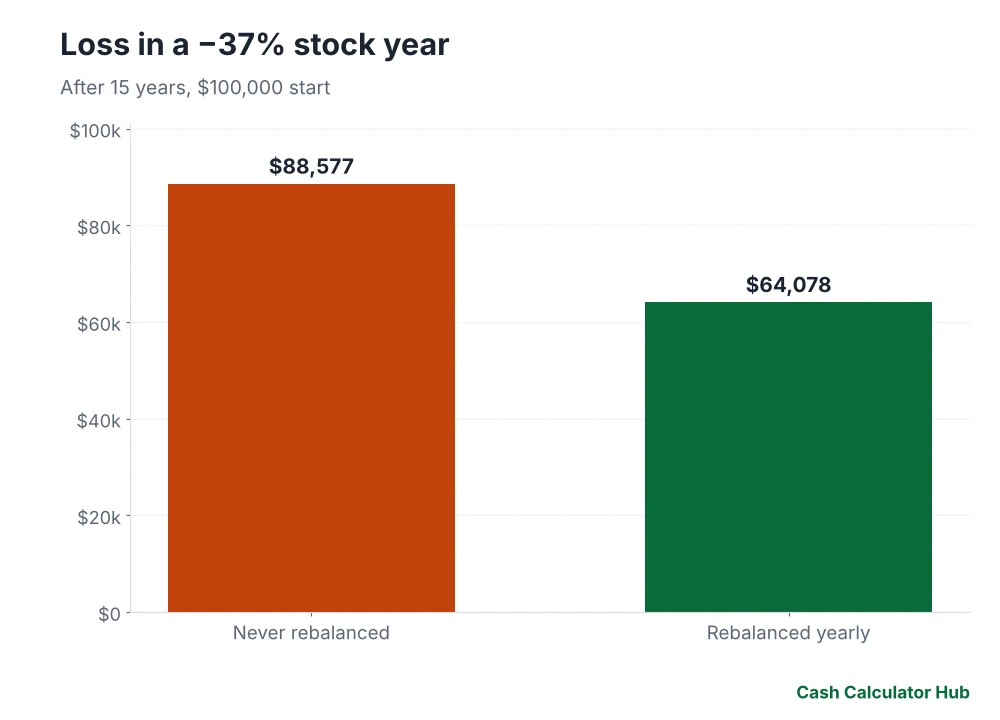
Rebalanced portfolios are not immune, but they take losses closer to the risk the investor planned for. See stocks versus bonds for the underlying trade-offs.
Three ways to rebalance
- Calendar. Check on a fixed date, such as every January, and adjust.
- Threshold. Rebalance when a class is 5 percentage points (or 25% relative) away from target.
- Cash flow. Direct new contributions to the underweight asset, and withdrawals from the overweight one. This avoids selling.
Research has found little difference in results between annual and more frequent rebalancing, so choose the simplest approach you will follow.
How to rebalance in practice
- List your holdings by asset class and compute current percentages.
- Compare them with targets.
- Sell the overweight and buy the underweight, or direct new contributions.
- Do it in tax-advantaged accounts first; see below.
Taxes
In a 401(k), IRA or Roth, rebalancing has no tax cost. In a taxable account, selling winners triggers capital gains. Use new money, dividends and tax-loss harvesting to reduce the need to sell. Gains held more than a year are taxed at long-term rates; see 2026 capital gains rates.
Shortcuts
- Target-date funds rebalance automatically as part of their design.
- Balanced funds and robo-advisers maintain the mix for a small fee.
- Auto-rebalance options in many 401(k) plans.
Does rebalancing improve returns?
Not reliably. In strongly trending markets, rebalancing can reduce returns; in volatile ones it can add a little. Its main job is risk control. If you are 15 years from retirement, a drifting portfolio is the thing to avoid; see sequence of returns risk.
Check your portfolio
Use the investment calculator and average return calculator to project mixes and the retirement calculator for goals. More: investment calculators.
Frequently asked questions
How often should I rebalance?
Once a year, or whenever an asset class is five percentage points away from its target, is sufficient for most investors.
Does rebalancing trigger taxes?
In a taxable account, selling appreciated assets triggers capital gains. In a 401(k) or IRA, rebalancing has no immediate tax effect.
Does rebalancing increase returns?
Not consistently. It mainly keeps your risk at the level you chose.
Can I rebalance without selling?
Yes. Direct new contributions and dividends to the underweight asset until the targets are restored.
Do target-date funds rebalance automatically?
Yes. They maintain the mix and shift it toward bonds as the target date approaches.
Sources and further reading
How the numbers were made: Every figure on this page was calculated from the formulas and assumptions stated above and rounded to the nearest dollar. Rates, limits and rules are for 2026 unless noted; confirm current figures with the sources listed before acting.
Keep reading
- Stocks vs Bonds: How to Choose Your Asset Allocation
- Compound Interest on $10,000: What It Becomes in 10, 20 and 30 Years
- How Much Do You Need to Retire? A Practical Way to Find Your Number
- Dividend Yield vs Total Return: What Should Investors Focus On?
- Cap Rate vs Cash-on-Cash Return: Evaluating a Rental Property
- What Is the Average Stock Market Return? S&P 500 History in Plain Numbers
This guide is general information, not financial, tax or legal advice. Figures use stated assumptions and 2026 rules and will differ from your situation; check current rules and talk to a licensed professional before you decide. Full disclaimer.