Quick answer: Use the 20/4/10 rule to find your car budget. On a $70,000 income that is roughly a $15,000 car. See how loan length changes the real cost.
Most people shop for a car by monthly payment. Dealers know that, which is why you hear “what do you want your payment to be?” before you hear the price. A payment target is fine as long as you set it honestly, and as long as you do not let the length of the loan do the adjusting.
The 20/4/10 rule
This old guideline is a cautious sanity check, not a law:
- 20% down payment, so you are not underwater when the car depreciates in year one.
- 4 years (48 months) maximum on the loan.
- 10% of gross monthly income for all transportation costs: loan payment, insurance and fuel.
Notice the third part. The rule counts insurance and gas, which turns the “payment” into a smaller number than most people expect.
What it gives you at three incomes
I assumed $150 a month for insurance and $140 for fuel, a 7.5% loan rate and a 4-year term:
| Gross income | 10% per month | Left for the car payment | Loan you can carry | Car price with 20% down |
|---|---|---|---|---|
| $50,000 | $417 | $127 | $5,239 | $6,500 |
| $70,000 | $583 | $293 | $12,132 | $15,000 |
| $90,000 | $750 | $460 | $19,025 | $24,000 |
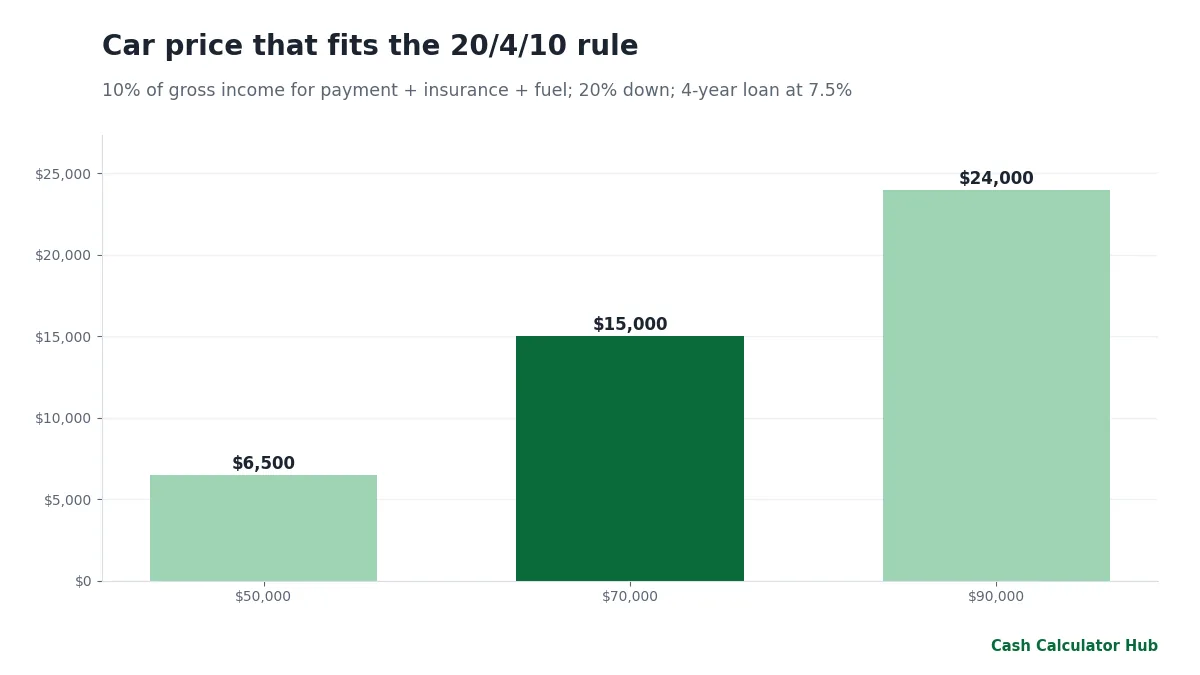
These numbers are sobering. At $70,000 a year the rule says a car around $15,000, which is below what the average new car sells for. That is exactly why many households stretch the loan to 72 or 84 months. Used cars and certified pre-owned models are where this rule tends to push people, and that is not a bad thing.
What a longer loan really costs
Take a $35,000 car. With 6% sales tax and $3,000 down you finance about $34,100. At 7.5%:
| Term | Monthly payment | Total interest |
|---|---|---|
| 48 months | $825 | $5,476 |
| 60 months | $683 | $6,898 |
| 72 months | $590 | $8,351 |
| 84 months | $523 | $9,835 |
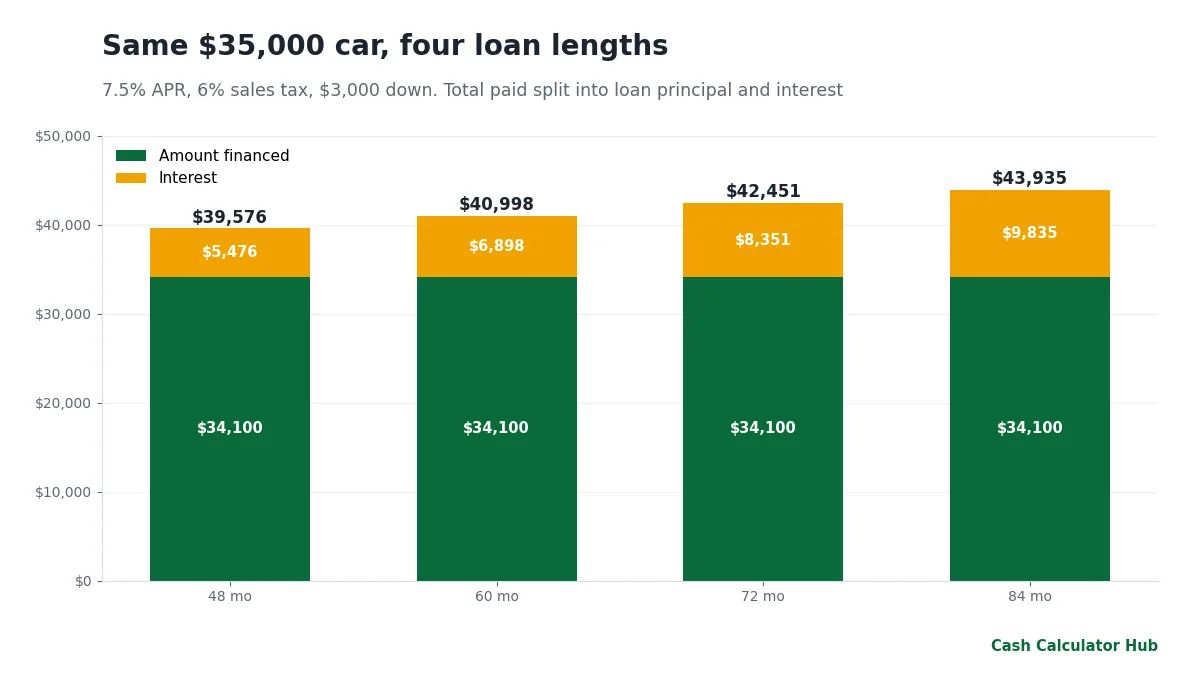
Going from 48 to 84 months lowers the payment by $301 a month and adds $4,359 of interest. It also keeps you in the loan far longer than most people keep a car, which is the real danger: negative equity.
Negative equity: why the 20% matters
New cars commonly lose a large share of their value in the first couple of years. If you put little down and take a long loan, the balance stays above the car’s value for years. Total the car or want to sell it, and you owe the difference. Rolling that old balance into the next loan starts a cycle that is hard to break.
The all-in cost list (bring a calculator)
Before you decide, add up the monthly cost of owning the car:
- Loan payment
- Insurance (get quotes on the exact model first)
- Fuel or charging
- Maintenance and tires, which for a typical car runs $50 to $100 a month on average
- Registration, taxes and parking
- Depreciation, which does not appear on any bill but is the largest cost of owning a new car
Used versus new
A three-year-old car typically costs thousands less than the same model new, though used-car loan rates tend to be higher. Compare both in the auto loan calculator, where you can add sales tax, fees, trade-in and the rate for each. If a dealer offers a rebate versus a low rate, see the cash back or low APR comparison.
A note on a possible tax break
For 2025 through 2028, the tax law created a temporary deduction for interest on loans for certain new vehicles assembled in the United States, subject to income limits and a cap. If you are buying new, ask the dealer which models qualify and check the current IRS rules before assuming you will get it.
Pick the payment, then the price
- Decide your all-in monthly transportation budget, using the 10% figure as a ceiling. Your own budget may be lower; see the 50/30/20 rule.
- Subtract insurance and fuel to find the payment.
- Enter that payment and a 48- to 60-month term in the auto loan calculator and solve for the price.
- Get pre-approved at a bank or credit union so you walk in knowing your rate.
- If you are thinking about leasing, test the auto lease calculator for the true cost.
Browse all of the auto calculators for related tools.
How much of my income should go to a car?
A common ceiling is 10% of gross income for payment, insurance and fuel combined. The loan payment alone is often kept under 8%.
Is a 72-month car loan a bad idea?
It is risky. The payment is lower, but you pay much more interest and are likely to owe more than the car is worth for years.
Should I put 20% down on a car?
If you can. It protects you against depreciation and usually earns a better rate.
What credit score do I need for a good rate?
Scores above about 720 typically get the best rates; below 660 can mean much higher rates. Get pre-approved to compare.
Sources and further reading
How the numbers were made: Every figure on this page was calculated from the formulas and assumptions stated above and rounded. Rates, limits and rules are for 2026 unless noted; confirm current figures with the sources listed before acting.
Keep reading
- Cash Back or Low APR? How to Pick the Better Car Deal
- The 50/30/20 Budget Rule: How It Works, and How to Adjust It
- Sales Tax by State: Base Rates, No-Tax States and How to Calculate Total Tax
- Lease vs Buy a Car: The Real Cost Over 3 and 6 Years
- Car Depreciation: How Fast Cars Lose Value, Year by Year
- New vs Used Car: The Five-Year Cost Comparison
This guide is general information, not financial, tax or legal advice. Figures use stated assumptions and 2026 rules and will differ from your situation; check current rules and talk to a licensed professional before you decide. Full disclaimer.