Quick answer: The full cost of an employee is typically 1.2 to 1.4 times salary. A $70,000 salary comes to about $91,855 in year one (1.31×) after employer payroll tax of 7.65%, health insurance, a retirement match, insurance, equipment and recruiting costs. Several of these lines are assumptions; replace them with your own numbers.
Owners and managers who budget only salary are surprised by the real cost of hiring. This guide builds the full cost from the bottom up so you can price a role, set a freelance rate or compare an employee with a contractor.
Key takeaways
- Employer payroll tax adds 7.65% (Social Security and Medicare) on top of wages.
- Benefits are a large share of compensation; the BLS reports roughly 30% of private-industry compensation.
- One-time costs such as recruiting and equipment matter in year one.
- Total cost multiplier is commonly 1.2× to 1.4× salary.
- Compare with contractor costs before choosing.
Cost build-up for a $70,000 salary
| Item | Annual cost |
|---|---|
| Salary | $70,000 |
| Employer payroll tax (7.65%) | $5,355 |
| Health insurance (employer share, assumed) | $7,000 |
| Retirement match (3%) | $2,100 |
| Workers’ comp and unemployment insurance (assumed 2%) | $1,400 |
| Equipment and software (assumed) | $2,500 |
| Recruiting and onboarding (assumed, year one) | $3,500 |
| Total first-year cost | $91,855 |
| Multiple of salary | 1.31× |

Which items are fixed assumptions?
Employer FICA of 7.65% follows from the law (see FICA explained). Health insurance, workers’ compensation, equipment and recruiting vary by company, state and role; use your own quotes.
Cost per productive hour
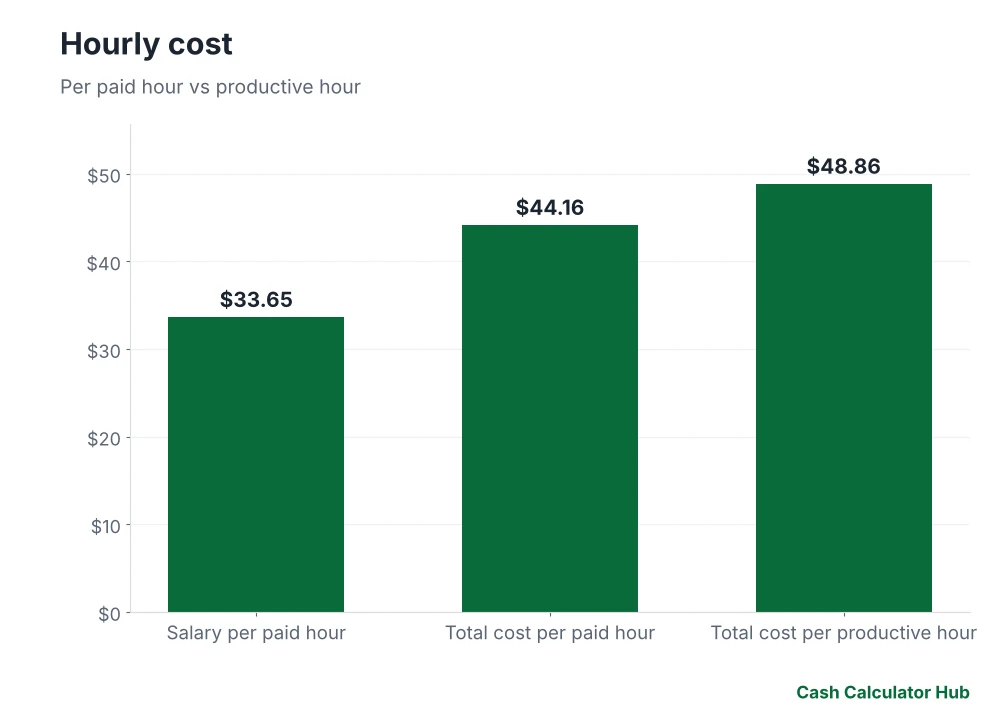
Paid hours: 2,080 a year. After 10 holidays, 10 vacation days and 5 sick days, productive hours = 2,080 − 200 = 1,880.
| Amount | |
|---|---|
| Total cost | $91,855 |
| Per paid hour | $44.16 |
| Per productive hour | $48.86 |
Pricing a service
If an employee costs $48.86 per productive hour, a business needs to charge more than that to cover overhead and profit. See margin vs markup and break-even.
Employee vs contractor
A contractor charges a higher hourly rate but the business avoids benefits and payroll tax. See W-2 vs 1099 and freelance rate. Misclassification risks apply.
Reducing cost without cutting pay
- Shop benefits annually.
- Use pre-tax benefit programs that lower payroll taxes.
- Stagger hiring to match revenue.
- Invest in retention; turnover costs often exceed a quarter of salary.
Tools
Use the salary calculator, take-home paycheck calculator and percentage calculator. More: business and everyday tools.
Frequently asked questions
How much does an employee really cost?
Typically 1.2 to 1.4 times their salary once taxes, benefits and overhead are included.
What payroll taxes do employers pay?
7.65% for Social Security and Medicare, plus federal and state unemployment taxes.
Are benefits a big part of employee cost?
Yes. BLS data show benefits make up roughly 30% of compensation for private-industry workers.
What is the cost per productive hour?
Total annual cost divided by hours actually worked, excluding holidays and leave.
Is hiring a contractor cheaper?
It can be for short-term needs, but the hourly rate is higher and classification rules apply.
Sources and further reading
- U.S. Department of Labor: Wage and Hour Division
- IRS: Tax topics and forms
- U.S. Small Business Administration
How the numbers were made: Employer payroll tax uses the statutory 7.65% rate; health insurance, workers’ compensation, equipment and recruiting lines are labeled assumptions and should be replaced with real quotes. Hours and per-hour figures are computed from the totals shown.
Keep reading
- Hourly to Salary: What Is $25 an Hour Per Year?
- How Much Is a $100,000 Salary After Taxes in 2026?
- Margin vs Markup: The Difference, the Formulas and a Conversion Table
- How to Set a Freelance Hourly Rate: From Income Goal to Billable Hours
- Time Value of Money: Present Value, Future Value and NPV Explained With Examples
- Depreciation Methods: Straight-Line vs Declining Balance vs Sum-of-the-Years’ Digits
This guide is general information, not financial, tax or legal advice. Figures use stated assumptions and 2026 rules and will differ from your situation; check current rules and talk to a licensed professional before you decide. Full disclaimer.