Quick answer: There are three common ways couples handle money: split bills 50/50, split in proportion to income, or pool everything. With incomes of $70,000 and $40,000 and $4,000 of shared monthly bills, 50/50 costs each partner $2,000; proportional costs $2,545 and $1,455. The best method is the one both partners consider fair and will keep up.
Money is one of the most common sources of conflict in relationships, often because the system feels unfair rather than because of the numbers. The right structure depends on income gap, goals and comfort with transparency. Here are the three main systems with numbers.
Key takeaways
- 50/50 is simple but burdens the lower earner when incomes differ.
- Proportional splits share the load by income.
- A joint pot treats all money as shared, with personal allowances.
- Agree on goals, debts and savings targets together.
- Revisit the system after raises, job changes or children.
The numbers
Incomes: Partner A $70,000, Partner B $40,000 (gross, for simplicity). Shared bills: $4,000 per month.
| Method | Partner A pays | Partner B pays | A’s share of own income | B’s share of own income |
|---|---|---|---|---|
| 50/50 | $2,000 | $2,000 | 34% | 60% |
| Proportional | $2,545 | $1,455 | 44% | 44% |
| Joint pot | pooled | pooled | same share | same share |
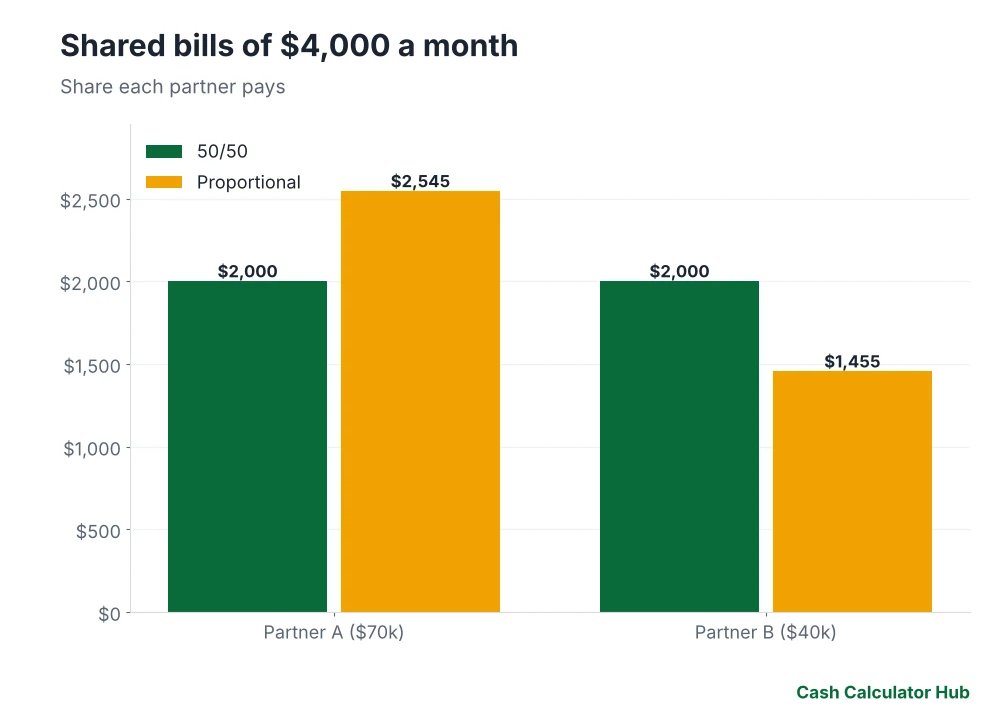
Under 50/50 the lower earner spends 60% of income on shared bills versus 34% for the higher earner. Under proportional, both spend 44%.
Joint pot approach
All income goes to joint accounts; each partner gets a personal allowance (for example 10% of income). Pros: simple, aligned goals. Cons: requires trust and agreement on spending.
Hybrid
Common: a joint account for shared bills and goals, funded proportionally, plus personal accounts for the remainder.
What to agree on
- Shared bills and who pays. Use a zero-based budget.
- Savings goals: emergency fund, home, retirement. See emergency fund and monthly saving for a goal.
- Debts: each partner’s loans and plan; see avalanche vs snowball.
- Retirement: both partners’ accounts, including a spousal IRA when one earns less.
- Taxes: filing jointly can change the tax picture; see marriage tax.
- Big purchases: a threshold above which you decide together.

Money dates
A monthly 30-minute check-in covering spending, goals and upcoming expenses keeps surprises low and builds trust.
Tools
Use the budget planner, marriage tax calculator and percentage calculator to run your own split. More: budgeting tools.
Frequently asked questions
Should couples split expenses 50/50?
It works when incomes are similar. When they differ a lot, a proportional split is often seen as fairer.
How do you split bills proportionally?
Divide each partner’s income by the combined income to get their share, then apply it to shared bills.
Should couples have joint accounts?
Many do, at least for shared bills; others keep separate accounts. What matters is transparency and agreement.
How should couples handle debt?
Share information, decide whether to pay together or separately, and prioritize high-interest balances.
How often should couples discuss money?
A short monthly check-in plus an annual review of goals works for many.
Sources and further reading
- Consumer Financial Protection Bureau
- MyMoney.gov: Financial literacy resources
- IRS: Tax topics and forms
How the numbers were made: Every figure on this page was calculated from the formulas and assumptions stated above and rounded to the nearest dollar. Rates, limits and rules are for 2026 unless noted; confirm current figures with the sources listed before acting.
Keep reading
- Marriage Tax Penalty or Bonus: Who Pays More in 2026?
- The 50/30/20 Budget Rule: How It Works, and How to Adjust It
- Debt Avalanche vs Snowball: A Four-Debt Example With Real Numbers
- Lifestyle Creep: How Rising Spending Eats Your Raises (and How to Stop It)
- Budgeting on an Irregular Income: Freelancers, Gig Workers and Commission Pay
- Subscription Audit: How Much Small Recurring Charges Really Cost You
This guide is general information, not financial, tax or legal advice. Figures use stated assumptions and 2026 rules and will differ from your situation; check current rules and talk to a licensed professional before you decide. Full disclaimer.