Quick answer: Guaranteed asset protection (GAP) insurance pays the difference between your car’s actual cash value and your loan balance if the car is totaled or stolen. On a $41,000 loan for a $38,000 car, the gap after one year can be about $5,053. It is worth considering when you put little down, finance for 60 months or longer, or lease.
After a total loss, auto insurance pays the car’s actual cash value at the time, not what you paid and not what you owe. If the loan balance is higher, you still owe the lender the difference even though the car is gone.
Gap coverage exists to close that difference. Whether you need it depends on how much equity you have in the car.
Key takeaways
- Comprehensive and collision coverage pay the car’s market value minus your deductible, not your loan balance.
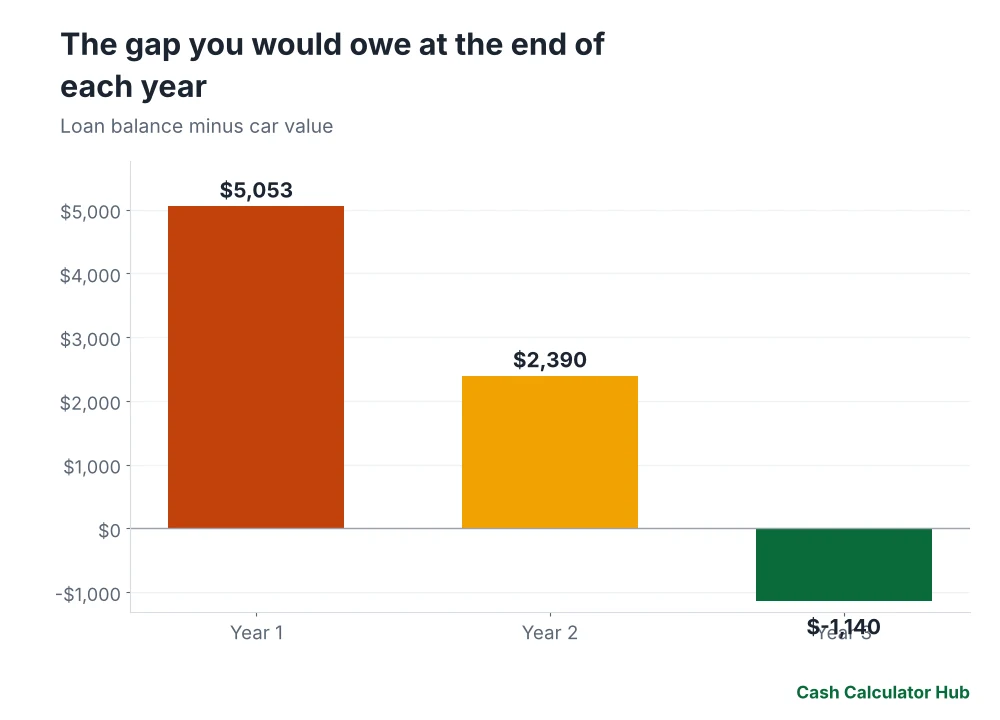
- On a $41,000 loan (a $38,000 car plus taxes and fees) at 8.0% for 6 years, the gap is $5,053 after year 1, $2,390 after year 2 and $-1,140 after year 3.
- Gap coverage is usually cheaper through your auto insurer than through the dealer.
- You can cancel it once your loan balance falls below the car’s value.
- Leases often include gap protection; check the contract.
How the gap arises
A new car loses value quickly in the first years, while a loan with a small down payment pays down slowly. The two lines can stay apart for years.
| End of year | Loan balance | Car value | Gap you would owe |
|---|---|---|---|
| 1 | $35,453 | $30,400 | $5,053 |
| 2 | $29,446 | $27,056 | $2,390 |
| 3 | $22,940 | $24,080 | $-1,140 |
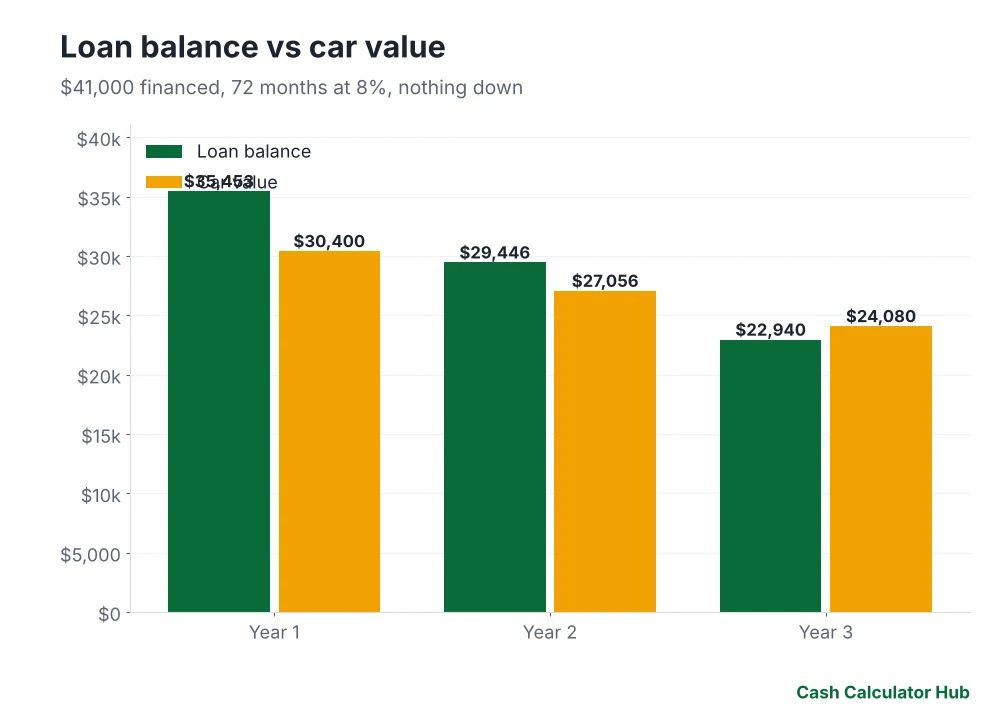
This example finances $41,000 (a $38,000 car plus $3,000 of taxes and fees) for 72 months at 8.0% with nothing down. Value follows the usual curve of about 20% in the first year and 11% a year afterward; see how fast cars lose value.
What happens in a total loss
- Your insurer values the car, often below what you expect.
- It pays that value minus your deductible to the lender.
- You owe the lender the rest of the loan.
- If you have gap coverage, it pays the remaining balance (usually not the deductible, and not past-due payments).
When you should consider it
- You put down less than 20%.
- Your loan term is 60 months or longer; see long car loans.
- You rolled negative equity from a trade-in into the loan.
- The car is a model that depreciates quickly.
- You are leasing and the contract does not include it.
When you can skip it
- You made a large down payment, so the balance is below the car’s value.
- The loan is short and the car holds value well.
- You have enough savings to cover a potential shortfall.
What it costs
Dealers often sell gap coverage as a one-time add-on, commonly several hundred dollars, and it may be financed into the loan, so you pay interest on it. Many insurers sell it as a small yearly add-on to your policy. Compare the options and ask whether you can cancel and receive a prorated refund once the loan is paid down.
Gap insurance versus loan/lease payoff coverage
Some policies offer “loan/lease payoff” coverage instead, which typically pays the gap up to a limit, such as 25% of the car’s value. Read the limit. Standard gap coverage normally covers the whole gap.
What gap insurance does not cover
- Your deductible (in many policies)
- Overdue payments or late fees
- Extended warranties or add-ons financed into the loan (depends on the contract)
- Damage the primary policy would not pay for
How to reduce the need for it
- Make a larger down payment. See how much to put down.
- Choose a shorter loan term.
- Keep the loan to the price of the car, not taxes, fees and add-ons.
- Pay extra principal in the first two years.
Plan the loan
Use the auto loan calculator to see the balance after 12, 24 and 36 months, and compare it with the value from the depreciation calculator. More: auto calculators.
Frequently asked questions
What does gap insurance cover?
It covers the difference between your car’s actual cash value and the amount you still owe on the loan or lease if the car is totaled or stolen.
Is gap insurance worth it?
It is worth it if you owe more than the car is worth, which is common with small down payments and long loans. If you have equity, you can skip it.
How much does gap insurance cost?
Dealer add-ons often cost a few hundred dollars up front, while insurer add-ons are typically a small yearly charge. Prices vary, so compare quotes.
Can I buy gap insurance after I buy the car?
Often yes through your auto insurer, but some companies require that the car be new or recently purchased.
Can I cancel gap insurance?
Yes, usually once your loan balance is below the car’s value or you pay off the loan. Ask for a prorated refund if you paid up front.
Sources and further reading
How the numbers were made: Every figure on this page was calculated from the formulas and assumptions stated above and rounded to the nearest dollar. Rates, limits and rules are for 2026 unless noted; confirm current figures with the sources listed before acting.
Keep reading
- 72- and 84-Month Car Loans: Lower Payments, Higher Risk
- Car Depreciation: How Fast Cars Lose Value, Year by Year
- Auto Loan Refinance: When Does It Pay Off?
- Trade-In vs Private Sale: What Your Car Is Really Worth to You
- The True Cost of Owning a Car: About $11,577 a Year
- Electric vs Gas Car: Eight-Year Cost of Ownership Without the Tax Credit
This guide is general information, not financial, tax or legal advice. Figures use stated assumptions and 2026 rules and will differ from your situation; check current rules and talk to a licensed professional before you decide. Full disclaimer.