Quick answer: Mortgage lenders price loans in credit score bands, and each band down raises the rate. In the illustrative sheet below, a 620 score pays 1.60 percentage points more than a 760 score, which costs about $387 extra a month on a $350,000 loan.
Credit score is the second-biggest lever on your mortgage cost after the size of the loan. The pricing grid varies by lender and week, so the table below is an illustration of the pattern, not a rate quote: use it to understand how much a score increase might be worth, and ask lenders for actual numbers.
Key takeaways
- Illustrative spread from the best band to the lowest in this sheet: 1.60 percentage points.
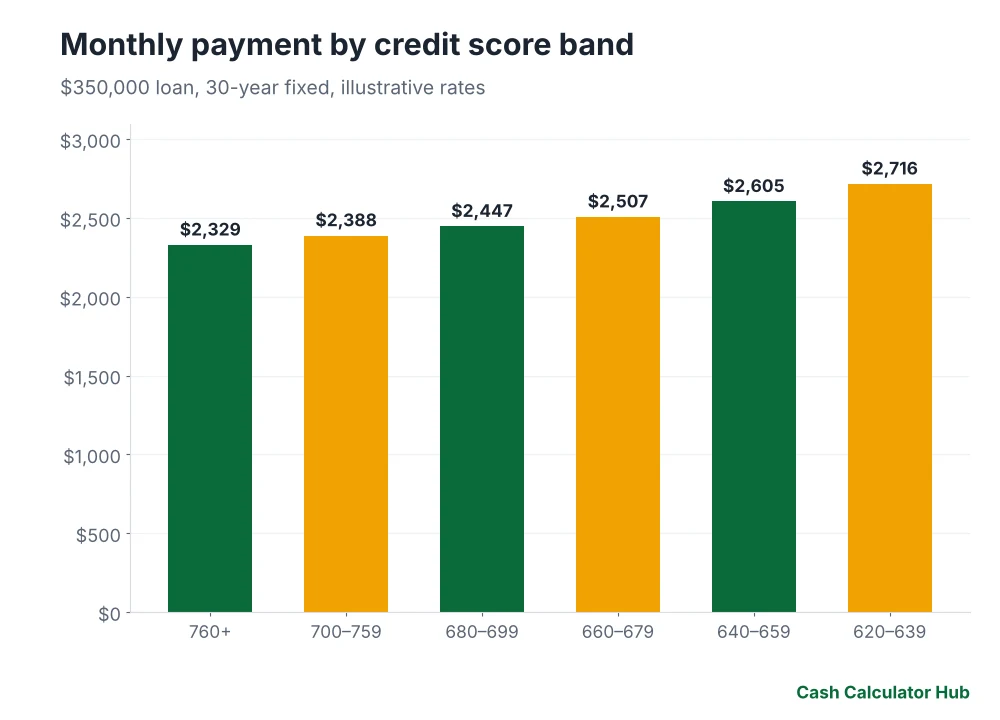
- Payment difference on $350,000: $387 a month.
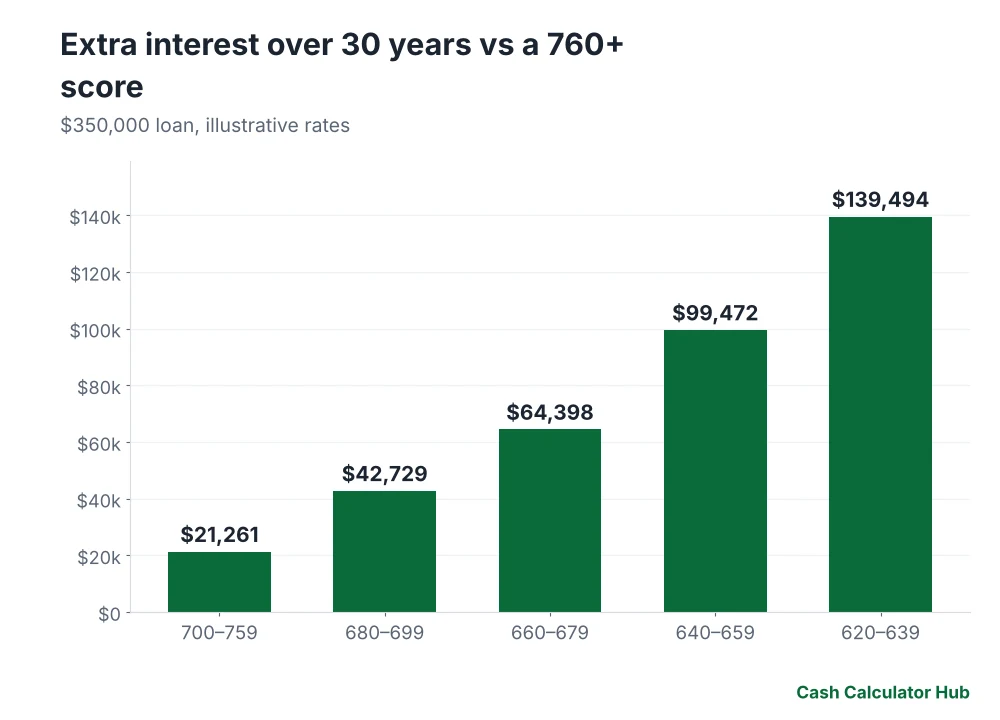
- Lifetime interest difference: $139,494.
- Conventional lenders reprice at 20-point bands (620, 640, 660, 680, 700, 740, 760 or similar).
- Rate shopping within a short window counts as one inquiry for scoring purposes.
An illustrative rate sheet
| Credit score | Rate | Monthly payment | Extra per month vs 760+ | Extra interest over 30 years |
|---|---|---|---|---|
| 760+ | 7.00% | $2,329 | $0 | $0 |
| 700–759 | 7.25% | $2,388 | $59 | $21,261 |
| 680–699 | 7.50% | $2,447 | $119 | $42,729 |
| 660–679 | 7.75% | $2,507 | $179 | $64,398 |
| 640–659 | 8.15% | $2,605 | $276 | $99,472 |
| 620–639 | 8.60% | $2,716 | $387 | $139,494 |
Real sheets also combine score with down payment and loan size: a borrower with 20% down and a 700 score may get a better rate than a borrower with 5% down and a 740. Credit also affects mortgage insurance pricing; see how PMI is priced.
What a score point is worth
Moving from the 640–659 band to the 700–759 band would lower the payment by about $217 a month and lifetime interest by $78,211 in this illustration. If it takes six months of focused effort to raise the score, delaying a purchase can be a positive trade.
What moves your score
The two biggest factors in FICO scoring are payment history (about 35%) and amounts owed, mostly credit card utilization (about 30%). Length of history (15%), new credit (10%) and credit mix (10%) make up the rest.
- Pay every bill on time. One 30-day late payment can drop a good score by many points.
- Lower card balances before your statement date. Utilization below 30% helps; below 10% helps more.
- Do not close old cards just before applying; it shortens history and cuts available credit.
- Dispute errors. Pull your free reports at AnnualCreditReport.com and challenge mistakes.
- Avoid new accounts in the months before you apply.
Rate shopping and inquiries
Mortgage inquiries within a short period, 14 to 45 days depending on the scoring model, are treated as one inquiry. Getting three or four quotes in one week costs you almost nothing and can save thousands. Details are in the preapproval guide.
Which score do lenders use?
Mortgage lenders typically use the middle of three scores from the credit bureaus, and often older FICO versions rather than the VantageScore shown by free apps. Your app score may be 20 or more points off. For couples, lenders use the lower of the two middle scores.
Minimums by loan type
| Loan | Typical minimum score |
|---|---|
| Conventional | 620 (some lenders go lower using their own rules) |
| FHA | 580 for 3.5% down; 500 to 579 with 10% down |
| VA | No VA minimum; lenders often want 580 to 620 |
| USDA | Usually 640 |
Low scores can still buy a home, but at higher rates. See FHA versus conventional if your score is in the 580–680 range.
Improve first, or buy now?
Compare the monthly saving from a higher score with how much home prices and rates might change while you wait. If you can reach the next band in 3 to 6 months at low cost, waiting often pays. If rates or prices are rising quickly, buying now and refinancing later may be better.
Test your own scenario
Run each rate in the mortgage calculator and compare payments, then use the house affordability calculator to see what the extra interest does to your price range. More: mortgage tools.
Frequently asked questions
What credit score do I need to buy a house?
A 620 is the usual minimum for conventional loans, 580 for FHA with 3.5% down, and most lenders want 620 or higher for VA loans. A higher score gives lower rates.
How much does a credit score change a mortgage rate?
It can change the rate by half a point or more between bands. The size of the gap depends on lender, market and loan details.
Does checking my credit hurt my score?
Checking your own credit is a soft inquiry and does not hurt. Multiple mortgage inquiries in a short window count as one.
What is the best credit score for a mortgage?
Scores of 760 and above generally receive the best pricing. Above 740 the improvements are smaller.
How fast can I raise my credit score?
Paying down card balances can lift a score within one or two billing cycles. Late payments and collections take longer to recover from.
Sources and further reading
How the numbers were made: Every figure on this page was calculated from the formulas and assumptions stated above and rounded to the nearest dollar. Rates, limits and rules are for 2026 unless noted; confirm current figures with the sources listed before acting.
Keep reading
- Debt-to-Income Ratio for a Mortgage: What Lenders Allow
- What Is PMI and How Do You Remove It? Costs and Timeline
- FHA vs Conventional Loan: Which Costs Less?
- Cash-Out Refinance vs HELOC: Which Costs Less for $50,000?
- Home Equity: How It Builds, How Much You Can Borrow and When to Use It
- The Hidden Costs of Buying a Home: A First-Year Budget
This guide is general information, not financial, tax or legal advice. Figures use stated assumptions and 2026 rules and will differ from your situation; check current rules and talk to a licensed professional before you decide. Full disclaimer.