Quick answer: With the federal EV tax credit ended for vehicles bought after September 30, 2025, an electric car costs less to run but more to buy. At 15,000 miles a year, charging at home at 17 cents per kWh and gas at $3.30, an EV saves about $1,200 a year; a $10,000 higher price plus a home charger takes about 9.5 years to recover.
The EV question is a break-even question. Electric cars cost less per mile to fuel and maintain, but they usually cost more to buy, and the largest federal incentive for new and used EVs ended for purchases after September 30, 2025.
Because electricity prices, gas prices and mileage vary so much, the model below states every assumption so you can replace them with yours: 15,000 miles a year, a gas car at 30 mpg and $3.30 a gallon, an EV at 3.4 miles per kWh with 80% home charging at 17 cents per kWh and 20% public fast charging at 45 cents.
Key takeaways
- Fuel: about $1,650 a year for gas versus $997 for the EV.
- Total running cost (fuel, maintenance, insurance): $5,350 for gas, $4,150 for the EV.
- Price premium of $10,000 plus a $1,400 home charger breaks even in about 9.5 years.
- Charging mostly at public fast chargers erases much of the saving.
- Resale values and battery warranties matter more than for gas cars.
The assumptions
| Item | Gas car | Electric car |
|---|---|---|
| Purchase price | $36,000 | $46,000 |
| Energy efficiency | 30 mpg | 3.4 mi/kWh |
| Energy price | $3.30/gallon | 17¢/kWh home, 45¢ public (80/20 mix) |
| Maintenance per mile | 10¢ | 6¢ |
| Insurance per year | $2,200 | $2,500 |
| Home charger | none | $1,400 installed |
| Resale after 8 years | 28% of price | 22% of price |
Yearly running costs
| Cost per year | Gas | Electric |
|---|---|---|
| Fuel or electricity | $1,650 | $997 |
| Maintenance | $1,500 | $900 |
| Insurance | $2,200 | $2,500 |
| Total | $5,350 | $4,150 |
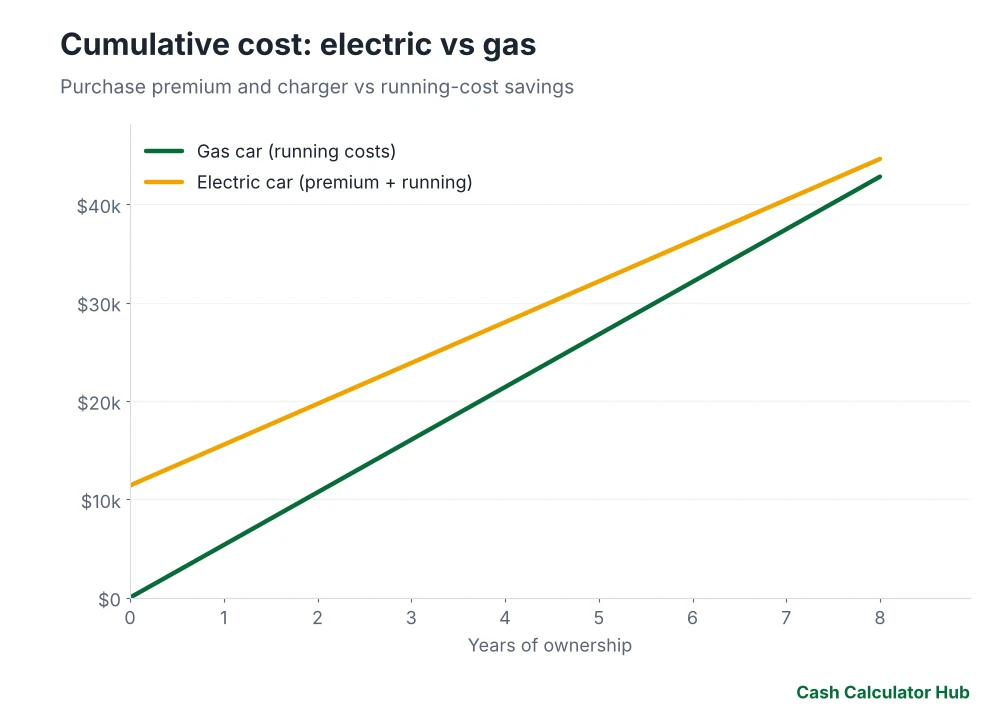
The EV saves about $1,200 a year. Because the price gap is $10,000 (plus the charger), break-even arrives after about 9.5 years of driving.
Eight-year total
Adding depreciation (the purchase price minus resale value) to the running costs:
| 8-year cost | Gas | Electric |
|---|---|---|
| Depreciation | $25,920 | $35,880 |
| Running costs | $42,800 | $33,200 |
| Home charger | $0 | $1,400 |
| Total | $68,720 | $70,480 |
Under these assumptions the EV costs about $1,760 more over eight years. The result is sensitive to the price gap and to where you charge.

What changes the answer
- Where you charge. At 17 cents per kWh at home, the EV’s energy cost is about $750 a year. If all charging happened at 45 cents, it would be $1,985, nearly as much as gas.
- Local electricity and gas prices. Compare your utility rate and your area’s gas price. Use the cost of living tool to compare locations.
- Mileage. The more you drive, the faster the EV pays back its price premium.
- Price gap. Many compact EVs now sell near gas-car prices; others still carry a premium.
- Resale and battery life. EV values have dropped faster than gas cars in some years; most batteries carry warranties of 8 years or 100,000 miles.
- Used EVs. The used-EV market offers lower prices but without the federal credit.
Costs beyond the car
- Home charging setup. A Level 2 charger and installation can cost $1,000 to $2,500, more if your panel needs an upgrade.
- Registration fees. Many states charge EV owners an annual fee to replace fuel-tax revenue.
- Insurance. EVs often cost more to insure.
Financing and the monthly payment
A higher price means a higher loan. On a $46,000 EV financed for 60 months at 7%, the payment is $820 with 10% down versus $642 for the gas car, a $178 gap, while fuel savings are about $54 a month. Think about the monthly cash flow as well as the long-run total. See how much car you can afford.
Test your numbers
Use the auto loan calculator for the payment, the depreciation calculator for resale, and the ROI calculator to treat the premium as an investment. More: auto calculators.
Frequently asked questions
Is it cheaper to own an electric car?
Usually cheaper to run, but not always cheaper overall. The saving depends on the price gap, electricity cost, where you charge and how much you drive.
Is there still a federal tax credit for EVs?
Federal clean-vehicle credits for new and used EVs ended for vehicles acquired after September 30, 2025. Some states and utilities still offer incentives.
How much does it cost to charge an EV at home?
At 17 cents per kWh and 3.4 miles per kWh, about 5 cents per mile, or around $730 for 15,000 miles. Your utility rate sets the real figure.
Do EVs have lower maintenance costs?
Typically yes, since there is no oil, fewer fluids and less brake wear, but tires and other repairs still apply.
How long do EV batteries last?
Many last well beyond the 8-year, 100,000-mile warranties common in the U.S., but replacement can cost thousands, so check the warranty.
Sources and further reading
How the numbers were made: Every figure on this page was calculated from the formulas and assumptions stated above and rounded to the nearest dollar. Rates, limits and rules are for 2026 unless noted; confirm current figures with the sources listed before acting.
Keep reading
- How Much Car Can I Afford? The 20/4/10 Rule With Real Numbers
- New vs Used Car: The Five-Year Cost Comparison
- Car Depreciation: How Fast Cars Lose Value, Year by Year
- Auto Loan Refinance: When Does It Pay Off?
- Gap Insurance: Do You Need It and What Does It Cover?
- Trade-In vs Private Sale: What Your Car Is Really Worth to You
This guide is general information, not financial, tax or legal advice. Figures use stated assumptions and 2026 rules and will differ from your situation; check current rules and talk to a licensed professional before you decide. Full disclaimer.