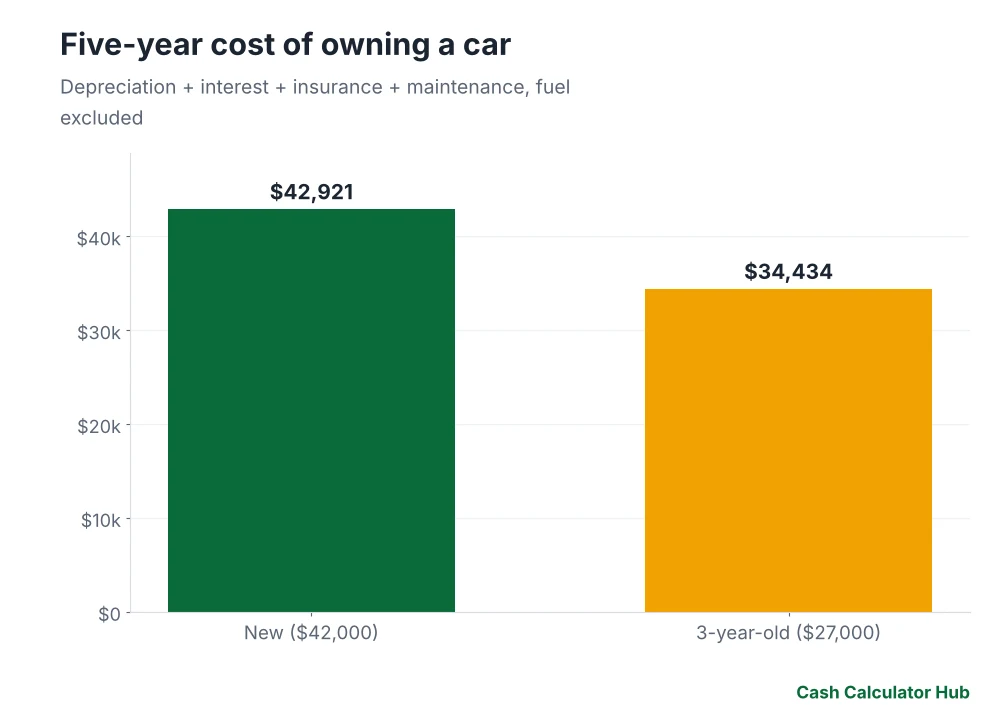
Quick answer: Buying a three-year-old car instead of a new one usually saves money over five years because the first owner absorbs the steepest depreciation. In this example a $42,000 new car costs about $42,921 to own for five years (excluding fuel) versus about $34,434 for a comparable $27,000 used car, even after counting higher used-car interest and repairs.
The new-versus-used decision is often made on feel: the smell of a new car versus the price of a used one. A five-year cost comparison puts numbers on it.
The model compares the same type of vehicle: a new one at $42,000 and a three-year-old equivalent at $27,000. Both are financed for 60 months with 10% down. The new car gets a 6.9% rate, the used car 8.5%. Fuel is excluded because it is similar for both.
Key takeaways
- Loan payment: $747 for new, $499 for used.
- Depreciation over five years: $20,919 new, $11,821 used.
- Insurance is a bit higher for new cars; repairs are higher for used cars in later years.
- Estimated five-year ownership cost: $42,921 new versus $34,434 used.
- Certified pre-owned programs can reduce the repair risk for a higher price.
Five-year cost, line by line
| Cost | New ($42,000) | 3-year-old ($27,000) |
|---|---|---|
| Down payment (10%) | $4,200 | $2,700 |
| Loan amount | $37,800 | $24,300 |
| Loan rate | 6.9% | 8.5% |
| Monthly payment | $747 | $499 |
| Interest paid over 60 months | $7,002 | $5,613 |
| Depreciation over five years | $20,919 | $11,821 |
| Insurance (five years) | $12,000 | $10,500 |
| Maintenance and repairs (five years) | $3,000 | $6,500 |
| Total cost of ownership | $42,921 | $34,434 |
Ownership cost here is depreciation + interest + insurance + maintenance; the down payment and principal are not added again because they are part of the value you recover. Insurance and maintenance figures are illustrative.
What drives the gap
The used car wins mainly on depreciation: it costs about $9,097 less. Higher interest and more repairs give some back, but not nearly enough to close the gap.

Where new cars win
- Warranty. A new-car warranty covers major repairs for 3 to 5 years or more.
- Financing. Manufacturers offer promotional rates on new cars, sometimes as low as 0% to 3.9%. See cash back or low APR.
- Technology and safety. Newer cars have the latest features.
- Predictability. You know the history of the car.
Where used cars win
- Lower depreciation. The steepest part of the curve is behind you.
- Lower price and taxes. The sales tax, registration and insurance costs are lower.
- Lower loan balance, so less risk of negative equity; see long loans and negative equity.
Certified pre-owned and low-mileage options
Certified pre-owned (CPO) cars come with inspection and an extended warranty, usually for a price premium of $1,000 to $2,500 over similar non-CPO cars. For buyers who want some of the warranty protection at a lower price, CPO is a middle path.
How to inspect a used car
- Get a pre-purchase inspection from an independent mechanic.
- Pull the vehicle history report for accidents and title issues.
- Test drive on highways and in town.
- Check for open recalls using the VIN.
- Compare the price with listings for similar cars.
A decision framework
Choose new if you drive a lot, plan to keep the car 8 to 10 years, or can get a promotional rate. Choose used if you want the lowest total cost, plan to keep the car 3 to 5 years, or are building savings. Either way, keep the payment within the 20/4/10 rule.
Use your own numbers
Enter the prices and rates in the auto loan calculator, estimate the loss in value with the depreciation calculator and compare options with the loan calculator. More: auto calculators.
Frequently asked questions
Is it cheaper to buy a new or used car?
Usually used, because depreciation is lower. A 2- to 3-year-old car often costs less to own over five years even after higher interest and repair costs.
How old should a used car be for the best value?
Many buyers target cars 2 to 4 years old, after the steepest depreciation but while the car is still reliable and may have warranty left.
Are used car loan rates higher?
Yes. Rates for used cars are typically 1 to 3 points higher than for new cars at the same credit score.
Does a new car need less maintenance?
Early on, yes, because warranties cover repairs and parts are fresh. Costs rise as the car ages.
Is certified pre-owned worth it?
It can be if you value a warranty and inspection, but compare the price premium with the coverage you would actually use.
Sources and further reading
How the numbers were made: Every figure on this page was calculated from the formulas and assumptions stated above and rounded to the nearest dollar. Rates, limits and rules are for 2026 unless noted; confirm current figures with the sources listed before acting.
Keep reading
This guide is general information, not financial, tax or legal advice. Figures use stated assumptions and 2026 rules and will differ from your situation; check current rules and talk to a licensed professional before you decide. Full disclaimer.