Quick answer: A VA loan lets eligible veterans, service members and some surviving spouses buy with no down payment and no monthly mortgage insurance. The one-time funding fee is 2.15% on a first-use, zero-down purchase (3.3% for later use), which can be financed. On a $400,000 home the payment is about $2,718 versus $2,856 for FHA.
The VA home loan is one of the strongest benefits in U.S. housing finance. The Department of Veterans Affairs guarantees part of the loan, so private lenders accept zero down and charge no monthly mortgage insurance.
This guide covers who qualifies, what the funding fee costs and how a VA loan compares with other low-down-payment options.
Key takeaways
- No down payment is required for eligible borrowers, up to the lender’s limit and the entitlement available.
- No monthly mortgage insurance, which makes the payment lower than FHA or low-down conventional loans.
- The funding fee is 2.15% for first use with no down payment, lower with 5% or 10% down, and waived for veterans with a service-connected disability rating of 10% or more.
- On a $400,000 home with no down payment: about $2,718 a month for VA, $2,856 for FHA (3.5% down) and $2,830 for conventional (5% down).
- The funding fee can be financed, which raises the loan balance.
Who is eligible
Eligibility is based on service: generally 90 consecutive days of active service during wartime, 181 days during peacetime, six years in the National Guard or Reserves, or being the surviving spouse of a service member who died in service or from a service-connected disability. Your Certificate of Eligibility (COE) confirms this and shows your exemption status for the funding fee.
The funding fee
The fee is a percentage of the loan, charged once at closing. Rates for purchase loans, which depend on the down payment and whether you have used the benefit before:
| Down payment | First use | Subsequent use |
|---|---|---|
| Less than 5% | 2.15% | 3.3% |
| 5% to under 10% | 1.5% | 1.5% |
| 10% or more | 1.25% | 1.25% |
Veterans receiving VA compensation for a service-connected disability, and some other groups, are exempt. On a $400,000 purchase with nothing down, the fee is $8,600. Most borrowers finance it, so the loan becomes $408,600.
Monthly cost against the alternatives
The comparison uses a $400,000 home, a VA rate of 7.0% and 7.25% for the others (VA loans often price slightly lower), and shows principal, interest and mortgage insurance only:
| Loan | Down payment | Loan amount | Monthly payment |
|---|---|---|---|
| VA, first use | $0 | $408,600 | $2,718 |
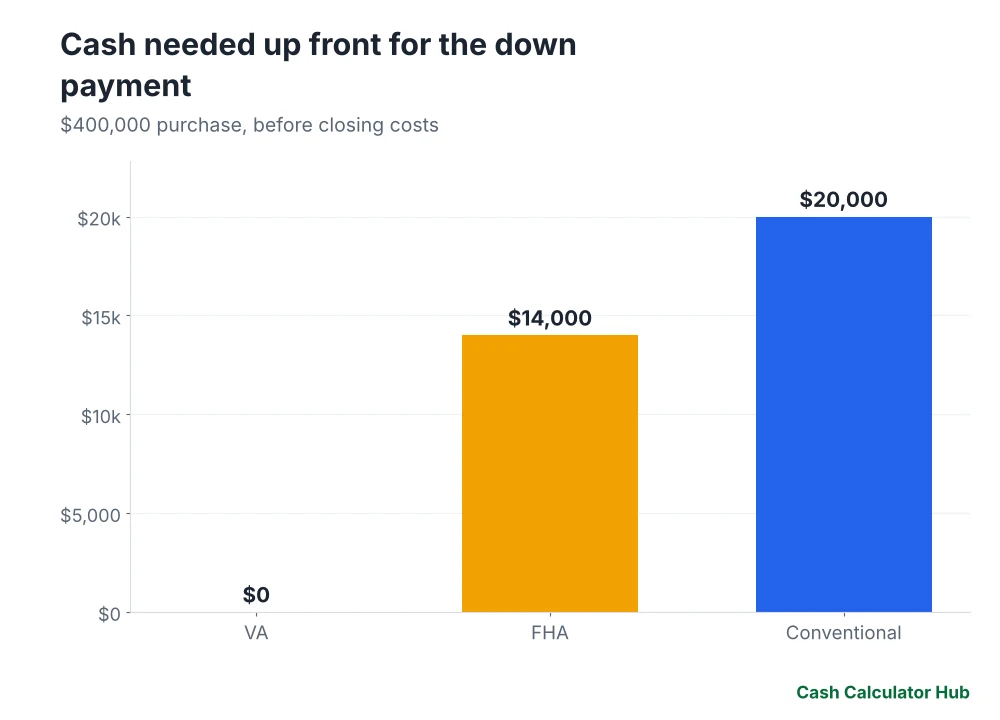
| FHA | $14,000 | $392,755 | $2,856 |
| Conventional with PMI | $20,000 | $380,000 | $2,830 |
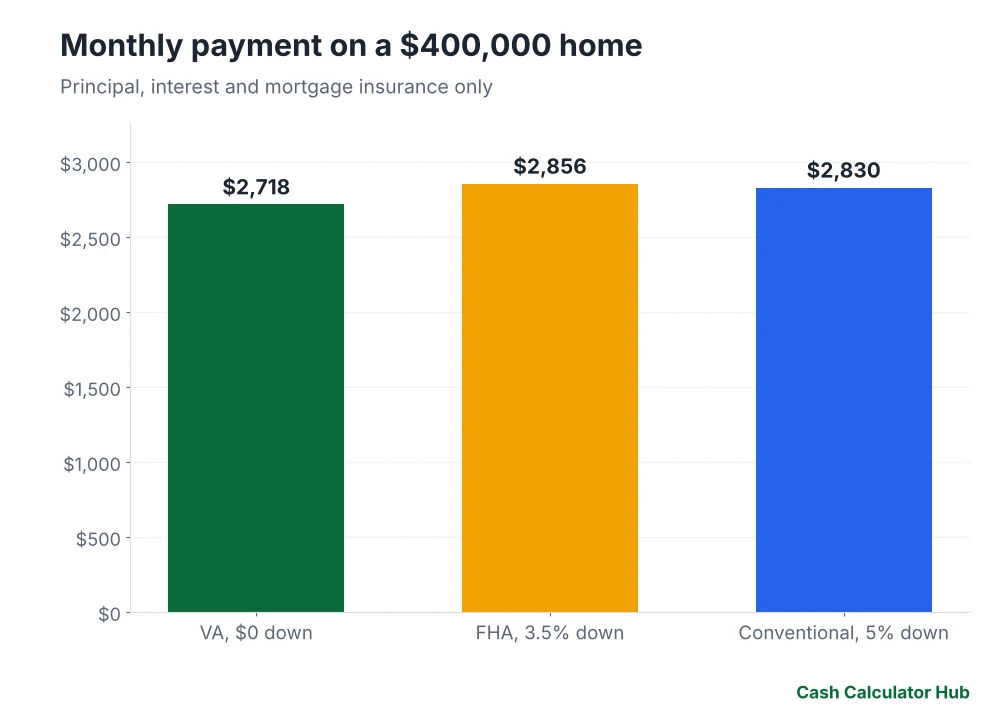
The VA loan wins on both cash up front and monthly cost. Taxes, insurance and any HOA dues apply to all three. For the full picture of owning, add them using the $400,000 house guide.
Other VA loan features
- Flexible credit standards. The VA sets no minimum credit score, though lenders do.
- Residual income test. In addition to DTI, the VA looks at how much money is left each month after major expenses.
- Limits on closing costs. The VA restricts which fees a veteran can be charged.
- Assumable loans. A VA loan can be assumed by a qualified buyer, which is valuable when rates are high and your rate is low.
- IRRRL. The Interest Rate Reduction Refinance Loan allows a streamlined refinance with a smaller funding fee of 0.5%.
Drawbacks to plan for
- The funding fee adds to the loan unless you pay it in cash.
- You must occupy the home as a primary residence.
- Sellers sometimes prefer conventional offers because of VA appraisal and property standards, though VA loans are widely accepted.
- Zero down means you start with little equity. If prices dip, you can owe more than the house is worth. See how equity builds.
Should you put money down anyway?
A 10% down payment cuts the fee to 1.25% of a smaller loan: $4,500 instead of $8,600, and it lowers the payment too. Putting 5% down trims the fee to 1.5%. If you have the cash and still keep an emergency fund, a partial down payment can reduce lifetime cost. Compare in the VA mortgage calculator.
Calculate your own
Use the VA mortgage calculator with your fee category, then compare with the FHA loan calculator and mortgage calculator. For affordability, see the house affordability calculator and all mortgage tools.
Frequently asked questions
Does a VA loan require a down payment?
No, eligible borrowers can buy with no down payment if the loan is within the lender’s limits and they have full entitlement. A down payment can lower the funding fee.
Is there PMI on a VA loan?
No. VA loans have no monthly mortgage insurance, which is a main reason the payment is lower.
Who pays the VA funding fee?
The borrower, unless exempt. It can be financed into the loan, or the seller can pay it as a concession.
Can I use a VA loan more than once?
Yes. You can use the benefit again after selling the home or paying off the loan, and in some cases you can have two VA loans at once. The funding fee for later use at zero down is 3.3%.
What credit score do I need for a VA loan?
The VA does not set a minimum, but most lenders look for around 620. Ask lenders for their requirements.
Sources and further reading
How the numbers were made: Every figure on this page was calculated from the formulas and assumptions stated above and rounded to the nearest dollar. Rates, limits and rules are for 2026 unless noted; confirm current figures with the sources listed before acting.
Keep reading
- FHA vs Conventional Loan: Which Costs Less?
- How Much Down Payment Do You Really Need for a House?
- Mortgage Payment on a $400,000 House: Real Numbers
- How Your Credit Score Changes Your Mortgage Rate and Payment
- Cash-Out Refinance vs HELOC: Which Costs Less for $50,000?
- Home Equity: How It Builds, How Much You Can Borrow and When to Use It
This guide is general information, not financial, tax or legal advice. Figures use stated assumptions and 2026 rules and will differ from your situation; check current rules and talk to a licensed professional before you decide. Full disclaimer.