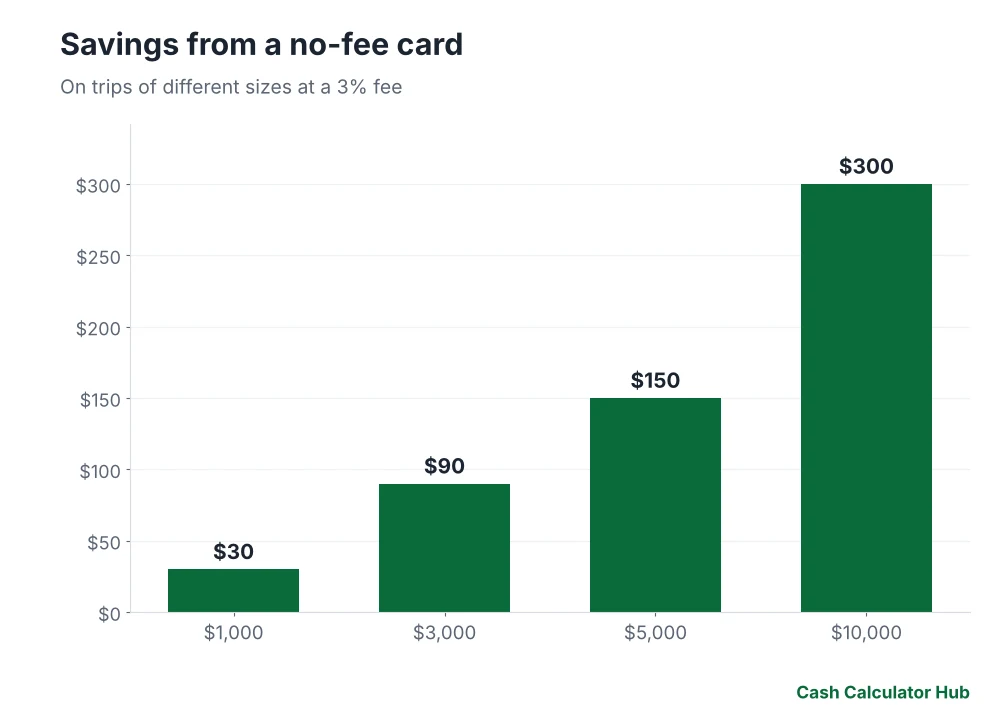
Quick answer: Many credit cards charge a 3% foreign transaction fee, which is $90 on $3,000 of spending abroad. Airport currency exchange can cost 5% to 10% in hidden markups, and dynamic currency conversion (paying in your home currency at the terminal) adds a poor rate. Use a no-fee card, pay in local currency and withdraw cash from bank ATMs.
Exchange costs come in two forms: visible fees (a percentage on each transaction) and hidden markups in the exchange rate. Comparing them requires converting both to a percentage of the amount.
Key takeaways
- Typical card fee: 3% of each foreign transaction; many travel cards charge none.
- Exchange-rate markups hide in the rate: airport kiosks often 5% to 10% worse than the mid-market rate.
- Always choose the local currency when asked at a card terminal (decline dynamic currency conversion).
- ATM withdrawals may incur fees from both your bank and the ATM operator.
- Compare the effective rate to the mid-market rate.
The costs on $3,000 of travel spending
| Method | Cost | Fee on $3,000 |
|---|---|---|
| No-fee card at network rate | 0% | $0 |
| Card with 3% foreign fee | 3% | $90 |
| Bank ATM withdrawal (3% + $5 per withdrawal; 3 withdrawals) | ~3% + $15 | $105 |
| Airport exchange kiosk (assume 8% worse rate) | 8% | $240 |
| Dynamic currency conversion (assume 5% markup) | 5% | $150 |
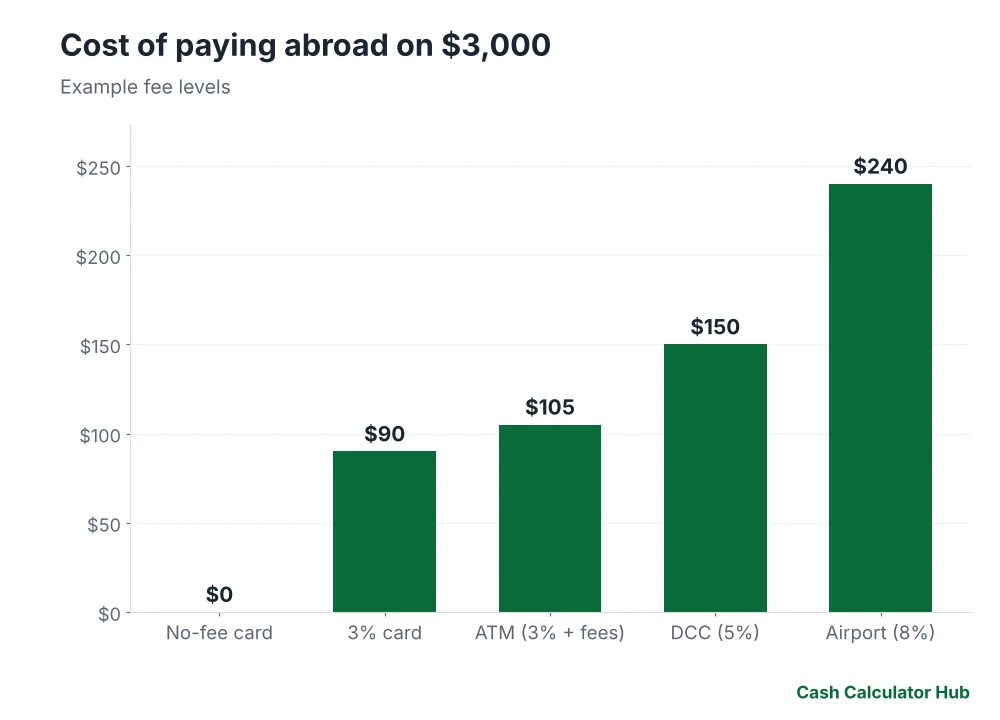
Percentages in this table are examples; actual fees and markups vary by provider and location.
Understanding the exchange rate
The mid-market rate is the midpoint between buy and sell prices. A provider quoting 1.00 USD = 0.90 EUR when the mid-market rate is 0.92 is marking up by about 2.2%.
Example: you exchange $500 at 0.90 instead of 0.92: you receive €450 instead of €460, a loss of €10.
Dynamic currency conversion
At a terminal abroad you may be asked: pay in dollars or euros? If you choose dollars, the merchant’s processor sets the rate, often with a markup. Choose the local currency.
How to save on a trip
- Use a card with no foreign transaction fee.
- Pay in local currency.
- Withdraw larger amounts less often from bank-affiliated ATMs.
- Avoid exchanging at airports unless necessary.
- Notify the card issuer and carry a backup card.
- Compare multi-currency accounts and travel cards for large trips.
Inflation and currency swings
Exchange rates move with inflation and interest differences. A weaker home currency raises the cost of travel regardless of fees. See inflation measurement and VAT for refunds on goods taken home.
Tools
Use the percentage calculator, VAT calculator and cost of living calculator to plan. More: inflation and currency tools.
Frequently asked questions
What is a foreign transaction fee?
A fee, commonly 3%, that some card issuers charge on purchases made in a foreign currency or processed abroad.
How can I avoid foreign transaction fees?
Use a card that does not charge them, and pay in the local currency.
Is it cheaper to exchange cash at the airport?
Usually not; airport kiosks tend to have the worst rates.
What is dynamic currency conversion?
A service that lets you pay in your home currency abroad, usually at a less favorable exchange rate.
What is the mid-market rate?
The midpoint between the buy and sell rates for a currency pair, used as a benchmark.
Sources and further reading
How the numbers were made: Every figure on this page was calculated from the formulas and assumptions stated above and rounded to the nearest dollar. Rates, limits and rules are for 2026 unless noted; confirm current figures with the sources listed before acting.
Keep reading
- What Was $100 Worth in 2000? Inflation, Calculated
- Sales Tax by State: Base Rates, No-Tax States and How to Calculate Total Tax
- How Long to Pay Off a Credit Card Making Only the Minimum?
- VAT vs Sales Tax: How They Work, Who Pays and a Worked Example
- Social Security COLA History: The 2.8% Increase for 2026 and What It Means
- Do Your Raises Keep Up With Inflation? How to Calculate Your Real Raise
This guide is general information, not financial, tax or legal advice. Figures use stated assumptions and 2026 rules and will differ from your situation; check current rules and talk to a licensed professional before you decide. Full disclaimer.