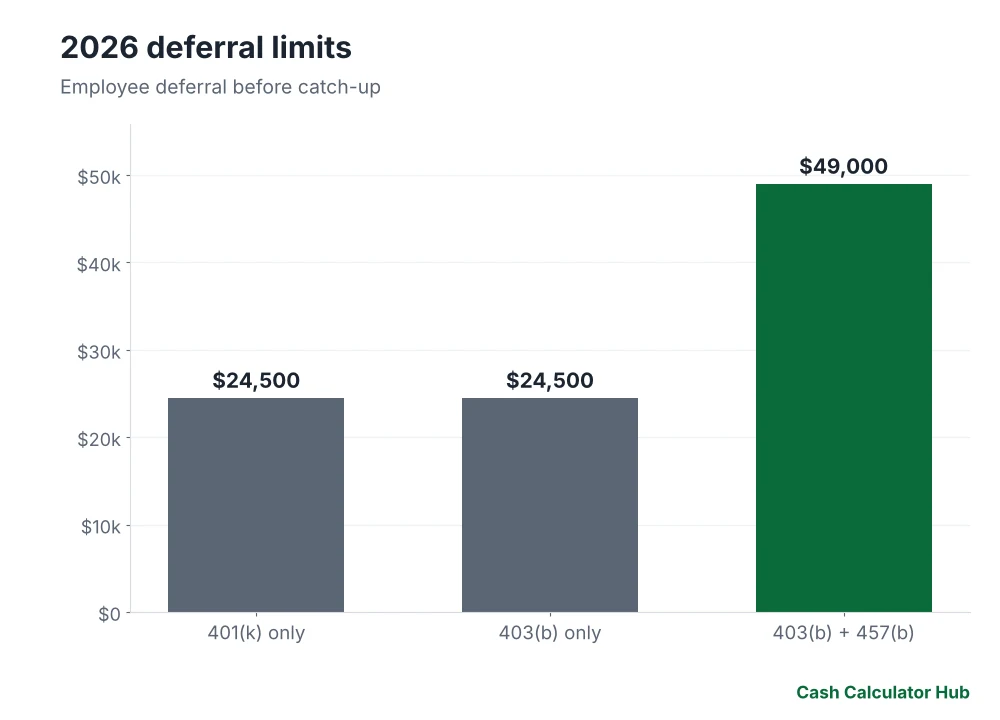
Quick answer: A 401(k), 403(b) and 457(b) all let you defer up to $24,500 of pay in 2026, but the 403(b) and 401(k) share one limit while a 457(b) has a separate limit. If your employer offers both a 403(b) and a governmental 457(b), you can defer up to $49,000, plus catch-up contributions at 50 and older.
The three plans are cousins that differ mainly by who offers them: 401(k) plans are for private companies, 403(b) plans for public schools, universities and nonprofits, and 457(b) plans for state and local government and some nonprofit employees. The rules about penalties, catch-ups and limits create real planning opportunities.
Key takeaways
- 2026 employee deferral limit: $24,500 per plan type; 401(k) and 403(b) share one limit.
- A 457(b) has a separate limit, so a worker with both can contribute up to $49,000.
- Governmental 457(b) withdrawals after leaving the job have no 10% early-withdrawal penalty.
- Catch-up: $8,000 at 50 or older, $11,250 at 60 to 63; 403(b) and 457(b) have special catch-ups.
- Watch fees: some 403(b) plans use high-cost annuities.
Side-by-side
| Feature | 401(k) | 403(b) | 457(b) |
|---|---|---|---|
| Who offers it | Private employers | Schools, nonprofits, hospitals | State/local government, some nonprofits |
| 2026 deferral limit | $24,500 | $24,500 (shared with 401(k)) | $24,500 (separate) |
| Catch-up at 50+ | $8,000 | $8,000 | $8,000 (or special 3-year catch-up) |
| Early withdrawal penalty | 10% before 59½ | 10% before 59½ | None for governmental plans after separation |
| Typical investments | Mutual funds | Mutual funds, annuities | Mutual funds, annuities |
| Roth option | Common | Often | Sometimes |
The double-limit opportunity
A public school teacher with access to both a 403(b) and a governmental 457(b) can defer $24,500 to each in 2026.
| Amount | |
|---|---|
| 403(b) | $24,500 |
| 457(b) | $24,500 |
| Total possible | $49,000 |
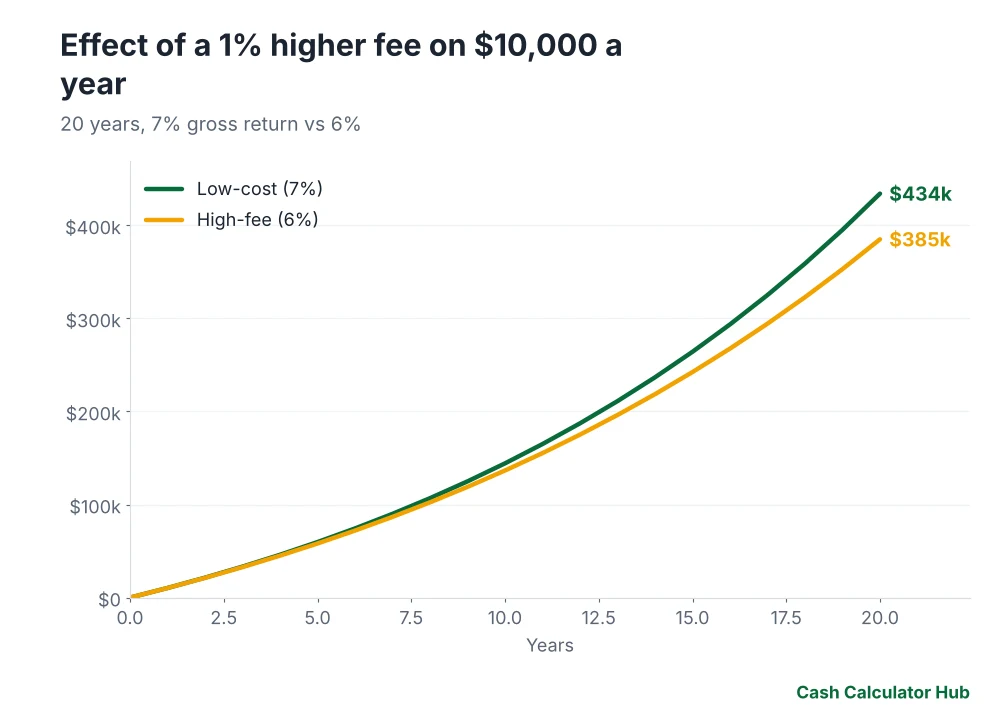
Few people can use the full amount, but even partial use matters. Saving an extra $10,000 a year for 20 years at 7% yields about $434,106.
No-penalty access
Money in a governmental 457(b) can be withdrawn after you leave the employer without the 10% early-withdrawal penalty, although income tax still applies. This makes it useful for early retirees who retire before 59½. Rollovers into an IRA lose that feature, so consider keeping the money in the 457(b).
Catch-up rules
- Age 50+: extra $8,000 in each of the plans (the 401(k)/403(b) share).
- Ages 60 to 63: the limit rises to $11,250 under the SECURE 2.0 Act.
- 15-year service catch-up (403(b)): up to $3,000 more per year for long-serving employees at certain employers, up to a lifetime max.
- 457(b) three-year catch-up: in the three years before normal retirement age, you may defer up to twice the limit, if you under-contributed earlier.
You cannot use both the age-50 and 457(b) three-year catch-ups in the same year; use the larger.
Fees and investments
Some 403(b) plans offer high-cost annuities and share classes. Compare expense ratios; see expense ratios. Prefer low-cost index funds when available, and ask whether the plan has a lower-cost option.
Employer match
Capture any match first, as in which account first. Many public employers also provide pensions, which change how much you need to save; see pension decisions.
Rolling over
You can roll a 403(b) or 457(b) to an IRA or another plan after leaving; see rollover options.
Tools
Use the 401(k) calculator and retirement calculator. Limits for the other accounts are in the 2026 limits guide. More: retirement tools.
Frequently asked questions
What is the difference between a 403(b) and a 457(b)?
A 403(b) is for schools and nonprofits and shares its limit with 401(k)s; a 457(b) is for government and some nonprofit workers, has a separate limit and no early-withdrawal penalty in governmental plans.
Can I contribute to both a 403(b) and a 457(b)?
Yes. The limits are separate, so you can defer up to $24,500 to each in 2026.
What is the 2026 limit for a 457(b)?
$24,500, plus catch-up contributions if you qualify.
Is there a penalty for early withdrawal from a 457(b)?
Not for a governmental 457(b) after you leave your employer, though ordinary income tax applies.
Is a 403(b) as good as a 401(k)?
They are similar in tax treatment; the main difference is often the investment menu and fees.
Sources and further reading
How the numbers were made: Every figure on this page was calculated from the formulas and assumptions stated above and rounded to the nearest dollar. Rates, limits and rules are for 2026 unless noted; confirm current figures with the sources listed before acting.
Keep reading
- 2026 401(k) and IRA Contribution Limits, Explained
- Where to Invest First: 401(k), HSA, Roth IRA or a Taxable Account?
- Roth vs Traditional 401(k) and IRA: How to Decide
- FIRE Explained: How Your Savings Rate Sets the Years Until Financial Independence
- 401(k) Rollover Options When You Leave a Job: What to Do With Your Old Plan
- Solo 401(k) vs SEP IRA: Which Retirement Plan Is Better for the Self-Employed?
This guide is general information, not financial, tax or legal advice. Figures use stated assumptions and 2026 rules and will differ from your situation; check current rules and talk to a licensed professional before you decide. Full disclaimer.