Quick answer: Buy now, pay later (BNPL) splits a purchase into installments, commonly four equal payments over six weeks, usually with no interest if you pay on time. A $400 purchase is four $100 payments. It is cheaper than a card if you never miss a payment, but late fees, easier overspending and stacking several plans make it risky.
BNPL is spreading from online checkout to in-store purchases. It is marketed as a no-interest alternative to cards, and sometimes it is. The risk is in the details and in how easily it adds up.
Key takeaways
- Pay-in-four: 25% down at purchase, then three more payments every two weeks, typically no interest.
- Longer BNPL loans may carry interest up to 36% APR.
- Late fees and overdraft charges can erase the savings.
- Multiple plans at once can strain a budget; track total payments due.
- Reporting practices vary; some BNPL use may appear on credit reports.
How pay-in-four works
| Payment | When | Amount |
|---|---|---|
| 1 | At checkout | $100 |
| 2 | 2 weeks later | $100 |
| 3 | 4 weeks later | $100 |
| 4 | 6 weeks later | $100 |

Compared with a card
If you paid the same $400 with a card at 24% APR and repaid over about six weeks, interest would be only a few dollars if you made payments quickly, but if the balance lingered for months it could reach $20 or more. BNPL’s advantage is a fixed schedule with no interest. The disadvantages are late fees, no grace-period flexibility, and the risk of buying more.
| Scenario | Cost on $400 |
|---|---|
| BNPL, all payments on time | $0 |
| BNPL, one late payment (assumed $7 fee) | $7 |
| Card at 24%, paid after 3 months | $24 |
| Card, paid in full by due date | $0 |
Longer BNPL loans
Some plans offer 6 to 24 months at rates up to 36% APR for larger purchases. Treat them like any installment loan; see loan vs card and term vs payment.
Hidden risks
- Overspending: small payments hide the total cost.
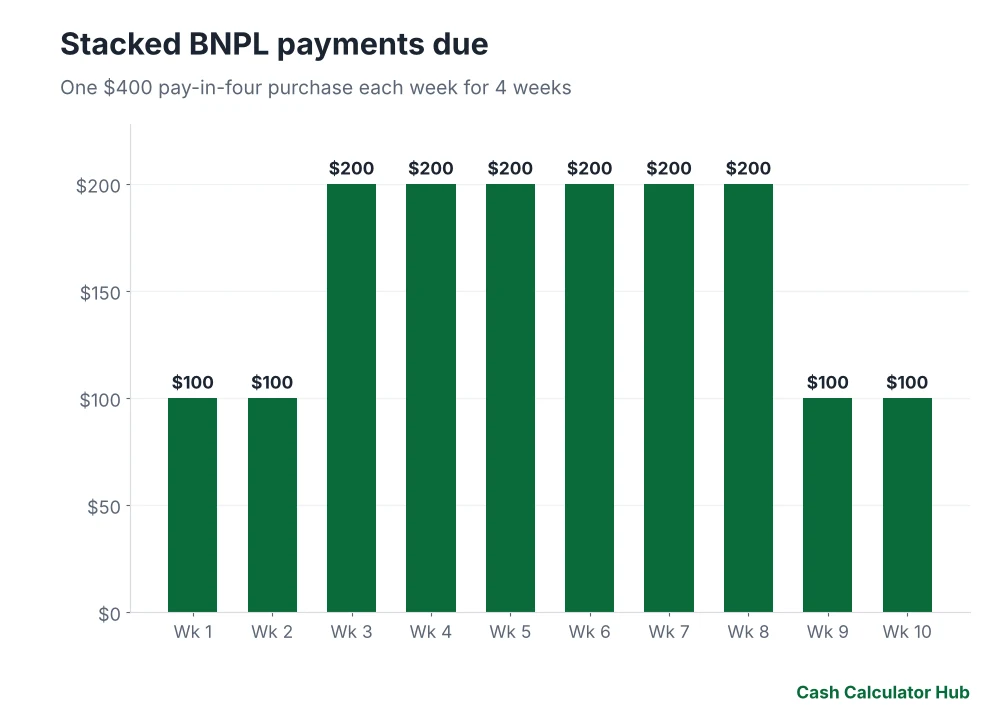
- Stacking: buying one $400 item each week for four weeks produces payments of $200 in most weeks. Track total dues.
- Returns and disputes can be complicated: payments may continue until the refund posts.
- Overdrafts: automatic debits from checking can trigger fees.
- Credit reporting: policies are changing; late payments may be reported.
How to use it safely
- Use only for planned purchases you could pay for in cash.
- Limit to one or two plans at a time.
- Pay from a funded account; keep a buffer.
- Read the late-fee and return policies.
- Prefer saving up with a sinking fund where possible.
Tools
Use the loan calculator and APR calculator for longer plans, and the budget planner to track due dates. More: loan calculators.
Frequently asked questions
What is buy now, pay later?
A payment option that splits a purchase into installments, often four payments over six weeks with no interest.
Does BNPL charge interest?
Pay-in-four typically does not, but longer plans can have interest of up to 36% APR.
Is BNPL better than a credit card?
It can be cheaper than carrying a card balance, but it can encourage overspending and carries late fees.
Does BNPL affect my credit score?
It depends on the provider; some report to credit bureaus, and missed payments can hurt.
What happens if I miss a BNPL payment?
You may be charged a late fee, lose access to future financing and, in some cases, be reported to credit bureaus.
Sources and further reading
- CFPB: Buy now, pay later research
- Consumer Financial Protection Bureau
- FTC: Consumer advice on money and credit
How the numbers were made: Every figure on this page was calculated from the formulas and assumptions stated above and rounded to the nearest dollar. Rates, limits and rules are for 2026 unless noted; confirm current figures with the sources listed before acting.
Keep reading
- How Long to Pay Off a Credit Card Making Only the Minimum?
- Debt Avalanche vs Snowball: A Four-Debt Example With Real Numbers
- The 50/30/20 Budget Rule: How It Works, and How to Adjust It
- How Long to Pay Off $10,000 of Credit Card Debt? Timelines at $200 to $1,000 a Month
- Payday Loan APR: What a $15 per $100 Fee Really Costs
- Student Loan Refinancing: Savings, What You Give Up and When It Makes Sense
This guide is general information, not financial, tax or legal advice. Figures use stated assumptions and 2026 rules and will differ from your situation; check current rules and talk to a licensed professional before you decide. Full disclaimer.