Quick answer: Real return is what is left of your yield after taxes and inflation. A 4.5% savings yield taxed at a combined 29% (24% federal, 5% state) leaves 3.19% after tax; with inflation at 3.7% the real after-tax return is about -0.49%, so $10,000 in the account grows in dollars but not in purchasing power.
The number on the rate sheet is a nominal, pre-tax return. What matters for your goals is how much more you can buy after taxes and inflation. The gap between the two is large when inflation is elevated, as it has been recently: the September 2026 CPI reading was 3.7% year over year.
The calculation has two steps. First subtract taxes from the yield. Then adjust the result for inflation.
Key takeaways
- After-tax yield = nominal × (1 − tax rate): 4.5% × (1 − 29%) = 3.19%.
- Real return = (1 + after-tax) ÷ (1 + inflation) − 1 = -0.49% at 3.7% inflation.
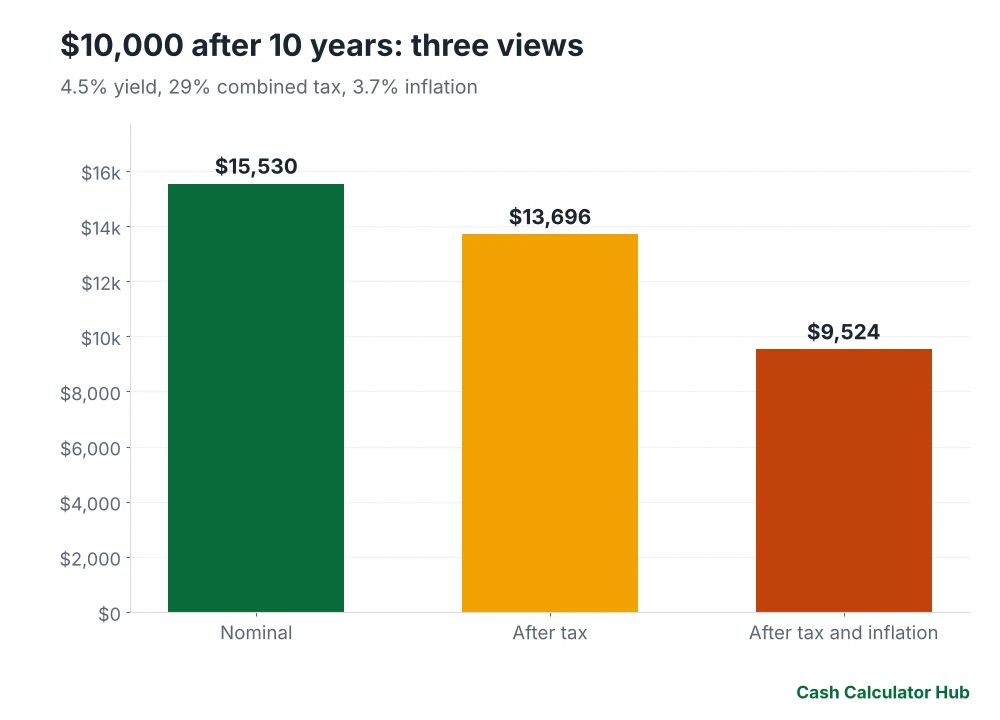
- $10,000 earning 3.19% grows to $13,696 in 10 years but buys what $9,524 buys today.
- Tax-advantaged accounts and inflation-linked assets can improve real returns.
- Cash is for safety and short-term goals, not long-term growth.
The calculation
| Step | Rate | $10,000 after 10 years |
|---|---|---|
| Nominal yield | 4.5% | $15,530 |
| After taxes (24% federal + 5% state) | 3.19% | $13,696 |
| After taxes and 3.7% inflation (today’s dollars) | -0.49% | $9,524 |
Real return = (1 + after-tax return) ÷ (1 + inflation) − 1. Here: 1.0320 ÷ 1.037 − 1 = -0.49%.
In the third row, the balance is in today’s purchasing power. You would have more dollars, but they buy about the same as $10,000 does now.
Different scenarios
| Inflation | Real after-tax return on a 4.5% yield |
|---|---|
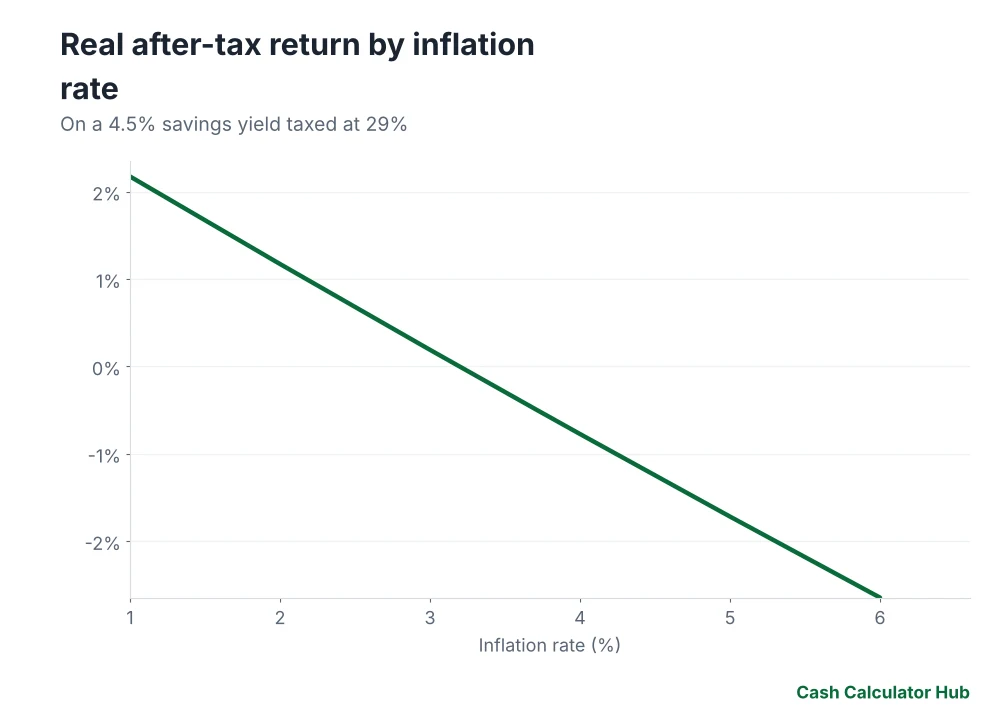
| 2.0% | 1.17% |
| 3.0% | 0.19% |
| 3.7% | -0.49% |
| 5.0% | -1.72% |
When inflation is near 2%, a 4.5% yield provides a positive real return. When inflation runs hotter, the cushion disappears. See what $100 was worth in 2000 for the long-run effect.
What reduces the tax drag
- Tax-advantaged accounts. Interest inside an IRA, 401(k) or HSA is not taxed each year.
- Treasury bills and some bonds. Interest on U.S. Treasuries is exempt from state income tax, which matters in high-tax states.
- Municipal bonds. Often free of federal tax; compare tax-equivalent yields.
- I bonds and TIPS. Principal adjusts with inflation. See TreasuryDirect for current terms.
What cash is for
Cash is the right home for emergencies and goals within a few years, because stability matters more than return. See emergency fund sizing and high-yield savings accounts.
For long horizons, the risk is the opposite: that inflation outpaces your savings. Over decades, stocks have historically delivered higher real returns, with more volatility; see average stock market returns.
Inflation and your pay
Real return applies to income too. A 3% raise during 3.7% inflation is a real pay cut. See cost of living and the inflation calculator.
Check yours
Use the inflation calculator for purchasing power, the interest calculator for yields and the income tax calculator for your bracket. More: inflation and currency tools.
Frequently asked questions
What is a real return?
It is your investment return after subtracting inflation (and, if you choose, taxes). It measures the change in your purchasing power.
How do I calculate after-tax return on savings?
Multiply the interest rate by (1 − your tax rate). A 4.5% yield at a 29% combined rate leaves about 3.2%.
Is my savings account losing money to inflation?
If the after-tax yield is lower than inflation, yes in purchasing power terms, even though the balance grows.
What beats inflation?
Over long periods, diversified stocks and inflation-linked bonds have tended to; in the short term it depends on conditions.
Are Treasury bills taxed?
Federal tax applies, but interest on U.S. Treasuries is exempt from state and local income tax.
Sources and further reading
How the numbers were made: Every figure on this page was calculated from the formulas and assumptions stated above and rounded to the nearest dollar. Rates, limits and rules are for 2026 unless noted; confirm current figures with the sources listed before acting.
Keep reading
- What Was $100 Worth in 2000? Inflation, Calculated
- Savings Account vs CD: Which Earns More for Your Cash?
- Compound Interest on $10,000: What It Becomes in 10, 20 and 30 Years
- Dividend Yield vs Total Return: What Should Investors Focus On?
- Portfolio Rebalancing: How and When to Do It
- Cap Rate vs Cash-on-Cash Return: Evaluating a Rental Property
This guide is general information, not financial, tax or legal advice. Figures use stated assumptions and 2026 rules and will differ from your situation; check current rules and talk to a licensed professional before you decide. Full disclaimer.