Quick answer: State sales tax runs from 0% to 7.25%, and local taxes add more.
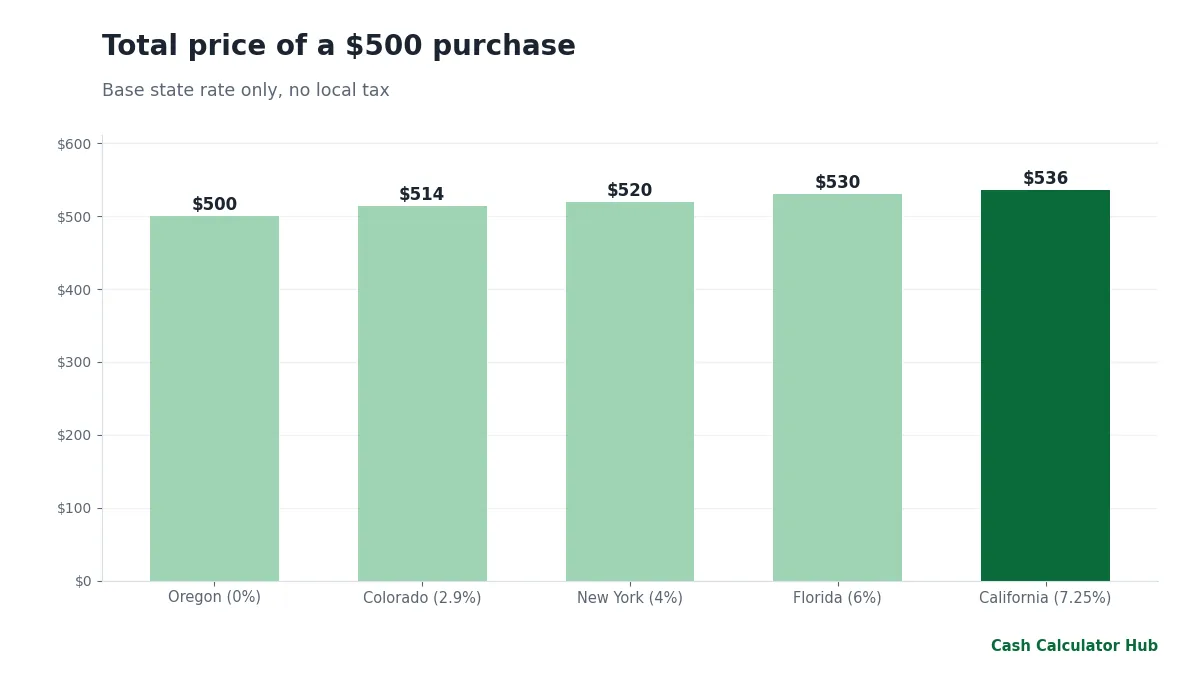
The United States has no national sales tax. Each state decides, and many cities and counties add their own. The result is a patchwork where the same $500 purchase can cost very different amounts depending on the register.
States with no statewide sales tax
Five states have none: Alaska, Delaware, Montana, New Hampshire and Oregon. Alaska allows local governments to charge their own sales taxes, so “no state tax” is not always “no tax.”
Base state rates
State rates range up to 7.25% (California). Rates in our calculator data, as of this writing, include:
| State | Base rate |
|---|---|
| California | 7.25% |
| Indiana | 7% |
| Mississippi | 7% |
| Rhode Island | 7% |
| Tennessee | 7% |
| Minnesota | 6.875% |
| Nevada | 6.85% |
| Texas | 6.25% |
| Florida | 6% |
| Colorado | 2.9% |

These are state-level rates. They are the starting point, and they change. Always verify with your state’s department of revenue.
Local taxes can matter more than the state rate
Cities, counties and special districts often add 1 to 5 points. Some states with low base rates have high combined rates for this reason. A low state rate does not guarantee a low total. If you need the exact figure for an address, look up your state’s rate finder or use your register receipt.
How to calculate sales tax
Adding tax: total = price × (1 + rate). A $500 item at 7.25% is $500 × 1.0725 = $536.25.
Removing tax: price before tax = total ÷ (1 + rate). A receipt total of $536.25 at 7.25% means the price was $536.25 ÷ 1.0725 = $500.
The tax amount: price × rate.
What is taxable?
It varies by state. Many states exempt groceries, prescription drugs and sometimes clothing. Some tax services, and many do not. Online purchases are generally taxable in most states, because since 2018 the Supreme Court’s Wayfair decision lets states require remote sellers to collect tax.
Sales tax versus VAT
Sales tax is collected only at the final sale to a consumer. VAT, used in most other countries, is collected at each stage of production and sold. Compare in the VAT calculator.
For business owners
- You must collect sales tax in states where you have nexus (physical presence or enough sales).
- Keep tax separate from revenue in your books; it is not income.
- When you set prices, decide whether they are tax-inclusive. This affects your margin; see margin vs markup.
- Discounts and coupons can reduce the taxable amount in some states.
For shoppers
- Add tax before you decide if a big purchase fits your budget. On a $30,000 car at 6%, tax is $1,800; see how much car you can afford for how it changes your loan.
- Compare discounts correctly with the discount calculator, including stacked discounts and tax.
- Remember that tax-free weekends can save real money on qualifying items.
Use the calculator
The sales tax calculator adds or removes tax with state base rates plus local tax, discounts and quantities. For percentages in general, use the percentage calculator. More in business and everyday tools.
Tax-free weekends and exemptions
Many states hold sales tax holidays on items such as school supplies, clothing under a price cap or energy-efficient appliances. Dates and limits differ by state, so check the state revenue department. Common exemptions include prescription drugs, some groceries and certain medical equipment, while prepared food, soft drinks and candy may be taxed even where groceries are not.
A few examples
| Purchase | Base rate 0% | 4% | 6% | 7.25% |
|---|---|---|---|---|
| $100 item | $100.00 | $104.00 | $106.00 | $107.25 |
| $1,000 laptop | $1,000.00 | $1,040.00 | $1,060.00 | $1,072.50 |
| $30,000 car | $30,000 | $31,200 | $31,800 | $32,175 |
Sales tax on large purchases is real money, and it is why you should always compare the out-the-door price. For cars, many states also charge title and registration fees on top; see the car affordability guide for how those increase the loan amount.
For sellers
If you sell online, learn your state’s economic nexus threshold. Many states require registration once you pass a certain amount of sales or number of transactions (often $100,000 or 200 transactions). Marketplaces like Amazon and Etsy collect and remit on your behalf in most states, but direct sales from your own site are your responsibility.
Which state has the highest sales tax?
California has the highest state base rate at 7.25%. Combined state and local rates are higher in some other states.
Which states have no sales tax?
Alaska (with local taxes), Delaware, Montana, New Hampshire and Oregon.
Do I pay sales tax online?
Usually yes, if the seller collects it for your state.
Is sales tax deductible?
You may deduct either state income tax or general sales tax if you itemize.
Sources and further reading
How the numbers were made: Every figure on this page was calculated from the formulas and assumptions stated above and rounded. Rates, limits and rules are for 2026 unless noted; confirm current figures with the sources listed before acting.
Keep reading
- Margin vs Markup: The Difference, the Formulas and a Conversion Table
- How Much Car Can I Afford? The 20/4/10 Rule With Real Numbers
- Successive Discounts: Why 20% Off Plus 10% Off Is Not 30% Off
- Payback Period and Discounted Payback: How Fast Does an Investment Return Your Money?
- Break-Even Analysis: How Many Units or How Much Revenue You Need to Cover Costs
- Gross Margin vs Operating Margin vs Net Margin: What Each Tells You
This guide is general information, not financial, tax or legal advice. Figures use stated assumptions and 2026 rules and will differ from your situation; check current rules and talk to a licensed professional before you decide. Full disclaimer.