Quick answer: A $6,000 balance at 22% takes about 18 years and $9,506 in interest on minimum payments alone.
Credit card issuers set the minimum payment low on purpose. It keeps your account in good standing and keeps interest flowing. Here is what that looks like with real numbers.
How the minimum is calculated
Most issuers use the greater of a floor amount (often about $35) or 1% of your balance plus that month’s interest. Interest is your APR divided by 12, multiplied by the balance. The recent average APR for accounts that carry a balance has been in the low 20s, so I use 22%.
On $6,000 at 22%:
- Monthly interest: $110
- 1% of balance: $60
- First minimum payment: $170, of which only $60 reduces the balance
As the balance falls, so does the minimum, which is why it takes so long.
The result
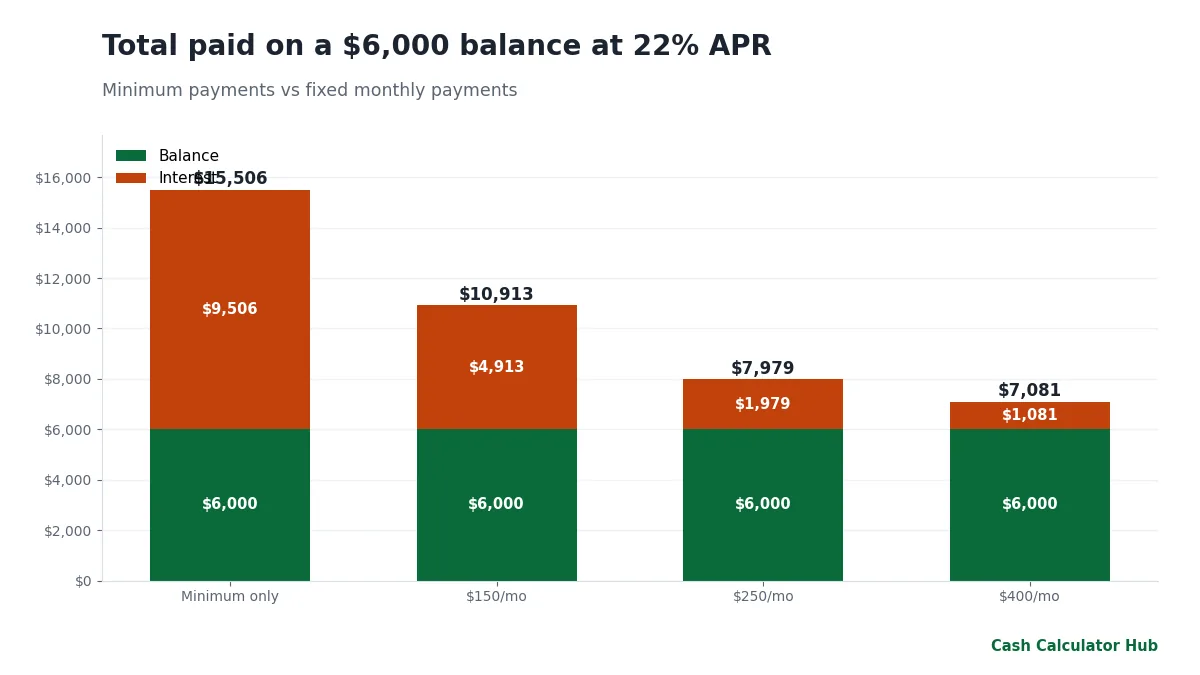
| Payment plan | Time to pay off | Total interest | Total paid |
|---|---|---|---|
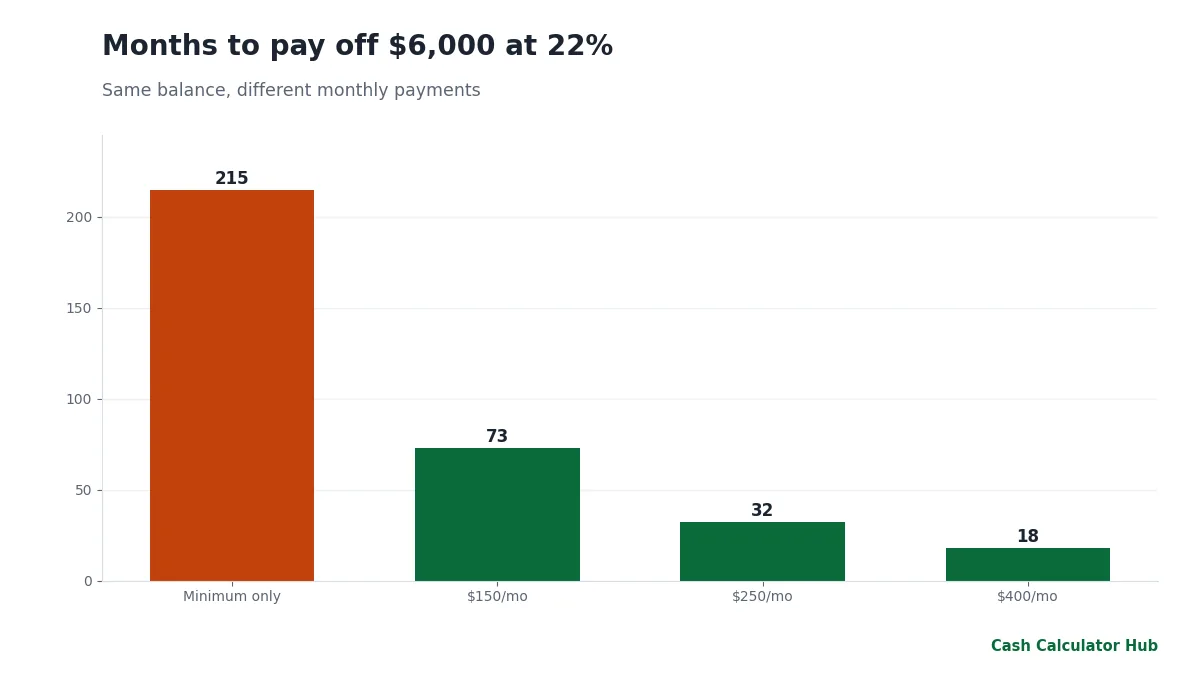
| Minimum only | 17 yrs 11 mo | $9,506 | $15,506 |
| $150 a month | 6 yrs 1 mo | $4,913 | $10,913 |
| $250 a month | 2 yrs 8 mo | $1,979 | $7,979 |
| $400 a month | 1 yrs 6 mo | $1,081 | $7,081 |
Paying only the minimum, you end up paying 2.6 times the amount you borrowed. A fixed $250 a month finishes in 2 years and 8 months and saves roughly $7,527 in interest. And $400 a month is done in 18 months.
The trap of a fixed minimum that falls
Some people set autopay to “minimum due.” That is the worst setting. If you can, set autopay to a fixed amount equal to your first minimum. Because the payment does not decrease as the balance falls, you shorten the term considerably. On this balance that means paying about $170 every month instead of watching it shrink.
A payoff plan that works
- Stop adding to the balance. Moving new purchases to a debit card or cash prevents the hole from deepening.
- Pick a fixed payment you can sustain and calculate the payoff date with the credit card calculator. To work backward from a date, use the credit card payoff calculator.
- Call your issuer. Ask for a lower APR. People with a good payment record sometimes succeed.
- Consider a 0% balance transfer if you qualify and can repay within the promotional period. Watch the 3% to 5% fee and the rate after the offer ends. See whether consolidation is worth it.
- If you have several cards, use the avalanche or snowball method.
What the minimum does to your credit
A balance near your limit raises your credit utilization, which can pull your score down. Paying down the balance, rather than just paying the minimum, helps both your score and your cash flow. Late payments are far more damaging than a high balance, so never miss one while you are working on a plan.
Where the money comes from
Free up a few hundred dollars a month by reviewing your budget with the 50/30/20 method, selling items you do not use or taking a temporary side job. Every dollar you put toward a 22% card is a guaranteed 22% return, better than almost any investment. That is why it comes before extra mortgage payments (see paying off a mortgage early) and often before investing beyond the 401(k) match. More tools: loans and debt calculators.
A smaller example: $2,500 at 22%
On $2,500 the minimum starts near $71, falls with the balance and takes about 11 years to clear if you never add to it, costing roughly $3,090 in interest. A fixed $150 a month clears it in about 21 months. Small balances are the easiest to eliminate, so start there if you have several (see avalanche versus snowball).
What happens to your credit
Your credit utilization (balance divided by limit) is one of the biggest score factors. Getting under 30% helps, and under 10% helps more. Paying down balances before the statement closing date lowers the reported utilization. Never close your oldest account just because you paid it off, since it supports your credit history length.
When you are stuck
If a payoff plan is not feasible, call your issuer before you miss a payment and ask about hardship programs. A nonprofit credit counseling agency (look for NFCC members) can review your budget and may negotiate lower rates through a debt management plan. Avoid companies that charge large upfront fees or promise to erase your debt.
Does paying more than the minimum matter?
Enormously. On this balance, $250 instead of the minimum saves about $7,527 and several years.
What if I can only afford the minimum?
Do not skip it. Call the issuer about hardship programs and talk to a nonprofit credit counselor.
Is it better to pay off the card or save?
Keep a small emergency fund, then pay the card. A 22% cost is hard to beat.
How is credit card interest calculated?
Usually daily, based on your average daily balance and APR, and added to the balance each month.
Sources and further reading
How the numbers were made: Every figure on this page was calculated from the formulas and assumptions stated above and rounded. Rates, limits and rules are for 2026 unless noted; confirm current figures with the sources listed before acting.
Keep reading
- Is Debt Consolidation Worth It? A $18,000 Credit Card Example
- Debt Avalanche vs Snowball: A Four-Debt Example With Real Numbers
- The 50/30/20 Budget Rule: How It Works, and How to Adjust It
- How Much Emergency Fund Do You Need? A Month-by-Month Plan
- Personal Loan vs Credit Card: Which Costs Less for a Big Expense?
- Zero-Based Budgeting: Give Every Dollar a Job (With a Worked Example)
This guide is general information, not financial, tax or legal advice. Figures use stated assumptions and 2026 rules and will differ from your situation; check current rules and talk to a licensed professional before you decide. Full disclaimer.