Quick answer: Aim for at least 20% down on a new car and 10% on a used one. On a $35,000 car with $2,800 of tax and fees financed at 7.5% for 60 months, putting 20% down instead of nothing lowers the payment by $140 a month and total interest by $1,416, and keeps you from owing more than the car is worth.
A down payment does three jobs: it reduces the amount you borrow, it can lower the rate you are offered, and it creates a cushion against depreciation. The cushion matters because a new car can lose 20% of its value in the first year.
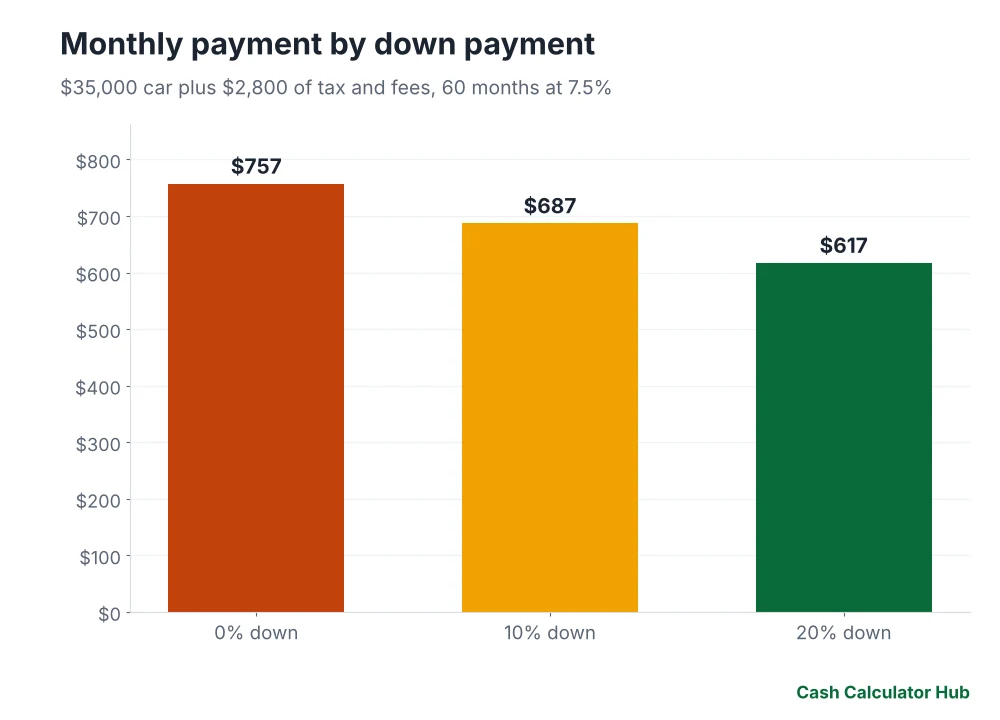
The model: a $35,000 car, $2,800 of taxes and fees financed with the loan, 7.5% for 60 months.
Key takeaways
- 20% down on a new car and 10% on a used car are the standard targets in the 20/4/10 rule.
- Payments: $757 with no down payment, $687 with 10% and $617 with 20%.
- Total interest: $7,646, $6,938 and $6,230.
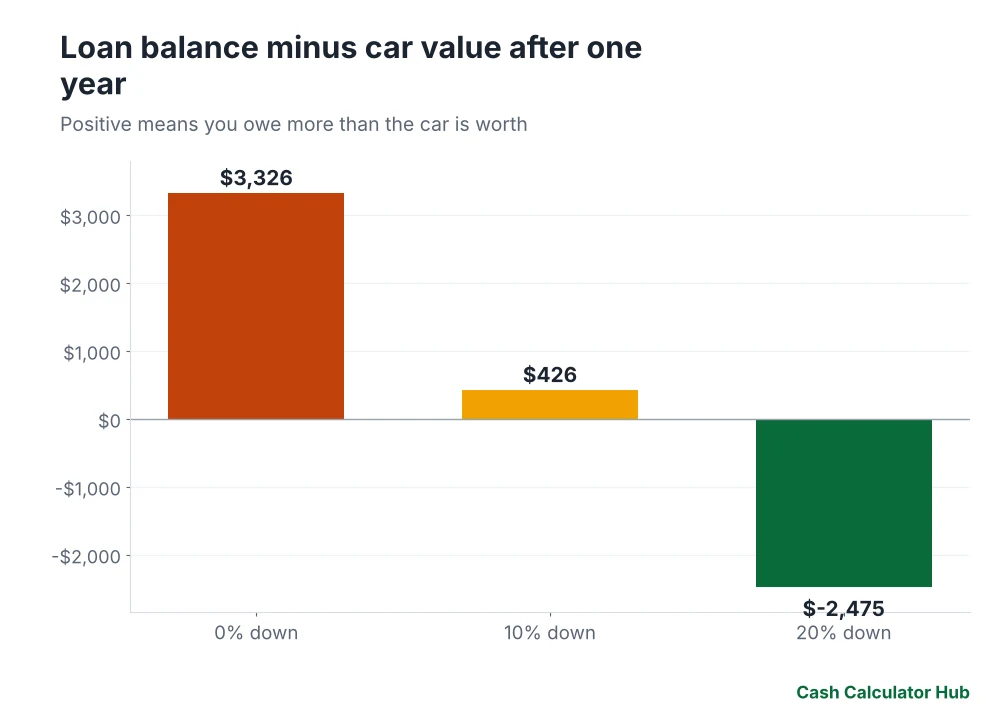
- After one year the 0%-down buyer is underwater by about $3,326; with 20% down the buyer has about $2,475 of equity.
- If cash is tight, a smaller down payment on a cheaper car beats a bigger loan on a more expensive one.
What each down payment does
| Down payment | Loan amount | Monthly payment | Total interest | Loan balance minus car value after 1 year |
|---|---|---|---|---|
| 0% ($0) | $37,800 | $757 | $7,646 | $3,326 |
| 10% ($3,500) | $34,300 | $687 | $6,938 | $426 |
| 20% ($7,000) | $30,800 | $617 | $6,230 | $-2,475 |
A positive last number means you owe more than the car is worth; a negative number means you have equity.
Why 20% works
Depreciation of about 20% in year one means 20% down roughly matches the first year’s loss. You owe about what the car is worth, instead of thousands more. See the depreciation curve. The rule of thumb is part of the 20/4/10 guideline in how much car you can afford: 20% down, a loan no longer than 4 years and total car costs under 10% of gross income.
What if you cannot put down 20%?
- Choose a cheaper car. Cutting the price by $5,000 reduces the loan more than waiting.
- Buy a slightly used car. The previous owner absorbed the steepest drop; see new versus used.
- Use a trade-in or sell your old car privately. See trade-in versus private sale.
- Save for a few more months. Even an extra $2,000 helps.
- Add gap coverage if you must borrow most of the price; see gap insurance.
How down payment affects the rate
Lenders consider loan-to-value. A smaller loan relative to the car’s value is lower risk, and many lenders offer better rates to borrowers who put money down. The effect varies by lender and credit score.
Should you put down more than 20%?
If you have plenty of cash and the loan rate is higher than you can earn elsewhere, a larger down payment can make sense. But do not drain your emergency fund. Keeping three to six months of expenses in savings is worth more than saving a few hundred dollars of interest.
Do not forget the cash costs
Besides the down payment you owe sales tax, registration and fees, which may be financed. Keep the amount financed close to the price of the car, not the price plus add-ons. Extended warranties and fees can add thousands.
Run your own version
Use the auto loan calculator with different down payments and the loan calculator to compare terms. The cash back or low interest calculator helps when a rebate competes with a promotional rate; see cash back or low APR. More: auto calculators.
Frequently asked questions
How much should I put down on a car?
The common guideline is 20% for a new car and at least 10% for a used car. This reduces the payment and the risk of owing more than the car is worth.
Can I buy a car with no down payment?
Yes, many lenders allow it, but you will pay more interest and probably be underwater for the first couple of years.
Does a larger down payment lower my interest rate?
Sometimes. Lenders view lower loan-to-value as less risky, and some offer a better rate for more money down.
Is it better to use savings or finance the car?
Keep your emergency fund intact. Use savings for a down payment only if you still have three to six months of expenses left.
Does a trade-in count as a down payment?
Yes. Its value, minus any loan balance on it, counts toward the down payment.
Sources and further reading
How the numbers were made: Every figure on this page was calculated from the formulas and assumptions stated above and rounded to the nearest dollar. Rates, limits and rules are for 2026 unless noted; confirm current figures with the sources listed before acting.
Keep reading
- How Much Car Can I Afford? The 20/4/10 Rule With Real Numbers
- Gap Insurance: Do You Need It and What Does It Cover?
- 72- and 84-Month Car Loans: Lower Payments, Higher Risk
- Auto Loan Refinance: When Does It Pay Off?
- Trade-In vs Private Sale: What Your Car Is Really Worth to You
- The True Cost of Owning a Car: About $11,577 a Year
This guide is general information, not financial, tax or legal advice. Figures use stated assumptions and 2026 rules and will differ from your situation; check current rules and talk to a licensed professional before you decide. Full disclaimer.