
Quick answer: The 2026 Social Security cost-of-living adjustment (COLA) is 2.8%, which adds $56 a month to a $2,000 benefit. COLAs are based on the increase in the CPI-W from the third quarter of one year to the third quarter of the next. Part B premium increases can absorb part of the raise.
Social Security is one of the few retirement incomes that rises with inflation automatically. Each year the Social Security Administration announces a COLA in October, effective for benefits paid starting in January.
Key takeaways
- 2026 COLA: 2.8% (2025: 2.5%).
- COLA = percent change in average CPI-W from Q3 to Q3.
- A COLA applies to everyone already getting benefits and to people nearing eligibility.
- A higher Medicare Part B premium can reduce the net increase.
- The COLA protects against average inflation, not necessarily your personal inflation.
COLA history
| Year | COLA | On a $2,000 monthly benefit |
|---|---|---|
| 2020 | 1.6% | +$32 a month |
| 2021 | 1.3% | +$26 a month |
| 2022 | 5.9% | +$118 a month |
| 2023 | 8.7% | +$174 a month |
| 2024 | 3.2% | +$64 a month |
| 2025 | 2.5% | +$50 a month |
| 2026 | 2.8% | +$56 a month |

What the 2026 COLA means
A 2.8% increase on a $2,000 monthly benefit is $56 a month, or $672 a year, bringing the benefit to $2,056.
The Medicare offset
Most beneficiaries have the Part B premium deducted from their benefit. The 2026 premium is $202.90; see Medicare costs.
| Amount | |
|---|---|
| Benefit after COLA | $2,056 |
| Part B premium | −$202.90 |
| Net deposit | $1,853.10 |
COLAs compound
Over time, COLAs build the benefit. A $2,000 benefit with the seven COLAs above would have grown to:
| Year | Benefit |
|---|---|
| After 2020 | $2,032 |
| After 2021 | $2,058 |
| After 2022 | $2,180 |
| After 2023 | $2,370 |
| After 2024 | $2,445 |
| After 2025 | $2,506 |
| After 2026 | $2,577 |
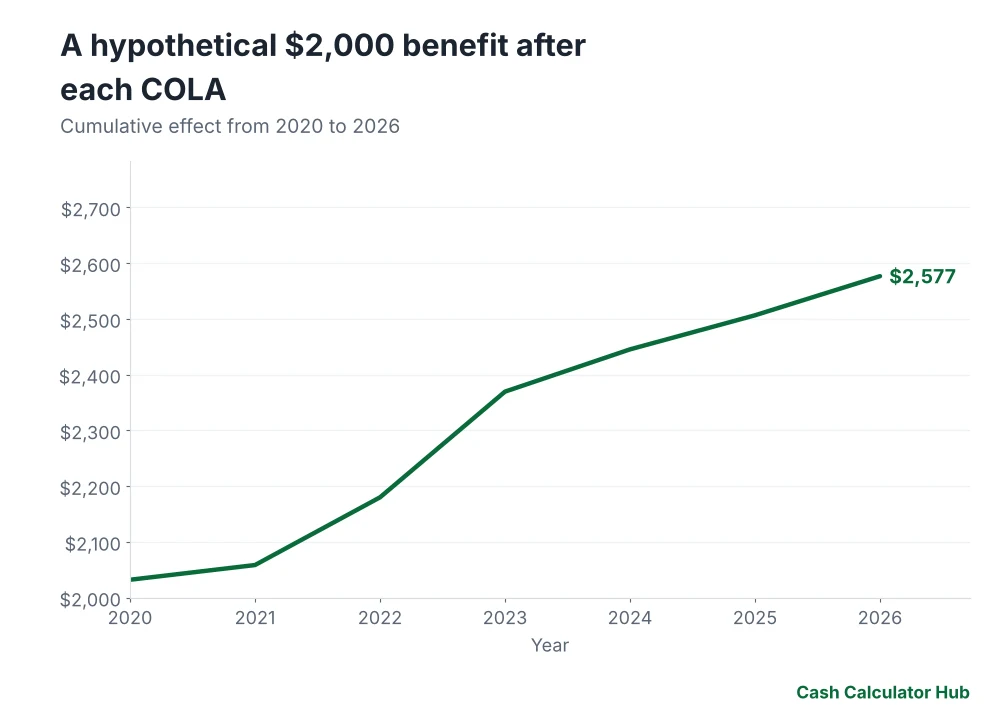
(These are cumulative increases from a hypothetical $2,000 benefit at the start of 2020; the actual starting benefit would be set by your claim.)
Does the COLA keep up with your costs?
CPI-W reflects urban wage earners, while retirees spend more on health care and housing. Some analysts argue another index (CPI-E) fits retirees better. Plan for your own inflation with the inflation calculator, and see how CPI is measured.
Planning ideas
- Claiming later increases the base to which COLAs apply; see 62 vs 67 vs 70.
- Spousal and survivor benefits also get COLAs; see spousal and survivor benefits.
- Benefits may be taxable; see taxation of benefits.
- Add other inflation-protected income, such as Treasury inflation-protected securities.
Tools
Use the Social Security calculator and retirement calculator. More: inflation and currency tools.
Frequently asked questions
What is the 2026 Social Security COLA?
2.8%, effective with benefits payable in January 2026.
How is the COLA calculated?
By the percentage increase in the CPI-W from the third quarter of the previous year to the third quarter of the current year.
Do I get the COLA if I haven’t claimed yet?
Yes, your benefit amount is increased by COLAs even before you start receiving it, from age 62.
Why didn’t my deposit rise by the full COLA?
Medicare premium increases are typically deducted from your benefit.
Does the COLA cover all my inflation?
Not necessarily; it is based on the CPI-W, which may differ from your spending.
Sources and further reading
- SSA: Cost-of-living adjustment (COLA) information
- Social Security Administration
- Medicare.gov: Your Medicare costs
How the numbers were made: COLA percentages are the SSA’s announced values for each year; dollar amounts were computed on a hypothetical $2,000 benefit and rounded. Confirm current figures at ssa.gov/oact/cola.
Keep reading
- Social Security at 62 vs 67 vs 70: When Does Waiting Pay Off?
- What Was $100 Worth in 2000? Inflation, Calculated
- How Much Do You Need to Retire? A Practical Way to Find Your Number
- VAT vs Sales Tax: How They Work, Who Pays and a Worked Example
- Do Your Raises Keep Up With Inflation? How to Calculate Your Real Raise
- CPI Explained: How Inflation Is Measured and What the Number Misses
This guide is general information, not financial, tax or legal advice. Figures use stated assumptions and 2026 rules and will differ from your situation; check current rules and talk to a licensed professional before you decide. Full disclaimer.