

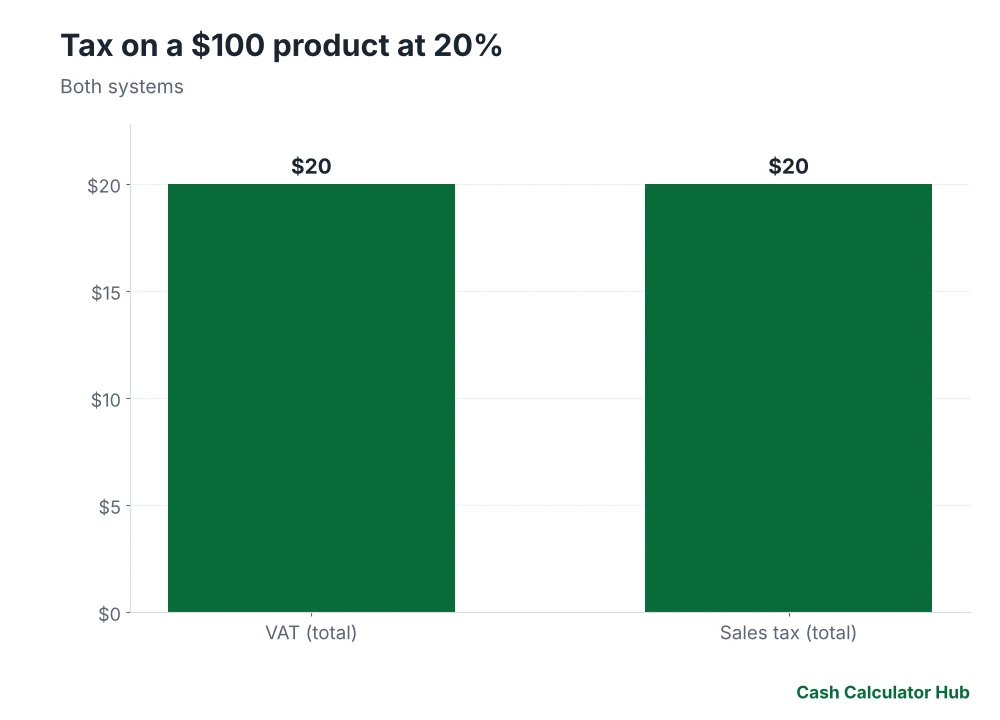
Quick answer: VAT (value-added tax) is collected at each stage of production and distribution on the value each business adds, while sales tax is collected once from the final consumer at the register. On a $100 product with 20% tax, both raise $20, but VAT collects it in pieces along the supply chain and lets businesses reclaim VAT they paid.
Most countries use a VAT; the United States uses state and local sales taxes instead. They are both consumption taxes, and the burden usually falls on the buyer. The mechanics differ in who collects and how evasion is checked.
Key takeaways
- VAT is collected at every stage; businesses credit input VAT against output VAT.
- Sales tax is collected only on the final sale to the consumer; businesses buy inputs tax-free with resale certificates.
- Both are consumption taxes and are usually paid by the end consumer.
- VAT prices in many countries include the tax; U.S. sales tax is added at checkout.
- Rates vary: the UK standard VAT rate is 20%, Germany’s 19%; U.S. sales tax varies by state and locality.
A 20% VAT example
Each business charges 20% on its sale, then subtracts the VAT it paid on purchases.
| Stage | Sale price (before VAT) | VAT charged | VAT paid on inputs | Net VAT remitted |
|---|---|---|---|---|
| Raw material | $40 | $8 | $0 | $8 |
| Manufacturer | $70 | $14 | $8 | $6 |
| Retailer | $100 | $20 | $14 | $6 |
| Total | $20 |

The consumer pays $120 ($100 plus $20). The government gets $20 in total, collected in slices of $8, $6 and $6.
The same product under a 20% sales tax
Only the retailer collects: $100 × 20% = $20 at the register.
| VAT | Sales tax | |
|---|---|---|
| Collected by | Every business in the chain | The final seller |
| Total tax on $100 product | $20 | $20 |
| Who pays economically | Consumer | Consumer |
| Paperwork | Many filers; credit system | Fewer filers; exemption certificates |
| Evasion risk | Self-checking through invoices | Concentrated at retail |
Calculating each
- Add VAT: price × (1 + rate). For $100 at 20% → $120.
- Remove VAT from a gross price: gross ÷ (1 + rate). For $120 → $100, VAT = $20.
- Sales tax: price × rate, added at checkout.
| Gross price | Net at 20% VAT | VAT portion |
|---|---|---|
| $60 | $50.00 | $10.00 |
| $120 | $100.00 | $20.00 |
| $240 | $200.00 | $40.00 |
| $600 | $500.00 | $100.00 |
Which is more efficient?
VAT avoids taxing business inputs (no cascading) and creates a paper trail. Sales taxes can “pyramid” if applied to business purchases. Both are regressive to some degree because lower earners spend a larger share of income, so many places exempt necessities.
For travelers and businesses
Visitors may reclaim VAT on goods taken out of the country. Businesses registered for VAT reclaim input VAT. See sales tax by state for U.S. rates and foreign transaction fees for travel costs.
Tools
Use the VAT calculator, sales tax calculator and discount calculator. More: inflation and currency tools.
Frequently asked questions
What is the difference between VAT and sales tax?
VAT is collected at each stage of production on the value added; sales tax is collected once at the final sale.
Who pays VAT?
Ultimately the consumer, although each business collects and remits its share.
Does the U.S. have a VAT?
No. The U.S. uses state and local sales taxes.
How do I remove VAT from a price?
Divide the gross price by (1 + the VAT rate), for example by 1.20 for 20% VAT.
Can businesses reclaim VAT?
Yes. VAT-registered businesses can credit VAT paid on inputs against VAT charged on sales.
Sources and further reading
How the numbers were made: Every figure on this page was calculated from the formulas and assumptions stated above and rounded to the nearest dollar. Rates, limits and rules are for 2026 unless noted; confirm current figures with the sources listed before acting.
Keep reading
- Sales Tax by State: Base Rates, No-Tax States and How to Calculate Total Tax
- Margin vs Markup: The Difference, the Formulas and a Conversion Table
- What Was $100 Worth in 2000? Inflation, Calculated
- Social Security COLA History: The 2.8% Increase for 2026 and What It Means
- Do Your Raises Keep Up With Inflation? How to Calculate Your Real Raise
- CPI Explained: How Inflation Is Measured and What the Number Misses
This guide is general information, not financial, tax or legal advice. Figures use stated assumptions and 2026 rules and will differ from your situation; check current rules and talk to a licensed professional before you decide. Full disclaimer.


