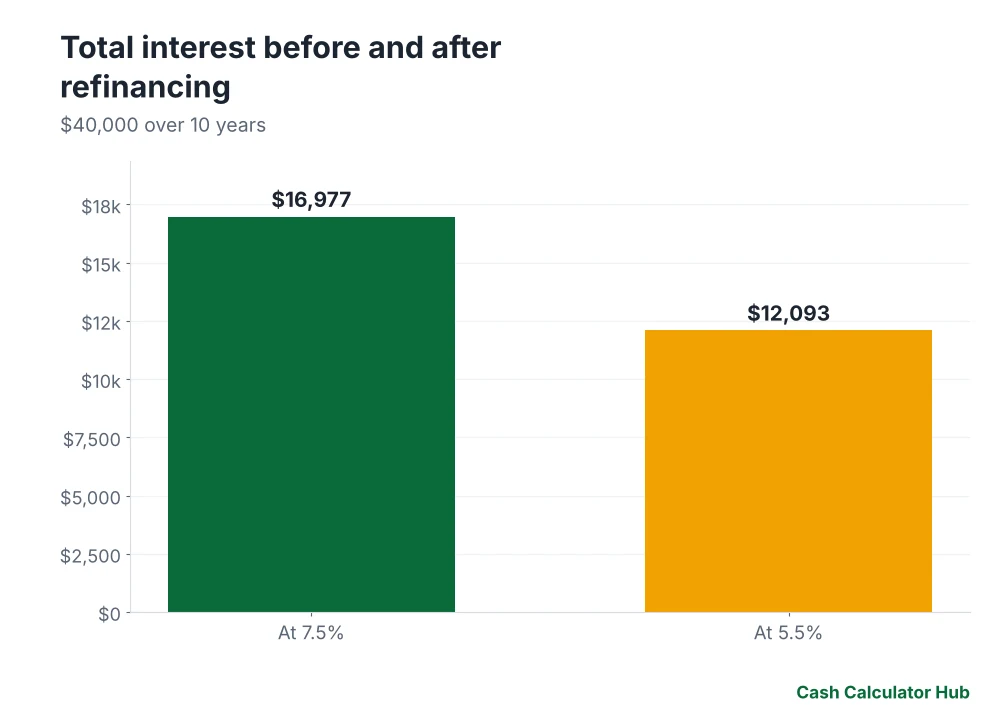
Quick answer: Refinancing replaces your existing student loans with a new private loan at a lower rate. On $40,000 over 10 years, moving from 7.5% to 5.5% lowers the payment from $475 to $434 and saves about $4,884 in interest. Refinancing federal loans into a private loan permanently gives up federal protections such as income-driven repayment, deferment options and forgiveness programs.
Refinancing makes the most sense for borrowers with stable income, good credit and high-rate private loans. It is riskier for federal loan holders, who may need the safety net. The decision comes down to savings versus flexibility.
Key takeaways
- $40,000 at 7.5% for 10 years: $475 a month, $16,977 of interest.
- At 5.5%: $434 a month, $12,093 of interest; saving $4,884.
- Private refinancing of federal loans is irreversible and ends federal protections.
- Lenders consider credit score, income, DTI and loan balance.
- Shorter terms save more interest but raise payments.
The savings
| Current loan | Refinanced | |
|---|---|---|
| Balance | $40,000 | $40,000 |
| Rate | 7.5% | 5.5% |
| Term | 10 years | 10 years |
| Monthly payment | $475 | $434 |
| Total interest | $16,977 | $12,093 |
| Savings | $4,884 |
How the rate changes savings
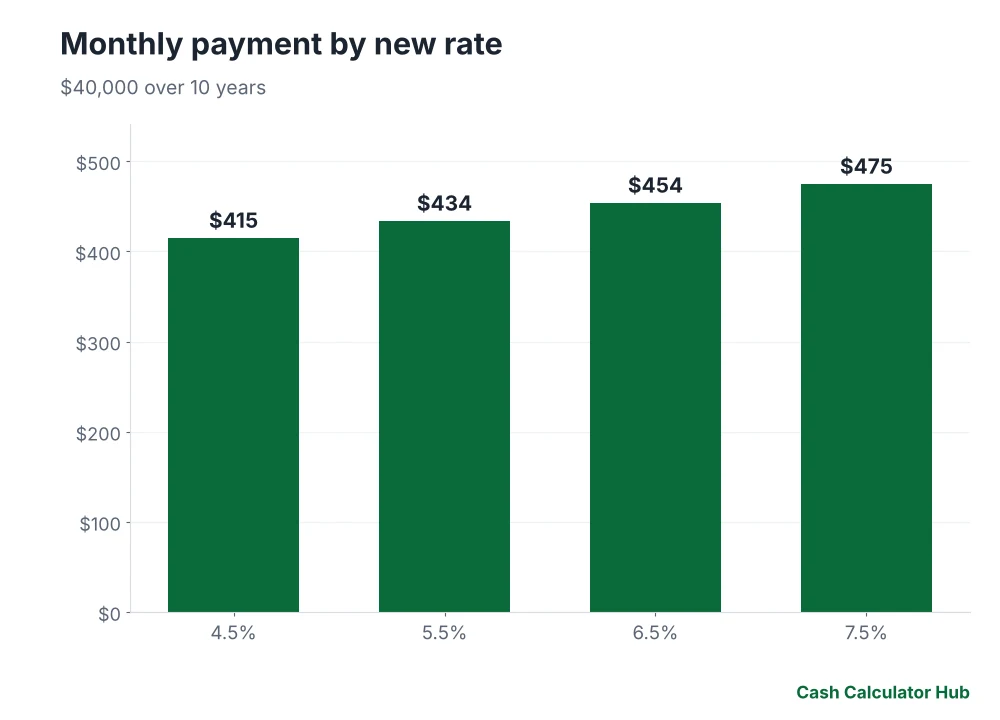
| New rate | Payment | Interest saved vs 7.5% |
|---|---|---|
| 4.5% | $415 | $7,230 |
| 5.5% | $434 | $4,884 |
| 6.5% | $454 | $2,474 |
| 7.0% | $464 | $1,245 |
What you give up on federal loans
- Income-driven repayment plans and payment caps tied to income.
- Federal deferment and forbearance options.
- Public Service Loan Forgiveness and other forgiveness programs.
- Discharge for death or disability on the federal terms (some private lenders offer similar).
If your job is stable and you have an emergency fund, the savings may be worth it. See student loan repayment plans for the federal options.
When it can make sense
- You have private loans at high rates.
- Your credit and income improved since you borrowed.
- You have no need for federal protections or forgiveness.
- You can choose a term you can afford.
Shopping tips
- Compare fixed and variable rates; fixed gives certainty.
- Get prequalified offers with soft credit checks.
- Check fees, cosigner release options and hardship policies.
- Refinance after paying down balances when your debt-to-income ratio improves; see DTI.
Pay off or refinance?
See pay off early or invest for how loan rates compare with investing returns, and consolidation for combining debts.
Tools
Use the student loan calculator, refinance calculator and loan calculator. More: loan calculators.
Frequently asked questions
Should I refinance my student loans?
If you have high-rate private loans and stable income, yes. For federal loans, weigh the savings against losing federal protections.
Does refinancing hurt my credit?
A hard inquiry can lower your score slightly, but on-time payments on a lower-rate loan help.
Can I refinance federal loans?
Yes, but only into a private loan, which permanently ends federal benefits.
How much can I save by refinancing?
It depends on the rate difference, balance and term; use a calculator with your numbers.
What credit score do I need to refinance?
Lenders vary; scores in the high 600s or above, with stable income, usually get the best offers.
Sources and further reading
- Federal Student Aid
- Consumer Financial Protection Bureau
- IRS Topic 456: Student loan interest deduction
How the numbers were made: Every figure on this page was calculated from the formulas and assumptions stated above and rounded to the nearest dollar. Rates, limits and rules are for 2026 unless noted; confirm current figures with the sources listed before acting.
Keep reading
- Student Loan Repayment in 2026: What Changed and How to Run Your Numbers
- Is Debt Consolidation Worth It? A $18,000 Credit Card Example
- Mortgage Refinance Break-Even Point: Is It Worth It?
- How Long to Pay Off $10,000 of Credit Card Debt? Timelines at $200 to $1,000 a Month
- Payday Loan APR: What a $15 per $100 Fee Really Costs
- Student Loans: Pay Off Early or Invest the Difference?
This guide is general information, not financial, tax or legal advice. Figures use stated assumptions and 2026 rules and will differ from your situation; check current rules and talk to a licensed professional before you decide. Full disclaimer.