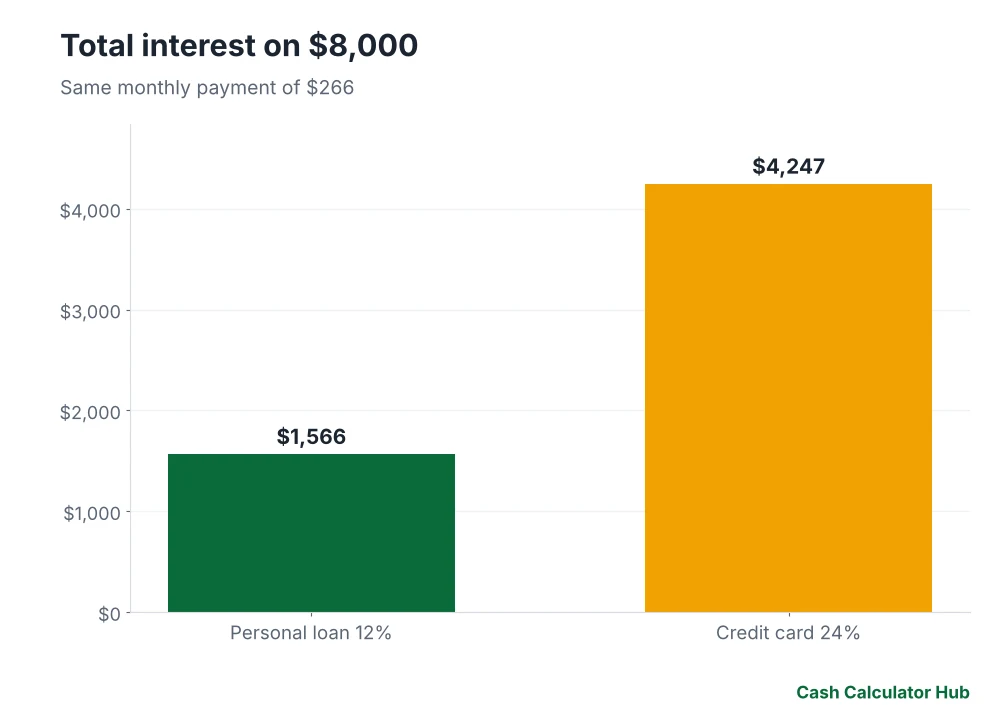
Quick answer: For a large one-time expense, a fixed-rate personal loan is usually cheaper than carrying a credit card balance. On $8,000, a 3-year loan at 12% has a $266 payment and $1,566 of total interest; paying the same $266 a month on a 24% credit card takes 3 yr 11 mo and costs $4,247 in interest. A 0% intro card can beat both if you can repay before the promotion ends.
Both products let you pay now and repay later. The difference is the rate, the structure and the discipline required. Loans have fixed payments and an end date. Cards have flexible, minimum-based payments that keep balances alive for years.
Key takeaways
- Personal loan (12%, 3 years): payment $266, interest $1,566.
- Credit card (24%) paying the same $266 a month: 3 yr 11 mo, interest $4,247.
- Cards with promotional 0% APR can be cheaper if repaid in time.
- Minimum-only payments on a card can multiply the cost many times over.
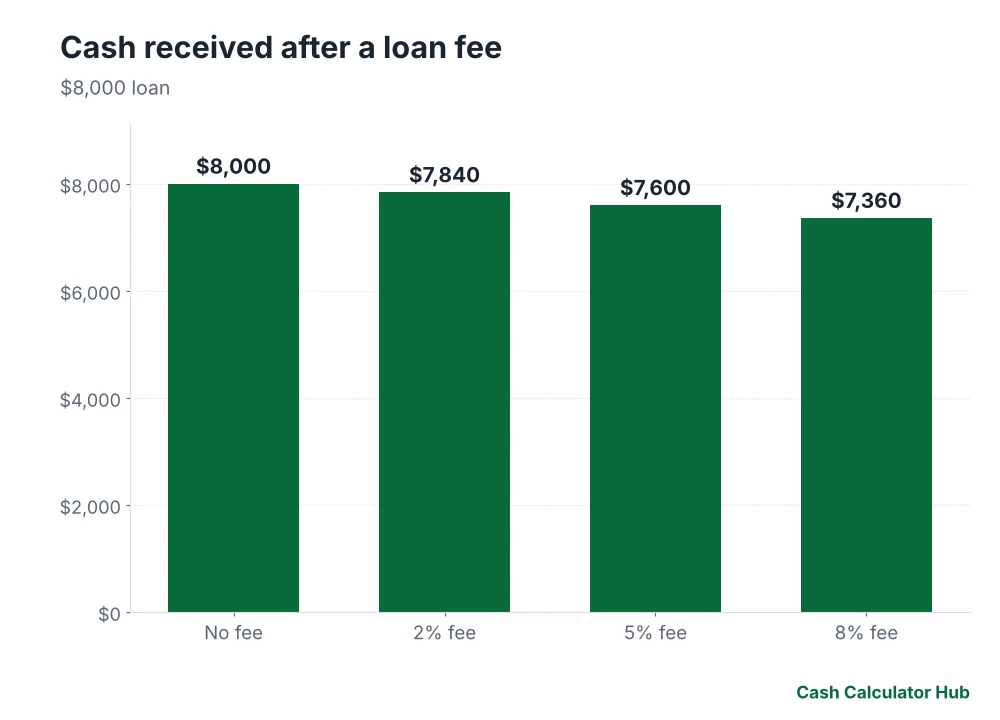
- Origination fees (1% to 8%) reduce loan proceeds; include them in the comparison.
Side-by-side on $8,000
| Personal loan | Credit card | |
|---|---|---|
| APR (assumed) | 12% | 24% |
| Term | 36 months, fixed | Open-ended |
| Monthly payment | $266 | $266 (self-imposed) |
| Time to payoff | 3 years | 3 yr 11 mo |
| Total interest | $1,566 | $4,247 |
If you only made the card’s minimum payment (often about 2% of the balance), repayment could take decades; see minimum payment payoff.
When each wins
Personal loan:
- Large expense paid over 2 to 5 years.
- Consolidating several cards; see consolidation.
- Need fixed payments and a clear end date.
Credit card:
- Small expenses paid off within the billing cycle.
- A 0% promotional period you can finish within; see balance transfers.
- Rewards worth more than the interest (only if paid in full).
Check fees
Loan origination fees reduce what you receive. If you borrow $8,000 with a 5% fee, you receive $7,600 unless you borrow more to compensate. Card balance transfer fees are typically 3% to 5%.
Credit impact
A loan adds an installment account and may lower utilization if used to pay cards. A card balance raises utilization, which can reduce your score. See credit score factors.
Alternatives
Home equity options (see HELOC vs home equity loan), 0% purchase offers, payment plans from providers and saving first via a sinking fund.
Tools
Use the personal loan calculator, credit card calculator and APR calculator. More: loan calculators.
Frequently asked questions
Is a personal loan cheaper than a credit card?
Often yes, because personal loan rates are usually lower than card APRs, and payments are fixed.
Can a credit card be cheaper than a loan?
Yes, a 0% introductory APR card can be cheaper if you pay the balance before the promotion ends.
What is an origination fee?
An upfront fee, commonly 1% to 8% of the loan, that is deducted from the proceeds.
Will a personal loan hurt my credit?
A hard inquiry can briefly lower your score, but on-time payments help over time.
Which is better for debt consolidation?
A fixed-rate personal loan or a 0% balance transfer card, depending on the amount, rates and fees.
Sources and further reading
How the numbers were made: Payments and interest were calculated with standard amortization formulas using the stated rates (12% loan, 24% card) and a fixed monthly payment equal to the loan payment. Actual rates depend on your credit and lender; confirm with the sources listed.
Keep reading
- Is Debt Consolidation Worth It? A $18,000 Credit Card Example
- How Long to Pay Off a Credit Card Making Only the Minimum?
- Debt Avalanche vs Snowball: A Four-Debt Example With Real Numbers
- APR vs APY: What’s the Difference and Why It Matters for Loans and Savings
- Credit Score Factors: What Moves Your Score and by How Much
- Balance Transfer Cards: Are They Worth the 3% to 5% Fee?
This guide is general information, not financial, tax or legal advice. Figures use stated assumptions and 2026 rules and will differ from your situation; check current rules and talk to a licensed professional before you decide. Full disclaimer.