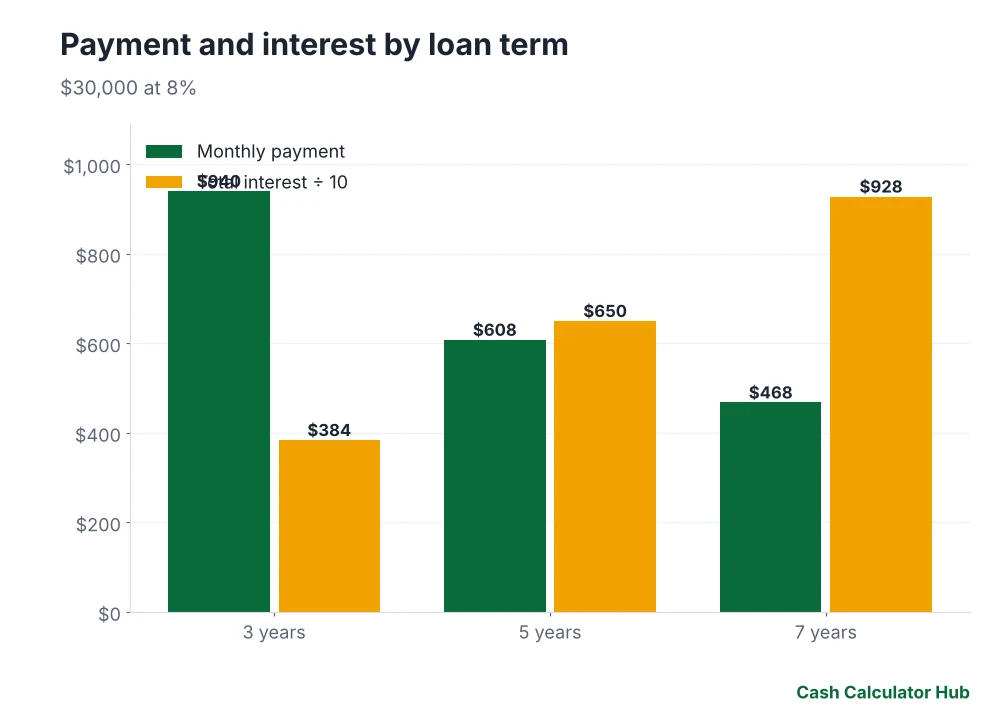
Quick answer: A longer loan term lowers the monthly payment but raises total interest. On $30,000 at 8%, a 3-year term costs $940 a month and $3,843 in interest; a 5-year term costs $608 and $6,498; a 7-year term costs $468 and $9,277. Choose the shortest term whose payment fits comfortably in your budget.
Lenders often present the monthly payment first because it is the number that feels affordable. The better comparison is payment and total cost together. The same principle applies to car loans, personal loans and mortgages.
Key takeaways
- Payment = P × r ÷ (1 − (1 + r)^−n); longer n lowers the payment.
- Interest paid rises sharply with term, since the balance stays higher for longer.
- 3 years: $3,843; 5 years: $6,498; 7 years: $9,277 of interest on $30,000 at 8%.
- Longer terms also raise the risk of owing more than an asset is worth.
- Make extra principal payments to shorten any loan.
$30,000 at 8%
| Term | Monthly payment | Total paid | Total interest |
|---|---|---|---|
| 3 years | $940 | $33,843 | $3,843 |
| 5 years | $608 | $36,498 | $6,498 |
| 7 years | $468 | $39,277 | $9,277 |
Why interest rises
Early payments are mostly interest. With a longer term, the balance declines more slowly, so each month’s interest is larger on average. A 7-year loan pays interest on a high balance for much longer.
Same idea, different loans
| Loan | Short term | Long term | |
|---|---|---|---|
| Car; see [[p:long-car-loans-and-negative-equity | long car loans]] | 48–60 months | 72–84 months |
| Mortgage; see [[p:15-year-vs-30-year-mortgage | 15 vs 30 years]] | 15 years | 30 years |
| Personal loan | 2–3 years | 5–7 years |
The extra-payment alternative
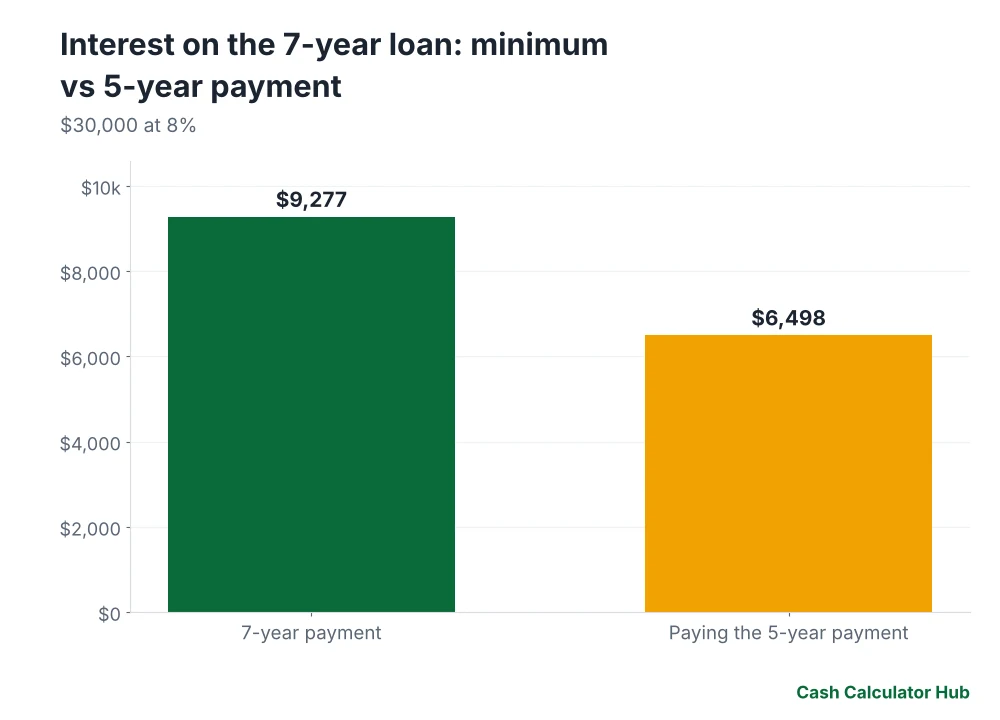
Take the longer term for flexibility, then pay extra when you can. On the 7-year loan, paying the 5-year payment ($608) would pay it off in about 5 yr and save interest, with the 7-year payment as a safety net.
How to choose
- Find the maximum payment that fits your budget; see budget rules.
- Choose the shortest term at or below it.
- Compare the total cost, not just the payment.
- Check for prepayment penalties.
- Avoid terms that outlast the asset’s useful life.
Tools
Use the loan calculator, amortization calculator and repayment calculator. See also extra payments. More: loan calculators.
Frequently asked questions
Does a longer loan term cost more?
Yes. A longer term lowers the monthly payment but increases total interest paid.
What is the best loan term?
The shortest term that you can afford comfortably.
How do I calculate a loan payment?
Use P × r ÷ (1 − (1 + r)^−n), where r is the monthly rate and n the number of payments.
Can I pay off a loan early?
Usually yes; check for prepayment penalties and make sure extra payments go to principal.
Why do lenders offer long terms?
Because the lower payment makes the loan look affordable, and longer terms earn them more interest.
Sources and further reading
How the numbers were made: Every figure on this page was calculated from the formulas and assumptions stated above and rounded to the nearest dollar. Rates, limits and rules are for 2026 unless noted; confirm current figures with the sources listed before acting.
Keep reading
- 72- and 84-Month Car Loans: Lower Payments, Higher Risk
- 15-Year vs 30-Year Mortgage: Which Costs Less Overall?
- Pay Off Your Mortgage Early: What Extra Payments Really Save
- How Long to Pay Off $10,000 of Credit Card Debt? Timelines at $200 to $1,000 a Month
- Payday Loan APR: What a $15 per $100 Fee Really Costs
- Student Loan Refinancing: Savings, What You Give Up and When It Makes Sense
This guide is general information, not financial, tax or legal advice. Figures use stated assumptions and 2026 rules and will differ from your situation; check current rules and talk to a licensed professional before you decide. Full disclaimer.