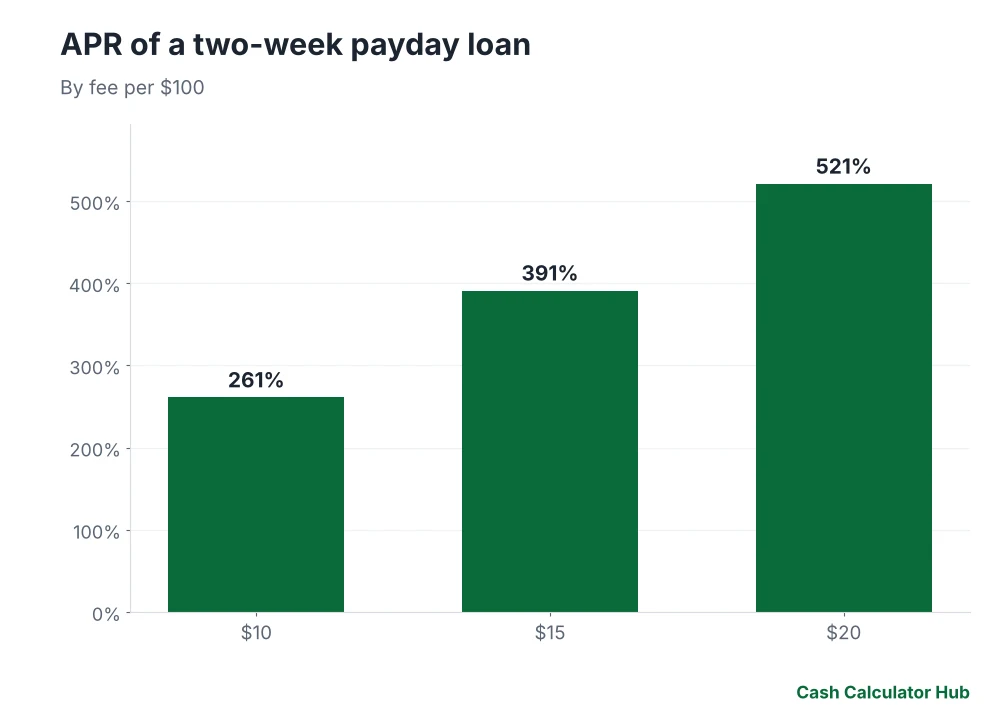
Quick answer: A payday loan with a $15 fee per $100 for two weeks has an APR of about 391% (15% ÷ 14 days × 365). Borrowing $500 costs $75 per two weeks, and if the loan is renewed six times the fees reach $450 without reducing the principal. Credit union alternatives, payment plans and small-dollar loans cost far less.
Payday loans are marketed as a small fee for quick cash. Converting the fee to an annual rate shows why consumer agencies warn about them. They are legal in many states and banned or capped in others, and the effective cost depends on how long you stay in them.
Key takeaways
- APR = fee ÷ amount × 365 ÷ days: 15% × 365 ÷ 14 = 391%.
- Borrowers often renew the loan, paying the fee again without repaying principal.
- Alternatives: credit union payday-alternative loans (capped at 28% APR), payment plans, employer advances and community assistance.
- Check your state’s rules; many cap fees or ban payday lending.
- Never give a lender access you cannot afford to lose, such as repeated bank withdrawals, without a plan.
The conversion
| Fee per $100 | Term | APR |
|---|---|---|
| $10 | 14 days | 261% |
| $15 | 14 days | 391% |
| $20 | 14 days | 521% |
| $15 | 30 days | 182% |
What rollovers cost
A $500 loan with a 15% fee costs $75 every two weeks.
| Renewals | Total fees | Equivalent to |
|---|---|---|
| 1 | $75 | 15% of the loan |
| 3 | $225 | 45% of the loan |
| 6 | $450 | 90% of the loan |
| 10 | $750 | 150% of the loan |
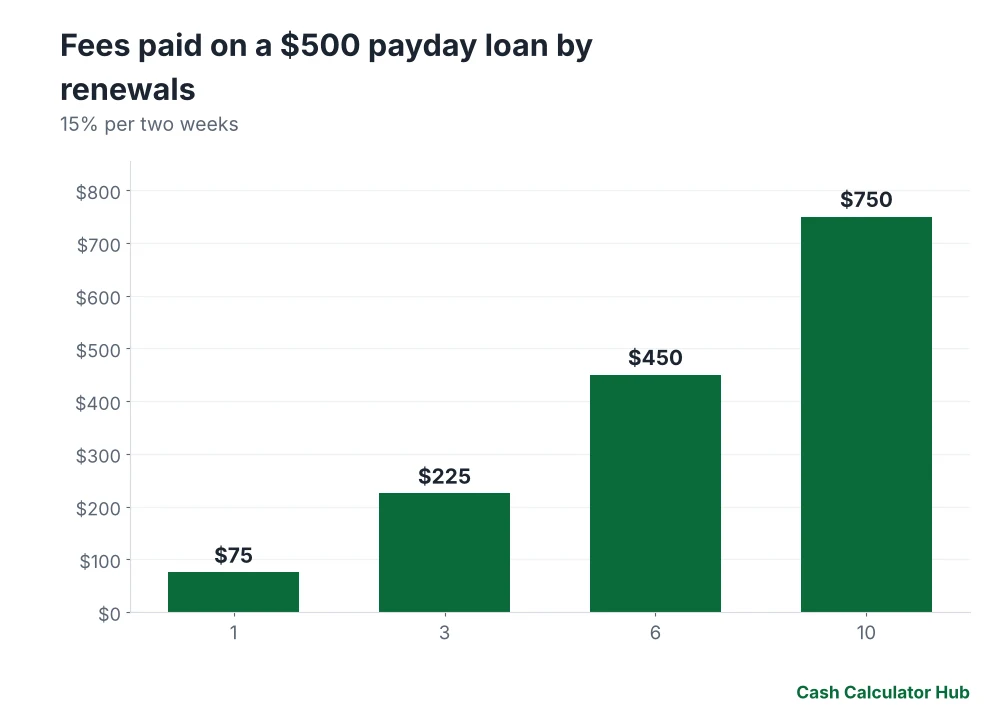
After six renewals you have paid $450 and still owe the $500.
Compare with other options
| Option | Typical cost on $500 for 2 weeks |
|---|---|
| Payday loan (15%) | $75 |
| Credit card cash advance at 29% APR (approx.) | $6 plus a fee |
| Credit union payday-alternative loan (28% APR cap) | $5 plus a small application fee |
| Payment plan with biller | often $0 |
Better paths
- Negotiate with the biller for an extension or payment plan.
- Credit union small loans (payday alternative loans).
- Paycheck advance from an employer, if offered.
- Community assistance for rent and utilities.
- Build a buffer with a starter emergency fund.
- Use a card or small personal loan only if the rate is far lower; see personal loan vs card.
Protect yourself
Read the finance charge, due date and rollover terms. Know your state’s limits and contact your state regulator or the CFPB if you have a dispute. If you are in a cycle of rollovers, a nonprofit credit counselor can help.
Tools
Use the APR calculator, loan calculator and simple interest calculator. See also APR vs APY. More: loan calculators.
Frequently asked questions
What is the APR on a payday loan?
A typical $15 per $100 fee on a two-week loan equals an APR of about 391%.
Why are payday loans so expensive?
Short terms and flat fees translate into very high annualized rates, and renewals multiply the cost.
What are payday alternative loans?
Small loans from credit unions with APRs capped at 28% and longer terms.
Are payday loans legal?
In many states, subject to limits; some states ban or cap them.
What should I do instead of a payday loan?
Ask for a payment plan, use a credit union loan, request an employer advance or seek community assistance.
Sources and further reading
How the numbers were made: Every figure on this page was calculated from the formulas and assumptions stated above and rounded to the nearest dollar. Rates, limits and rules are for 2026 unless noted; confirm current figures with the sources listed before acting.
Keep reading
- How Long to Pay Off a Credit Card Making Only the Minimum?
- Is Debt Consolidation Worth It? A $18,000 Credit Card Example
- Debt Avalanche vs Snowball: A Four-Debt Example With Real Numbers
- How Long to Pay Off $10,000 of Credit Card Debt? Timelines at $200 to $1,000 a Month
- Student Loan Refinancing: Savings, What You Give Up and When It Makes Sense
- Student Loans: Pay Off Early or Invest the Difference?
This guide is general information, not financial, tax or legal advice. Figures use stated assumptions and 2026 rules and will differ from your situation; check current rules and talk to a licensed professional before you decide. Full disclaimer.