Quick answer: Cap rate is net operating income divided by the property’s price, independent of financing: $17,176 ÷ $300,000 = 5.7% here. Cash-on-cash return is annual pre-tax cash flow after mortgage payments divided by the cash you invested; with 25% down at 7.25%, it is -1.5%. When the mortgage rate exceeds the cap rate, borrowing reduces returns.
Rental property returns are easy to overstate. Two metrics do most of the work: cap rate, which measures the property, and cash-on-cash return, which measures your investment including the loan.
The example: a $300,000 rental that rents for $2,400 a month, with a 5% vacancy allowance, property tax of $3,600, insurance of $1,400, maintenance at 10% of rent and property management at 8% of rent.
Key takeaways
- Net operating income (NOI): $17,176 a year after operating costs, before the mortgage.
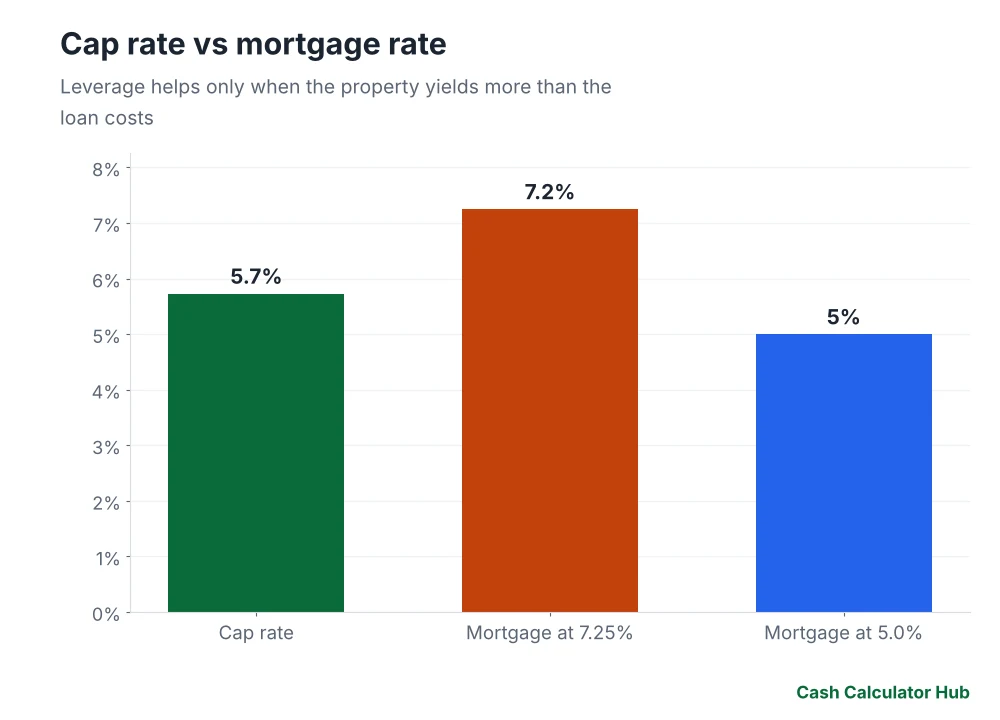
- Cap rate: 5.73% ($17,176 ÷ $300,000).
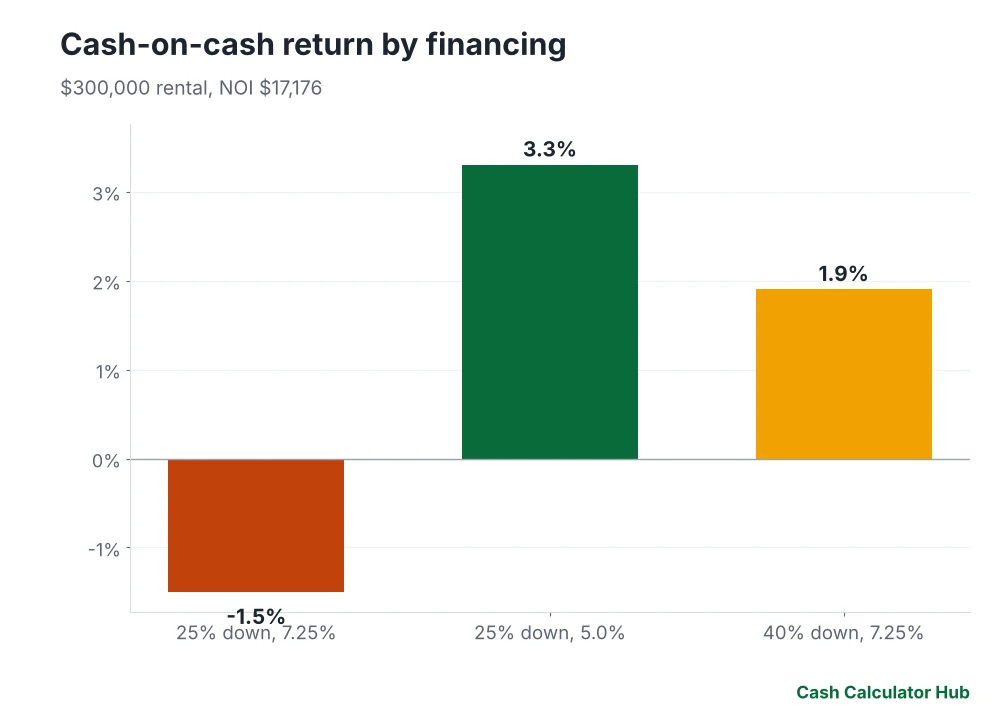
- With 25% down at 7.25%, mortgage payments are $18,419 a year, so cash flow is $-1,243 and cash-on-cash return is -1.5%.
- At a 5% mortgage rate the same deal returns 3.3%; with 40% down at 7.25%, 1.9%.
- When the cap rate is below the mortgage rate, leverage hurts cash flow (negative leverage).
Step 1: net operating income
| Item | Yearly |
|---|---|
| Gross rent ($2,400 × 12) | $28,800 |
| Vacancy allowance (5%) | −$1,440 |
| Property tax | −$3,600 |
| Insurance | −$1,400 |
| Maintenance (10% of rent) | −$2,880 |
| Property management (8% of rent) | −$2,304 |
| Net operating income (NOI) | $17,176 |
NOI excludes mortgage payments, depreciation and income taxes.
Step 2: cap rate
Cap rate = NOI ÷ purchase price = $17,176 ÷ $300,000 = 5.73%.
Cap rate tells you the property’s yield if you paid all cash. Compare it across properties and markets. A higher cap rate means more income per dollar of price, usually with more risk or a weaker area.
Step 3: cash-on-cash return
Cash-on-cash = annual cash flow after debt service ÷ cash invested. Cash invested is the down payment plus closing costs (2% here).
| Scenario | Mortgage payment per year | Cash flow | Cash invested | Cash-on-cash |
|---|---|---|---|---|
| 25% down, 7.25% | $18,419 | $-1,243 | $81,000 | -1.5% |
| 25% down, 5.0% | $14,494 | $2,682 | $81,000 | 3.3% |
| 40% down, 7.25% | $14,735 | $2,441 | $126,000 | 1.9% |
Why high rates flip the math
The property yields 5.7% unleveraged. A mortgage at 7.25% costs more than that. Each borrowed dollar earns less than it costs, which reduces your return; this is negative leverage. At 5%, the loan costs less than the property earns, so leverage helps. That is why the same building can be a good investment in one rate environment and a poor one in another.
Other numbers that matter
- Gross rent multiplier: price ÷ annual rent (10.4 here); a rough screen.
- The 1% rule: monthly rent ≥ 1% of price. Here the rent is 0.8%, which is below the rule at current rates.
- Appreciation and principal paydown add to total return but not to cash flow.
- Tax benefits such as depreciation (27.5 years for residential property) and deductible expenses; see depreciation methods.
- Capital expenditures such as a new roof or HVAC are not in NOI but are real costs.
Reality checks
- Stress the rent. Cut it 10% and see whether cash flow stays positive.
- Use real expenses. Get actual tax bills and insurance quotes.
- Budget repairs at 10% to 15% of rent plus reserves.
- Check loan terms. Investment property loans have higher rates and larger down payments than owner-occupied loans.
- Compare with alternatives. A 6% cash-on-cash return in a property requires time, risk and illiquidity; an index fund does not. See average stock market returns.
Run it
The rental property calculator computes NOI, cap rate and cash-on-cash. Use the real estate calculator, mortgage calculator and ROI calculator to extend the analysis. More: investment tools.
Frequently asked questions
What is a good cap rate?
It depends on the market and risk. Many investors look for 5% to 8% or more, with lower cap rates in high-demand areas and higher cap rates in riskier ones.
What is a good cash-on-cash return?
Investors often target 8% to 12%, but the right number depends on risk and alternatives. At high mortgage rates, many properties show lower returns.
Is cap rate affected by the mortgage?
No. Cap rate uses net operating income and price only, so it is independent of financing.
What is negative leverage?
It occurs when the cost of the loan is higher than the property’s cap rate, so borrowing lowers your return.
Does NOI include the mortgage payment?
No. NOI is income minus operating expenses, excluding debt service, depreciation and income taxes.
Sources and further reading
How the numbers were made: Every figure on this page was calculated from the formulas and assumptions stated above and rounded to the nearest dollar. Rates, limits and rules are for 2026 unless noted; confirm current figures with the sources listed before acting.
Keep reading
- Rent vs Buy: How Long Until Buying a Home Wins?
- ROI vs IRR vs CAGR: Which Return Number Should You Trust?
- Mortgage Payment on a $400,000 House: Real Numbers
- Dividend Yield vs Total Return: What Should Investors Focus On?
- Portfolio Rebalancing: How and When to Do It
- What Is the Average Stock Market Return? S&P 500 History in Plain Numbers
This guide is general information, not financial, tax or legal advice. Figures use stated assumptions and 2026 rules and will differ from your situation; check current rules and talk to a licensed professional before you decide. Full disclaimer.