
Quick answer: ROI ignores time, CAGR smooths it and IRR handles uneven cash flows. Worked examples show when each one misleads you and how to compare investments fairly.
People throw these three terms around as if they were interchangeable. They are not, and picking the wrong one can make a bad deal look good or a good deal look bad. Here is when each applies.
ROI: the total, ignoring time
ROI = (final value + income − cost) ÷ cost
It answers one question: for each dollar you put in, how many dollars did you get back as profit? It is simple and widely used (for marketing, equipment, real estate flips). The weakness is that it ignores how long it took.
CAGR: the smoothed yearly rate
CAGR = (end value ÷ start value)^(1 ÷ years) − 1
CAGR is the constant annual growth rate that would produce the same end result. It makes investments of different lengths comparable, as long as you invest once and take out once, with no flows in between.
IRR: the rate for uneven cash flows
IRR is the discount rate at which the net present value of all cash flows equals zero.
If you put money in and take it out at several different dates, IRR gives you one annualized return that accounts for the timing of every flow. It is what you use for rental properties, business projects and anything with more than two cash flows. Calculators use iteration; there is no neat formula.
Three deals with the same $10,000
| Deal | Result | ROI | Years | CAGR |
|---|---|---|---|---|
| A: Stock fund | $15,000 | 50% | 5 | 8.4% |
| B: Flip | $13,000 | 30% | 2 | 14.0% |
| C: Startup | $25,000 | 150% | 12 | 7.9% |
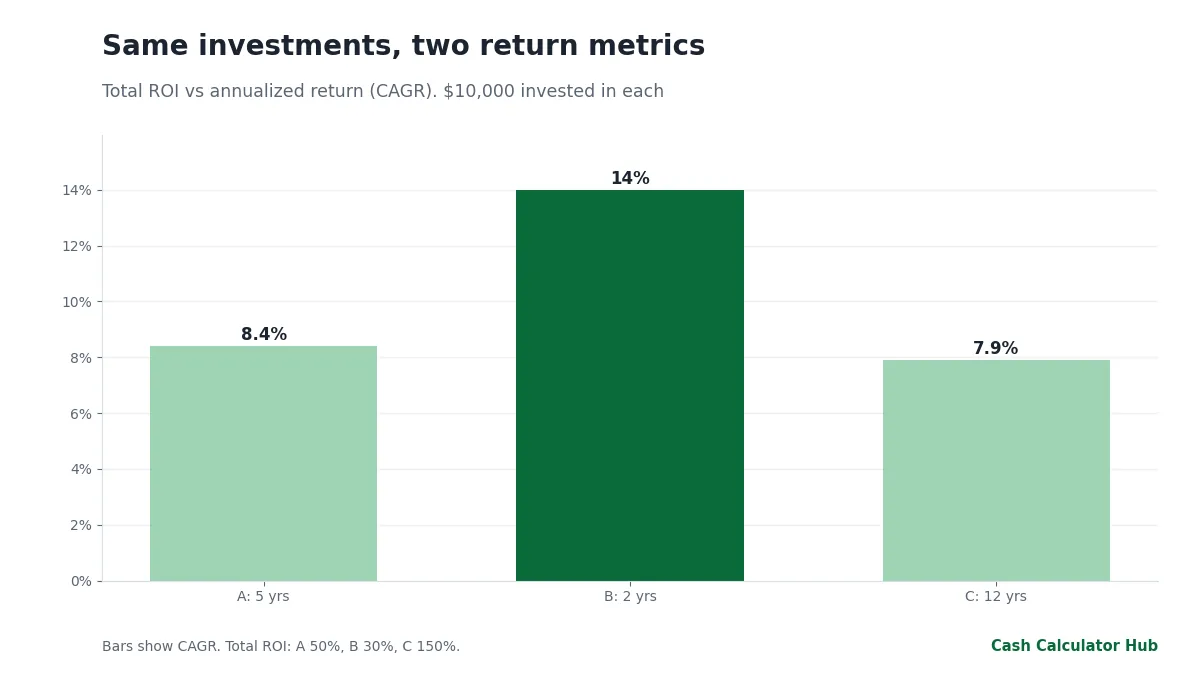
Deal C wins on ROI at 150%, but over twelve years it earns just 7.9% a year, which is lower than the long-run return of a broad stock index fund. Deal B, the headline loser at 30%, is earning 14.0% a year because it did it in two years. Whether B is better depends on whether you can find another deal to reinvest in, but the metrics tell different stories for a reason.
An IRR example
You invest $50,000 in a rental. Net rent after expenses is $4,000, $4,200, $4,400, $4,600 and $4,800 over five years, and you sell at the end of year 5 for $70,000.
- Total cash in: $92,000
- Net profit: $42,000
- ROI: 84%
- IRR: 14.7% a year
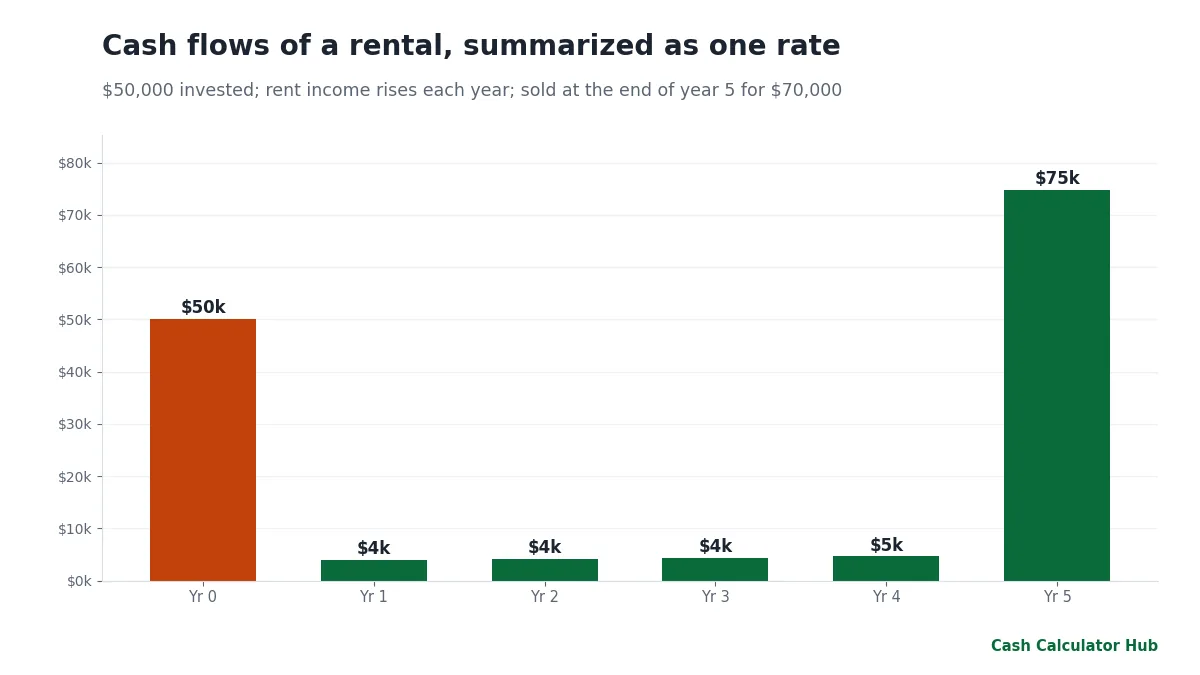
IRR is the right tool here because the money comes back in six different pieces at six different times. A single ROI number would not tell you if the returns arrive early or late.
Which one to use
| Situation | Best metric |
|---|---|
| One in, one out, any holding period | CAGR |
| Quick profit check on one purchase | ROI |
| Multiple deposits, withdrawals or income | IRR (or XIRR with dates) |
| Comparing deals of different lengths | CAGR or IRR |
| Checking if a project is worth it | NPV and discounted payback |
Common traps
- Comparing ROI across different time frames. Always annualize.
- Forgetting costs. Closing costs, fees and taxes shrink the real return.
- Trusting IRR when cash flows change sign several times. Multiple solutions are possible; check with NPV.
- Assuming IRR reinvests at the same rate. It implicitly does. If you cannot reinvest at that rate, the real return is lower.
- Ignoring risk. A 12% return from a CD-like asset and a 12% return from a startup are not the same thing.
Calculators for each
Start with the ROI and profit margin calculator for the quick check, then the average return calculator for CAGR from start and end values. For uneven flows use the IRR calculator (it also gives NPV and handles dates), and the payback period calculator to see how long it takes to recover your money. For rentals specifically, our rental property calculator reports cap rate, cash-on-cash and IRR together. See also how compound growth builds and why fees change returns. Browse all investment calculators.
Sanity checks before you trust any return number
- Include all the costs. Purchase fees, taxes, maintenance and your time. A flip with a 30% ROI before costs can be a 10% ROI after.
- Match the time horizon. Compare 12-month returns with 12-month returns.
- Compare with the alternative. A 9% return sounds good until you realize an index fund historically returned something similar with far less work.
- Check the risk. A return of 15% from a concentrated bet is not equivalent to 15% from a diversified portfolio.
- Ask what is reinvested. IRR assumes interim cash flows are reinvested at the IRR, which may not be possible.
NPV: the companion metric
Net present value discounts each cash flow at the rate you require and adds them. If NPV is positive, the investment earns more than your required rate. Two projects with the same IRR can have very different NPVs if one is larger. Use IRR to rank rates and NPV to measure the dollars created. The present value calculator and the IRR calculator both show it.
What is a good IRR?
It depends on risk. Stocks have historically returned about 7% to 10% a year before inflation; riskier projects should target more.
Is IRR better than ROI?
For multiple cash flows over time, yes. For a quick profit check, ROI is fine.
Why does my IRR differ from my average return?
IRR weights your actual deposit and withdrawal timing. A simple average ignores it.
Can CAGR be negative?
Yes. If the end value is below the start value, CAGR is negative.
Sources and further reading
How the numbers were made: Every figure on this page was calculated from the formulas and assumptions stated above and rounded. Rates, limits and rules are for 2026 unless noted; confirm current figures with the sources listed before acting.
Keep reading
- Compound Interest on $10,000: What It Becomes in 10, 20 and 30 Years
- How Expense Ratios Quietly Cost You Six Figures
- Savings Account vs CD: Which Earns More for Your Cash?
- Margin vs Markup: The Difference, the Formulas and a Conversion Table
- Percentage Increase and Decrease: Formulas, Examples and the 20% Trap
- Capital Gains Tax Rates 2026: 0%, 15% and 20% Brackets Explained
This guide is general information, not financial, tax or legal advice. Figures use stated assumptions and 2026 rules and will differ from your situation; check current rules and talk to a licensed professional before you decide. Full disclaimer.