Quick answer: Buying beats renting only if you stay long enough. In a $400,000 example at 7% the break-even is about year 13.
“Renting is throwing money away” is the oldest line in housing. It is also wrong in an interesting way: a large share of what you pay as an owner is also gone, just under different names. Interest, property tax, insurance, repairs and the 6% you lose selling are all costs you never see again. The real question is whether the equity you build and the appreciation you capture outrun those costs and the return you could have earned renting and investing instead.
The answer usually comes out as a number of years. Here is how it works.
The comparison, built honestly
The calculator model behind this post has two people with the same monthly budget. The buyer purchases a $400,000 home with 10% down and a 7% 30-year mortgage. The renter rents an equivalent home for $2,400 a month, invests the down payment and closing costs, and invests every month the amount by which the owner’s costs exceed the rent. Assumptions:
- Home appreciation 3% a year, rent growth 3% a year, investment return 6% a year
- Property tax 1.1%, insurance $2,100 a year, maintenance 1% of the price a year, PMI until 20% equity
- Closing costs 3% to buy and 6% to sell
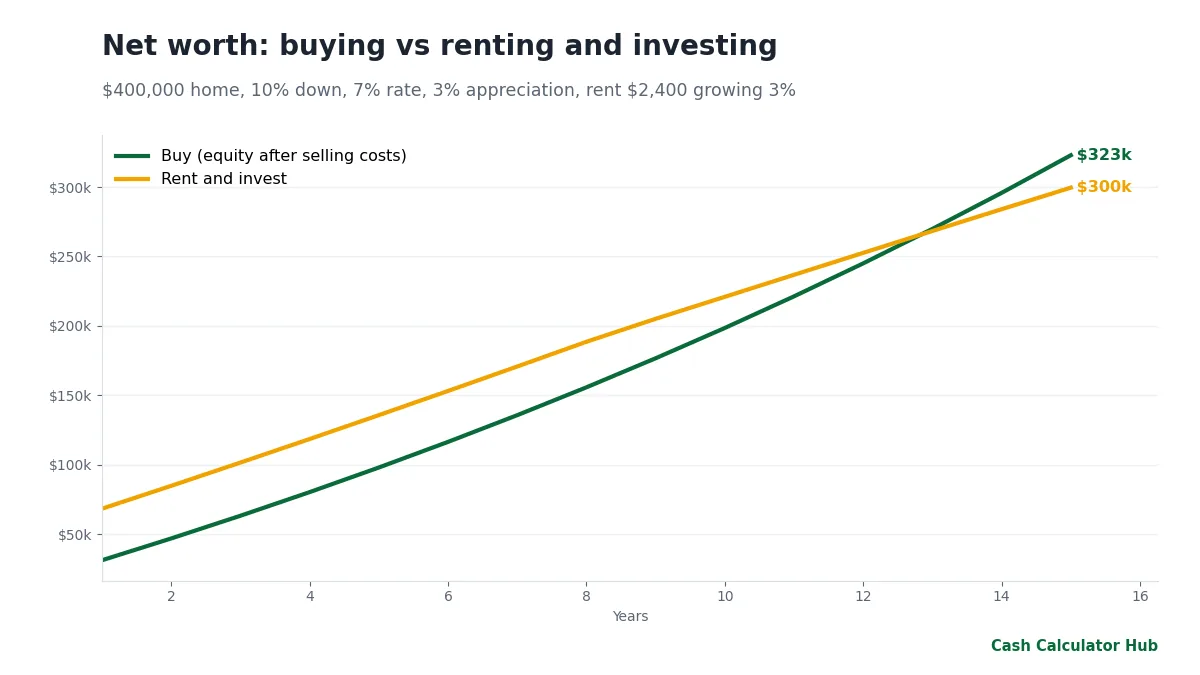
In this example, the buyer’s net worth overtakes the renter’s in year 13. After 10 years the buyer is still about $22,448 behind, which surprises many people. Before the crossover, the renter is ahead because the buyer paid closing costs and almost all of the early payments went to interest.
The three things that move the break-even most
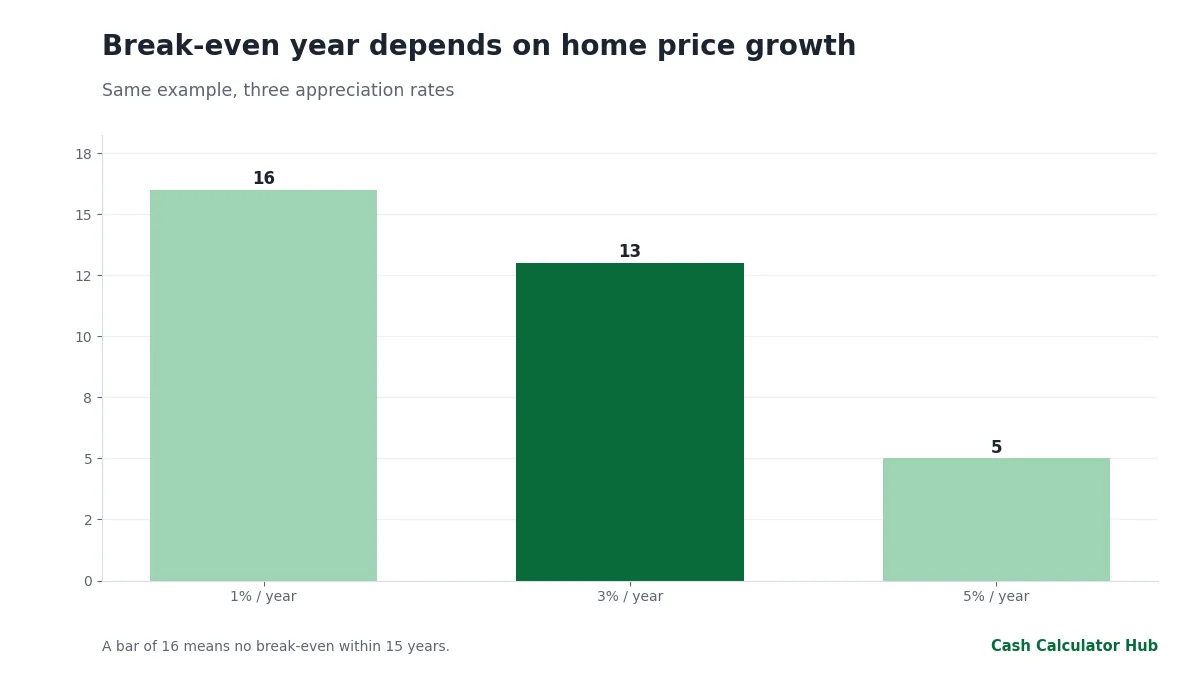
1. How fast prices grow. Home appreciation is the biggest swing factor and the least predictable:
| Appreciation | Break-even year | Buyer minus renter at year 10 |
|---|---|---|
| 1% | over 15 | -$108,075 |
| 3% | 13 | -$22,448 |
| 5% | 5 | $82,416 |
2. The mortgage rate. At 7% the first-year interest on this loan is about $25,200. That is a heavy drag compared with the 3% to 4% loans that made buying such an obvious win a few years ago. If rates fall and you refinance, the break-even moves earlier. If you can buy with a lower rate through a buydown or a seller credit, it moves earlier too.
3. The rent-to-price ratio. If you can rent a comparable home for 0.4% of its price per month, renting is a bargain. At 0.8% or more, buying gets much more attractive. Here, $2,400 on a $400,000 home is 0.6%, a middle-of-the-road ratio, and at a 7% mortgage rate it still produces a long break-even. In markets where rent runs 0.8% of the price or more, buying pays off much sooner.
What the model leaves out (and cuts both ways)
- Tax benefits. Mortgage interest and property tax only reduce your tax bill if you itemize. Many owners take the standard deduction ($16,100 single, $32,200 married filing jointly for 2026), so the benefit is smaller than most people assume.
- Stability and control. You cannot be non-renewed, and you can renovate. These are real, non-financial benefits.
- Flexibility. Renting makes it easy to move for a job. Selling costs about 6%, so a two-year stay is almost always a loss.
- Discipline. Many renters never invest the difference. If you would spend the savings, owning forces saving by default.
A decision checklist
- Will you stay at least as long as the break-even year? If not, rent.
- Can you pay 10% or more down and still hold a six-month emergency fund?
- Is your total payment under about 28% of gross income? Check it with the affordability guide for a $100K salary.
- Is the rent-to-price ratio above roughly 0.5% a month?
- Have you accounted for maintenance, about 1% of the home’s value each year?
Try your own version
Put your actual price, rent and rate into the rent vs buy calculator and watch the break-even year move. For the cost side, the mortgage calculator gives the full monthly payment, and the real estate calculator shows your net gain or loss on a later sale. If you are comparing this with building wealth another way, try the time it takes to save $1 million. More tools are in the mortgage and real estate category.
Reading the break-even number honestly
A break-even year is not a prediction. It is a measure of how much your assumptions matter. If your answer is “year 6 when appreciation is 4% and year 15 when it is 2%,” your decision depends on a number nobody knows. In that case, favor flexibility: choose the option that is cheaper to leave. Renting is cheaper to leave in the first few years. Owning gets cheaper to leave only when equity is large.
When it is not purely financial
Buying gives control over your space, fixed principal-and-interest costs and potential stability for children and schools. Renting gives mobility and freedom from maintenance. Put a price on those, and include them. Many people buy with a longer horizon than the math suggests and are happy; many others buy too soon and feel trapped. Writing down how long you honestly expect to stay is the most useful step.
Is it better to rent or buy in 2026?
It depends on the local rent-to-price ratio, your time horizon and your rate. With mortgage rates around 7%, buying needs a longer holding period than it did when rates were near 3%.
How long should I stay in a home to make buying worthwhile?
A common rule is five years. In this example it is year 13. Run your own numbers rather than trusting a rule.
Does a bigger down payment change the answer?
It reduces interest and PMI, which shortens the break-even a little, but it also removes money you could have invested as a renter.
What if I plan to rent the home out later?
Then you are also an investor. Check the numbers with the rental property calculator.
Sources and further reading
How the numbers were made: Every figure on this page was calculated from the formulas and assumptions stated above and rounded. Rates, limits and rules are for 2026 unless noted; confirm current figures with the sources listed before acting.
Keep reading
- How Much House Can I Afford on a $100K Salary?
- How Long Does It Take to Save $1 Million?
- Mortgage Payment on a $400,000 House: Real Numbers
- How Much Salary Do You Need to Move to a New City?
- How Much Rent Can You Afford? The 30% Rule, the 40× Rule and a Better Test
- Mortgage Recast vs Refinance: Which Lowers Your Payment Better?
This guide is general information, not financial, tax or legal advice. Figures use stated assumptions and 2026 rules and will differ from your situation; check current rules and talk to a licensed professional before you decide. Full disclaimer.