
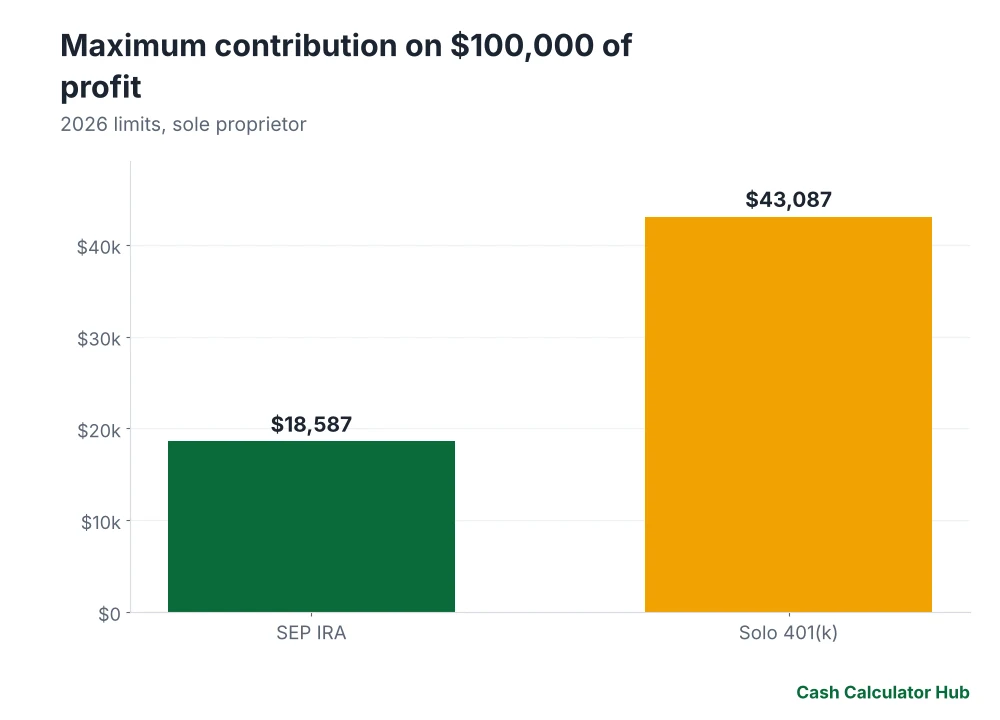
Quick answer: A Solo 401(k) usually allows a much larger contribution than a SEP IRA at lower income, because it combines an employee deferral (up to $24,500 in 2026) with an employer contribution of about 20% of net earnings. On $100,000 of self-employment profit, that is about $43,087 for a Solo 401(k) versus $18,587 for a SEP IRA. The total limit for both is $72,000.
Self-employed people can save far more for retirement than employees can, because they act as both employee and employer. The two main choices are the SEP IRA, which is simpler, and the Solo 401(k), which allows more at modest income and offers Roth options.
Key takeaways
- Net earnings for contribution purposes: $100,000 − half of self-employment tax ($7,065) = $92,935.
- Employer contribution (both plans): about 20% of that, $18,587.
- Solo 401(k) adds the employee deferral of up to $24,500 → about $43,087.
- Total limit across both parts is $72,000 in 2026, plus catch-up if age 50 or older.
- SEP IRAs have no employee deferral and no loan option; Solo 401(k)s may allow Roth contributions and loans.
How the numbers work
For a sole proprietor, contributions are based on net earnings from self-employment after subtracting half of self-employment tax and the contribution itself, which is why the effective employer rate is 20% rather than 25%.
| Step | Amount |
|---|---|
| Net profit | $100,000 |
| Self-employment tax (92.35% × 15.3%) | $14,130 |
| Half of SE tax (deduction) | $7,065 |
| Net earnings for plan purposes | $92,935 |
| Employer contribution (20%) | $18,587 |
| Employee deferral (Solo 401(k) only) | $24,500 |
| Solo 401(k) total | $43,087 |
| SEP IRA total | $18,587 |
Compare by income
| Net profit | SEP IRA (about) | Solo 401(k) (about) |
|---|---|---|
| $40,000 | $7,435 | $31,935 |
| $60,000 | $11,152 | $35,652 |
| $100,000 | $18,587 | $43,087 |
| $150,000 | $27,881 | $52,381 |
| $250,000 | $46,468 | $70,968 |
At incomes above roughly $300,000 both plans reach the same cap. At lower incomes the Solo 401(k) allows much more.

Feature comparison
| Feature | Solo 401(k) | SEP IRA |
|---|---|---|
| Employee deferral | Yes, up to $24,500 | No |
| Employer contribution | About 20% of net earnings | Up to about 20% |
| Roth option | Often yes | Roth SEP now allowed, if the provider offers it |
| Loans | Possible | No |
| Catch-up at 50+ | Yes ($8,000; $11,250 at 60 to 63) | No |
| Paperwork | Form 5500-EZ if assets exceed $250,000 | Minimal |
| Setup deadline | Generally by December 31 for deferrals | Up to the tax filing deadline, including extensions |
| Employees | Only you (and a spouse) | Can cover employees, with equal percentages |
How to choose
- Solo 401(k): You are the only employee, want a higher contribution at moderate income or want Roth savings.
- SEP IRA: You want simplicity, you have a high income, or you need to open and fund after year-end.
- Employees: If you hire staff, a SEP requires contributions for eligible employees; a solo plan generally no longer applies.
Other options
A SIMPLE IRA allows $17,000 plus catch-up, and a defined-benefit plan can allow larger deductions for older high earners. For a W-2 job plus side business, the $24,500 employee deferral limit is shared across plans. See 2026 contribution limits.
Taxes
Contributions reduce income tax, but not self-employment tax. Track self-employment taxes with SE tax explained.
Tools
Compare account growth with the 401(k) calculator, and estimate tax with the income tax calculator. For the account ordering, see which account first. More: retirement tools.
Frequently asked questions
What is the difference between a Solo 401(k) and a SEP IRA?
A Solo 401(k) allows both an employee deferral and an employer contribution, so you can save more at lower income. A SEP IRA only has the employer contribution but is simpler.
How much can I put in a SEP IRA?
Up to about 20% of net self-employment earnings for a sole proprietor (25% of compensation for a corporation), capped at $72,000 in 2026.
How much can I put in a Solo 401(k)?
An employee deferral up to $24,500 plus an employer contribution of about 20% of net earnings, with a total cap of $72,000, plus catch-up if 50 or older.
Can I have both a SEP IRA and a Solo 401(k)?
Generally not for the same business; the combined limit applies and the plans would need to be coordinated.
Which is better for a side business?
If you have a workplace 401(k), the employee deferral limit is shared, so a SEP IRA or the employer-side of a Solo 401(k) may be the way to add savings.
Sources and further reading
How the numbers were made: Every figure on this page was calculated from the formulas and assumptions stated above and rounded to the nearest dollar. Rates, limits and rules are for 2026 unless noted; confirm current figures with the sources listed before acting.
Keep reading
- 2026 401(k) and IRA Contribution Limits, Explained
- Where to Invest First: 401(k), HSA, Roth IRA or a Taxable Account?
- Roth vs Traditional 401(k) and IRA: How to Decide
- 401(k) Rollover Options When You Leave a Job: What to Do With Your Old Plan
- Sequence of Returns Risk: Why Bad Years Early in Retirement Matter Most
- Medicare Costs in Retirement: Premiums, Deductibles and IRMAA Surcharges
This guide is general information, not financial, tax or legal advice. Figures use stated assumptions and 2026 rules and will differ from your situation; check current rules and talk to a licensed professional before you decide. Full disclaimer.