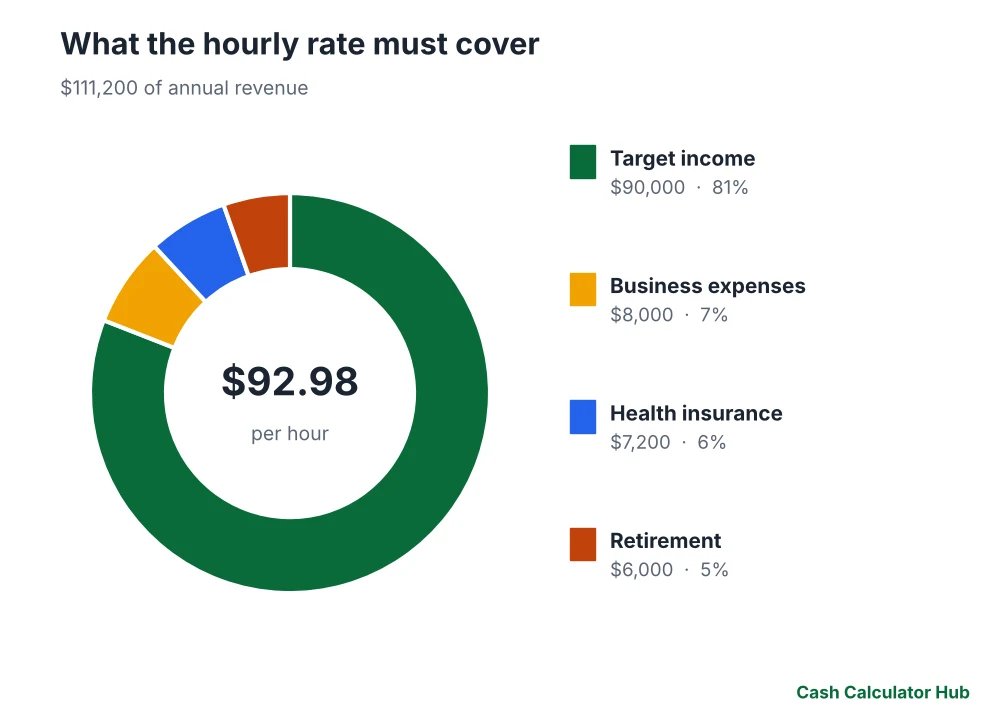
Quick answer: Freelance rate = (target income + business costs + benefits you pay yourself) ÷ billable hours. To net $90,000 before income tax with $21,200 of expenses, insurance and retirement contributions, and 1,196 billable hours (46 working weeks × 40 hours × 65% billable), you need about $92.98 an hour.
Freelancers often copy a salary-based hourly figure and end up underpaid, because they forget unpaid time, overhead, benefits and taxes. A bottom-up formula fixes that.
Key takeaways
- Only a share of working hours is billable: admin, marketing and gaps are unpaid.
- Add business expenses, insurance and retirement savings to your income goal.
- Divide by realistic billable hours, not 2,080.
- Taxes are paid from the rate; see self-employment tax.
- Round up and revisit yearly; use project pricing when you can.
Step 1: Your income and cost targets
| Item | Annual |
|---|---|
| Target income before income tax | $90,000 |
| Business expenses (software, equipment, insurance) | $8,000 |
| Health insurance | $7,200 |
| Retirement contribution | $6,000 |
| Total revenue needed | $111,200 |
Step 2: Billable hours
| Item | Hours |
|---|---|
| Weeks worked (52 − 6 off) | 46 |
| Hours available (× 40) | 1840 |
| Billable share | 65% |
| Billable hours | 1,196 |
Step 3: The rate
$111,200 ÷ 1,196 = $92.98 an hour.
Sensitivity
| Billable share | Billable hours | Rate needed |
|---|---|---|
| 50% | 920 | $120.87 |
| 60% | 1,104 | $100.72 |
| 65% | 1,196 | $92.98 |
| 75% | 1,380 | $80.58 |
| 85% | 1,564 | $71.10 |
A lower billable share means a higher rate. Compare with an employee’s hourly equivalent: see W-2 vs 1099 and hourly to salary.

Taxes
The rate covers revenue; you then pay self-employment tax and income tax. A common reserve is 25% to 30% of net profit.
Pricing beyond hourly
- Project pricing: estimate hours × rate plus a buffer for revisions.
- Retainers: monthly fee for guaranteed capacity.
- Value pricing: tied to the client’s outcome.
Tools
Use the salary calculator, percentage calculator and take-home paycheck calculator. More: business and everyday tools.
Frequently asked questions
How do I calculate my freelance hourly rate?
Add your income goal, expenses and benefits, then divide by your realistic billable hours.
What are billable hours?
Hours you can charge clients for, excluding admin, marketing and downtime.
How many billable hours per year is realistic?
Many freelancers bill 50% to 70% of working hours.
Should I charge hourly or per project?
Project pricing can reward efficiency; hourly is simple for uncertain scope.
How much should I save for taxes as a freelancer?
Many set aside 25% to 30% of net income for income and self-employment taxes.
Sources and further reading
- IRS: Self-employment tax
- U.S. Small Business Administration
- U.S. Department of Labor: Wage and Hour Division
How the numbers were made: Every figure on this page was calculated from the formulas and assumptions stated above and rounded to the nearest dollar. Rates, limits and rules are for 2026 unless noted; confirm current figures with the sources listed before acting.
Keep reading
- Hourly to Salary: What Is $25 an Hour Per Year?
- How Much Is a $100,000 Salary After Taxes in 2026?
- Margin vs Markup: The Difference, the Formulas and a Conversion Table
- The True Cost of an Employee: Why a $70,000 Salary Costs About $90,000
- Time Value of Money: Present Value, Future Value and NPV Explained With Examples
- Depreciation Methods: Straight-Line vs Declining Balance vs Sum-of-the-Years’ Digits
This guide is general information, not financial, tax or legal advice. Figures use stated assumptions and 2026 rules and will differ from your situation; check current rules and talk to a licensed professional before you decide. Full disclaimer.