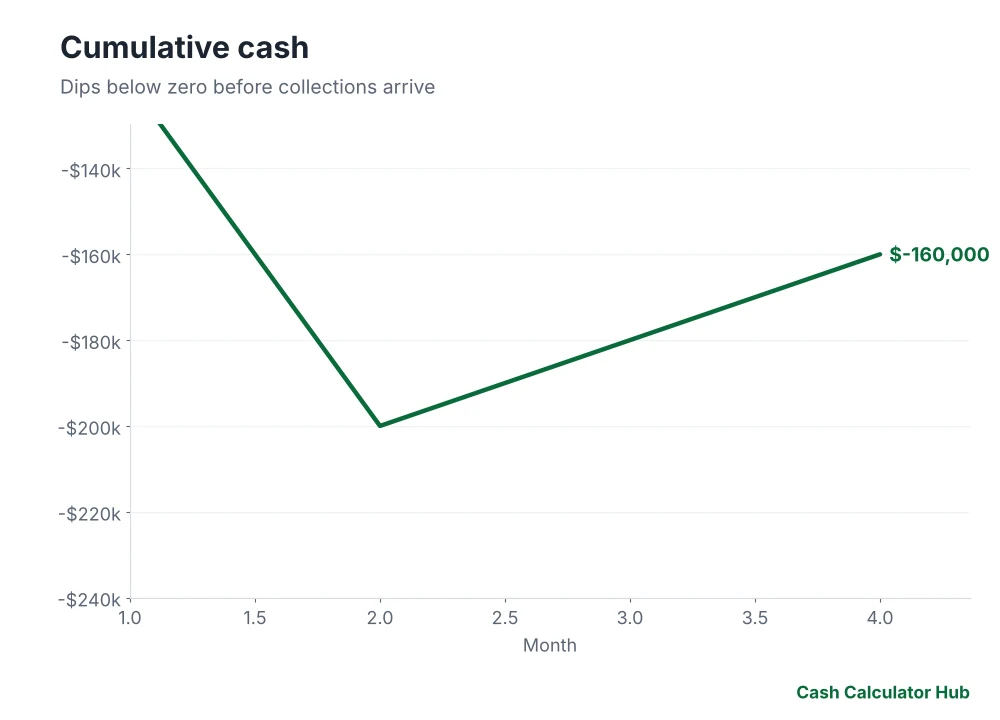
Quick answer: Profit measures revenue minus expenses when they are recorded; cash flow measures when money actually moves. A business with $100,000 of monthly sales and $20,000 of monthly profit can still run out of cash if customers pay after 60 days and inventory or bills are paid up front: in the example, cumulative cash falls as low as $-200,000.
Many failing small businesses were profitable on paper. The gap between accounting profit and cash comes from timing: receivables, payables, inventory and capital purchases. Understanding it keeps you solvent.
Key takeaways
- Profit uses accrual accounting; cash flow tracks money in and out.
- Slow-paying customers and inventory purchases consume cash.
- Depreciation reduces profit but not cash; loan principal reduces cash but not profit.
- Forecast cash weekly; keep a buffer of one to three months of costs.
- Speed up collection, slow down payments responsibly and use credit lines sparingly.
A four-month example
Sales are $100,000 a month (billed on credit, collected after 60 days), costs of goods $60,000, operating expenses $20,000, and a $40,000 inventory purchase in month 1.
| Month 1 | Month 2 | Month 3 | Month 4 | |
|---|---|---|---|---|
| Sales (accrual) | $100,000 | $100,000 | $100,000 | $100,000 |
| Costs of goods + expenses | $80,000 | $80,000 | $80,000 | $80,000 |
| Profit | $20,000 | $20,000 | $20,000 | $20,000 |
| Cash collected from customers | $0 | $0 | $100,000 | $100,000 |
| Inventory purchase | −$40,000 | $0 | $0 | $0 |
| Net cash flow | $-120,000 | $-80,000 | $20,000 | $20,000 |
| Cumulative cash | $-120,000 | $-200,000 | $-180,000 | $-160,000 |
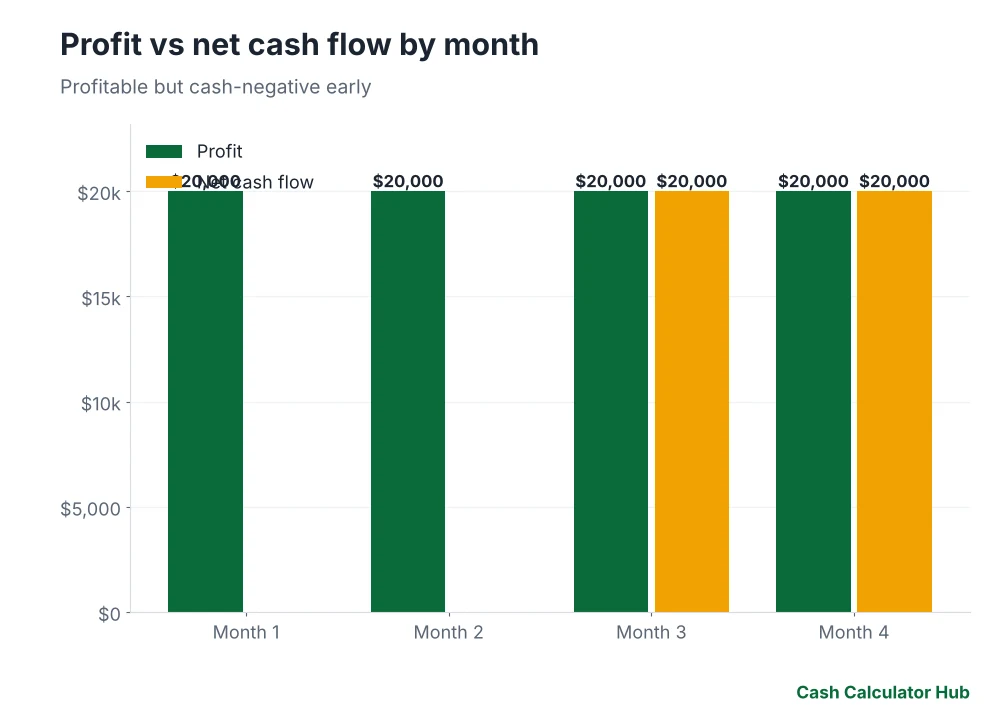
The business is profitable every month, yet it needs funding of at least $200,000 until collections catch up.
Why profit and cash differ
| Item | Affects profit? | Affects cash? |
|---|---|---|
| Credit sales | Yes, when billed | Only when collected |
| Inventory purchase | When sold | When paid |
| Depreciation | Yes | No |
| Loan principal | No | Yes |
| Owner draws | No | Yes |
| Taxes | When accrued | When paid |
Fixes
- Invoice quickly and offer small early-payment discounts.
- Shorten terms or take deposits.
- Manage inventory; avoid overstock.
- Negotiate supplier terms to align payments with receipts.
- Keep a buffer and a line of credit for gaps.
- Forecast weekly for 13 weeks.
Related measures
Margins show profitability; see margin types. Break-even shows volume needed; see break-even analysis. Investment timing: payback period. Personal parallel: irregular income budgeting.
Tools
Use the margin calculator, ROI calculator and payback period calculator. More: business and everyday tools.
Frequently asked questions
What is the difference between cash flow and profit?
Profit is revenue minus expenses recognized in the period; cash flow is the actual movement of money in and out.
Why can a profitable business run out of cash?
Because customers may pay late, inventory and bills are paid first, and loan repayments use cash without reducing profit.
How can I improve cash flow?
Collect faster, extend supplier terms, control inventory, and keep a cash buffer.
Is depreciation a cash expense?
No. It reduces profit but not cash.
How far ahead should I forecast cash?
Many small businesses forecast weekly for 13 weeks and monthly for 12 months.
Sources and further reading
How the numbers were made: Every figure on this page was calculated from the formulas and assumptions stated above and rounded to the nearest dollar. Rates, limits and rules are for 2026 unless noted; confirm current figures with the sources listed before acting.
Keep reading
- Margin vs Markup: The Difference, the Formulas and a Conversion Table
- ROI vs IRR vs CAGR: Which Return Number Should You Trust?
- How Much Emergency Fund Do You Need? A Month-by-Month Plan
- The True Cost of an Employee: Why a $70,000 Salary Costs About $90,000
- How to Set a Freelance Hourly Rate: From Income Goal to Billable Hours
- Time Value of Money: Present Value, Future Value and NPV Explained With Examples
This guide is general information, not financial, tax or legal advice. Figures use stated assumptions and 2026 rules and will differ from your situation; check current rules and talk to a licensed professional before you decide. Full disclaimer.