
Quick answer: FIRE (financial independence, retire early) means saving enough that investment income covers your spending, commonly 25 times annual expenses under the 4% rule. With a 5% real return and starting from zero, saving 10% of income takes about 52 years, 25% about 32 years, 50% about 17 years and 75% about 8 years.
The FIRE movement popularized a simple insight: what matters most is not your salary but the gap between what you earn and what you spend. A high savings rate does two things at once: it builds the nest egg faster and it lowers the amount you need, because you spend less.
The table below assumes you start with no savings, earn a 5% real (after-inflation) return and need 25 times your annual spending.
Key takeaways
- Target = 25 × annual spending (the 4% rule).
- The savings rate, not income, sets the timeline.
- Years to financial independence from zero: 52 at 10%, 32 at 25%, 17 at 50%, 8 at 75%.
- Early retirees should consider a withdrawal rate nearer 3.5%, healthcare costs and access to retirement accounts before 59½.
- Variants: Lean FIRE, Fat FIRE, Barista FIRE and Coast FIRE.
The core math
If you earn 100 units and save s, you spend 100 − s. You need 25 × (100 − s) to retire. Each year your savings earn a real return and you add s more.
| Savings rate | Annual spending (of 100) | Target (25×) | Years to FI |
|---|---|---|---|
| 10% | 90 | 2250 | 52 |
| 25% | 75 | 1875 | 32 |
| 40% | 60 | 1500 | 22 |
| 50% | 50 | 1250 | 17 |
| 60% | 40 | 1000 | 13 |
| 75% | 25 | 625 | 8 |
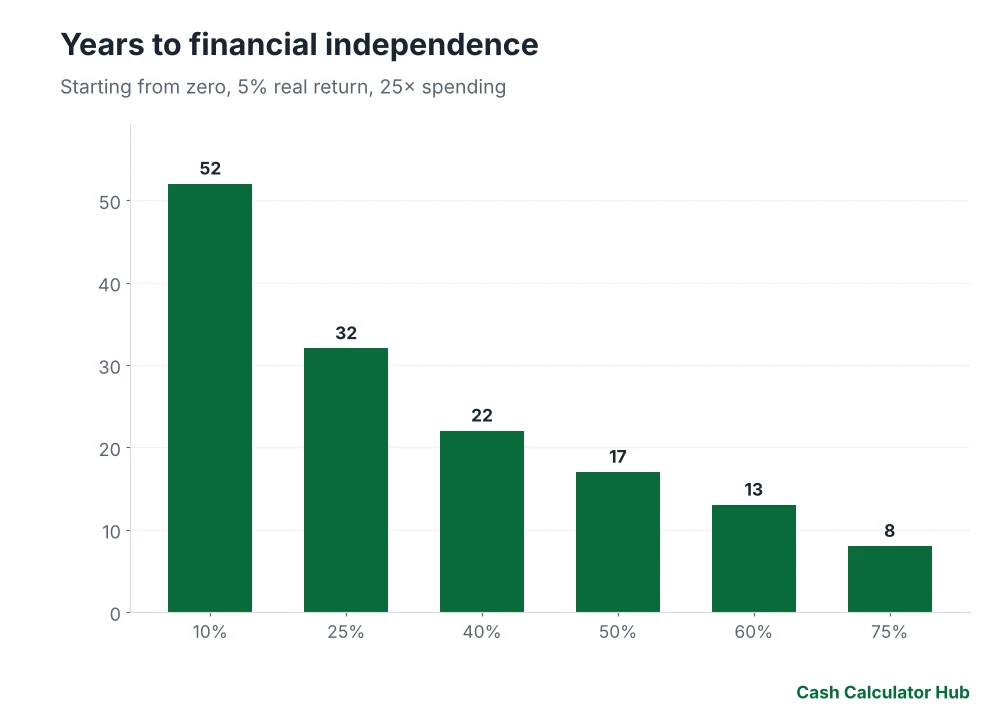
Going from a 10% to a 25% savings rate saves 20 years. Going from 50% to 75% saves 9 more. The first gains are the largest.
In dollars
For a household with a $80,000 take-home budget:
| Savings rate | Spending | Savings per year | Target portfolio |
|---|---|---|---|
| 10% | $72,000 | $8,000 | $1,800,000 |
| 25% | $60,000 | $20,000 | $1,500,000 |
| 50% | $40,000 | $40,000 | $1,000,000 |
FIRE flavors
- Lean FIRE: very low spending, often under $40,000.
- Fat FIRE: higher spending, $100,000 or more.
- Barista FIRE: part-time work covers some costs and healthcare.
- Coast FIRE: you have saved enough that compounding alone will reach your target by traditional retirement age, so you only need to cover current expenses.
Coast FIRE example
To reach $1.5 million at age 65 with 5% real growth, a 35-year-old needs about $347,066 today, since it will grow by a factor of 4.32 in 30 years. After that, they only need to earn enough to pay current bills.

Challenges for early retirees
- Healthcare before Medicare; marketplace premiums matter. See Medicare costs.
- Access to retirement accounts before 59½: Roth conversion ladders, the rule of 55, or 72(t) payments. See Roth conversions.
- Sequence risk over a 40 to 50 year retirement; see sequence of returns.
- Lower Social Security if you stop working early; see claiming age.
- Longer horizon means a lower safe withdrawal rate; see the 4% rule.
How to raise your savings rate
- Track spending with the 50/30/20 rule or a zero-based budget.
- Cut the biggest costs first: housing, transport and food. See the true cost of a car.
- Raise income and keep lifestyle flat; see lifestyle creep.
Tools
Use the retirement calculator, investment calculator and savings calculator to test your numbers. More: retirement tools.
Frequently asked questions
What is FIRE?
Financial Independence, Retire Early: saving aggressively so that investments can cover living expenses, typically 25 times annual spending.
How much do I need to retire early?
About 25 times your annual spending under the 4% rule, or about 28 to 33 times if you want a more conservative 3% to 3.5% rate.
What savings rate do I need for FIRE?
A 50% savings rate reaches financial independence in roughly 17 years from zero at a 5% real return; higher rates are faster.
What is Coast FIRE?
Having enough invested that growth alone will reach your retirement target by a normal retirement age, so you only need to earn enough to cover current expenses.
Is the 4% rule safe for early retirement?
Many early retirees use 3% to 3.5% because the portfolio must last 40 to 50 years.
Sources and further reading
How the numbers were made: Every figure on this page was calculated from the formulas and assumptions stated above and rounded to the nearest dollar. Rates, limits and rules are for 2026 unless noted; confirm current figures with the sources listed before acting.
Keep reading
- How Much Do You Need to Retire? A Practical Way to Find Your Number
- The 50/30/20 Budget Rule: How It Works, and How to Adjust It
- How Long Does It Take to Save $1 Million?
- 401(k) Rollover Options When You Leave a Job: What to Do With Your Old Plan
- Solo 401(k) vs SEP IRA: Which Retirement Plan Is Better for the Self-Employed?
- Sequence of Returns Risk: Why Bad Years Early in Retirement Matter Most
This guide is general information, not financial, tax or legal advice. Figures use stated assumptions and 2026 rules and will differ from your situation; check current rules and talk to a licensed professional before you decide. Full disclaimer.