
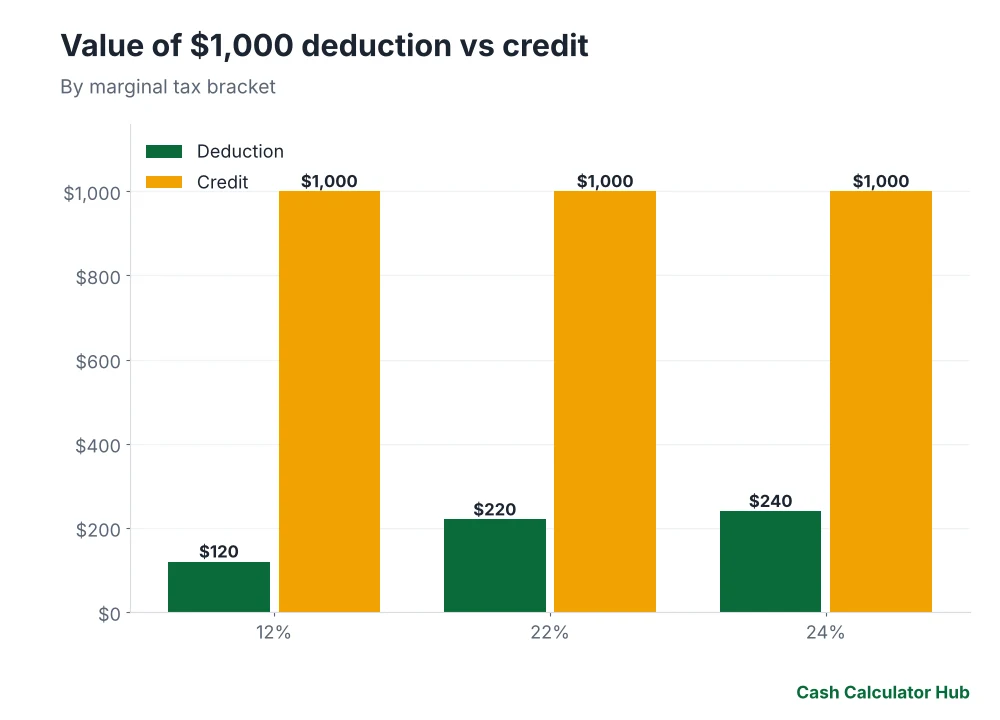
Quick answer: A tax deduction reduces the income that is taxed, so its value is the amount times your marginal rate: $1,000 saves $220 at 22%. A tax credit reduces your tax bill dollar for dollar: a $1,000 credit saves $1,000. Refundable credits can even produce a refund beyond what you owe.
Both reduce your taxes, but they work at different points in the calculation, and that makes credits more valuable per dollar. Understanding the difference helps you prioritize which breaks to pursue.
Key takeaways
- Deduction value = amount × marginal tax rate.
- Credit value = the full amount, subject to limits.
- Refundable credits can exceed your tax; non-refundable credits cannot.
- Examples of deductions: standard, mortgage interest, IRA contributions. Examples of credits: Child Tax Credit, education credits, saver’s credit.
- Deductions help higher brackets more; credits help everyone equally.
Value of $1,000 by bracket
| Marginal rate | $1,000 deduction saves | $1,000 credit saves |
|---|---|---|
| 12% | $120 | $1,000 |
| 22% | $220 | $1,000 |
| 24% | $240 | $1,000 |
Common deductions
- Standard or itemized deduction; see standard vs itemized.
- Traditional IRA and HSA contributions.
- Student loan interest, up to $2,500.
- Half of self-employment tax; see SE tax.
- Qualified business income deduction.
Common credits
- Child Tax Credit; see CTC.
- Earned Income Tax Credit (refundable).
- American Opportunity Tax Credit for college (partly refundable).
- Saver’s credit for retirement contributions at low income.
- Child and dependent care credit.
Refundable vs non-refundable
| Type | What happens when the credit exceeds your tax |
|---|---|
| Non-refundable | The extra is lost (some carry forward) |
| Partly refundable | A portion can be refunded |
| Fully refundable | The entire excess is paid to you |
Example
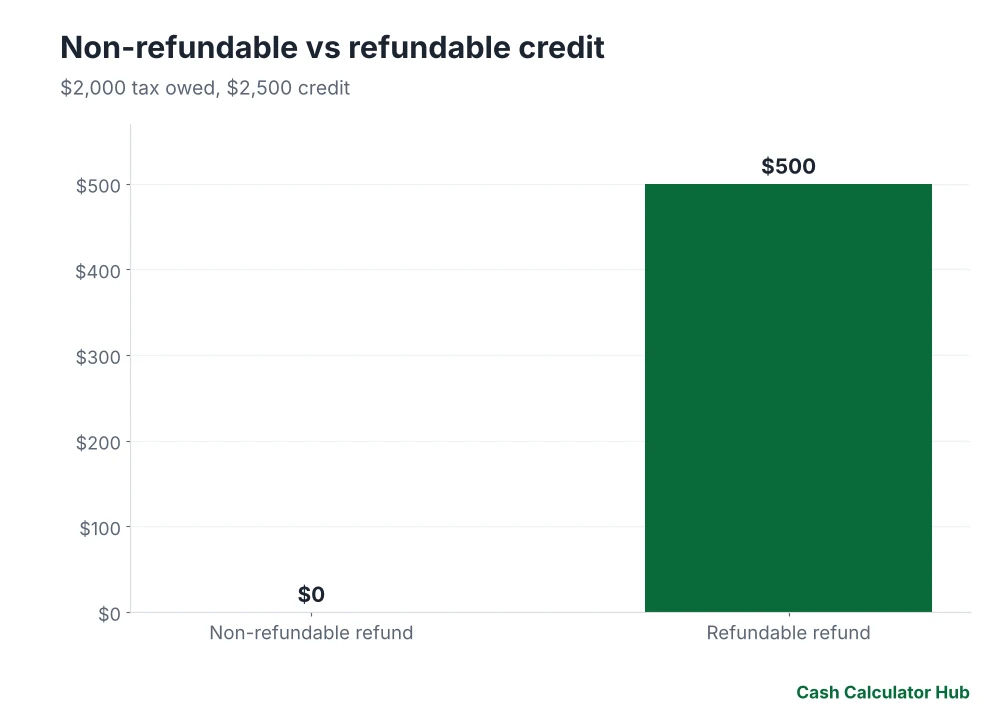
A single filer with $2,000 of tax owed and a $2,500 non-refundable credit pays $0, and the extra $500 is lost. With a refundable credit the same filer would receive $500.
Strategy
- Claim all credits first; they are worth the most per dollar.
- Maximize deductions that also build wealth, such as retirement and HSA accounts.
- Know the income phase-outs that limit both.
Tools
Use the income tax calculator to compare, and see the brackets at 2026 brackets. More: tax tools.
Frequently asked questions
Is a tax credit better than a deduction?
Per dollar, yes. A credit cuts your tax by its full value, while a deduction cuts it by value times your tax rate.
What is a refundable tax credit?
One that can reduce your tax below zero, so you receive the excess as a refund.
Is the standard deduction a credit?
No. It is a deduction that reduces taxable income.
What is an example of a tax credit?
The Child Tax Credit, the Earned Income Tax Credit and education credits.
How much does a $1,000 deduction save?
Your marginal rate times $1,000, for example $220 at a 22% rate.
Sources and further reading
How the numbers were made: Every figure on this page was calculated from the formulas and assumptions stated above and rounded to the nearest dollar. Rates, limits and rules are for 2026 unless noted; confirm current figures with the sources listed before acting.
Keep reading
- 2026 Federal Tax Brackets and Standard Deduction, Explained With Examples
- Marriage Tax Penalty or Bonus: Who Pays More in 2026?
- Student Loan Repayment in 2026: What Changed and How to Run Your Numbers
- Take-Home Pay on $50K, $75K and $150K Salaries (2026 Federal Taxes)
- Estate and Gift Tax Basics 2026: $15 Million Exemption and $19,000 Annual Gifts
- Overtime and Bonus Pay: Why the Tax Looks So High and How Much You Really Keep
This guide is general information, not financial, tax or legal advice. Figures use stated assumptions and 2026 rules and will differ from your situation; check current rules and talk to a licensed professional before you decide. Full disclaimer.