Quick answer: A $400,000 house costs about $2,670 a month at 7% with 20% down.
A $400,000 house does not cost one monthly payment. It costs a range of payments depending on your rate, your down payment and the county you buy in. Here are the numbers laid out so you can find your own row.
Start with principal and interest
With 20% down you borrow $320,000. On a 30-year fixed loan:
| Rate | Principal & interest | Total interest over 30 years |
|---|---|---|
| 6.0% | $1,919 | $370,682 |
| 6.5% | $2,023 | $408,142 |
| 7.0% | $2,129 | $446,428 |
| 7.5% | $2,237 | $485,495 |
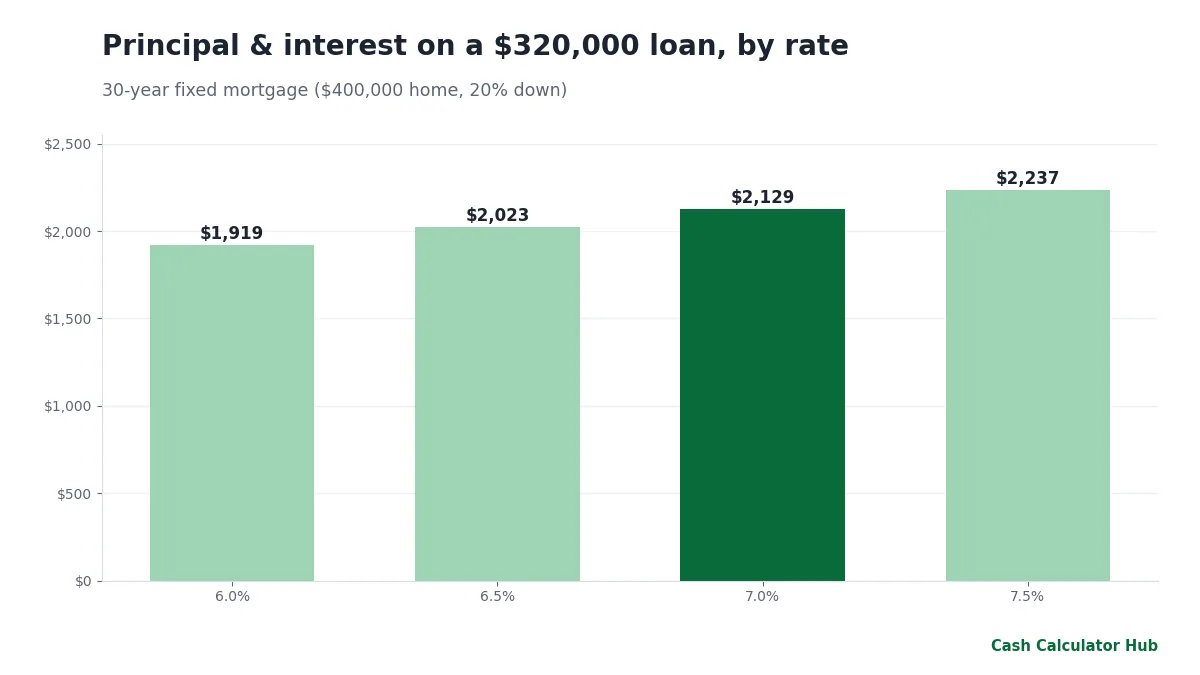
The gap between 6% and 7.5% is $319 a month, which is $3,827 a year. Over the full loan it is $114,813 more in interest. Rates matter. So does shopping at least three lenders, because the same borrower is often quoted rates a quarter point apart.
Add the pieces your lender collects with it
Principal and interest are only the loan. Most lenders also collect property tax and insurance each month into an escrow account. Using 1.1% property tax and $2,100 a year in insurance on a $400,000 house at 7%:
| Piece | Monthly cost |
|---|---|
| Principal & interest | $2,129 |
| Property tax (1.1%) | $367 |
| Homeowners insurance | $175 |
| Total (PITI) | $2,671 |
If you put less than 20% down, add private mortgage insurance. On a 5% down payment ($380,000 loan) PMI at roughly 0.6% a year would add about $190 a month until your balance falls to 80% of the home’s value. HOA dues, if there are any, sit on top.
What the first years really look like
At 7%, your first payment of $2,129 includes $1,867 of interest and only $262 of principal. You pay down about $3,251 of the loan in year one. That is why selling or refinancing in the first five years rarely leaves much equity from payments alone.
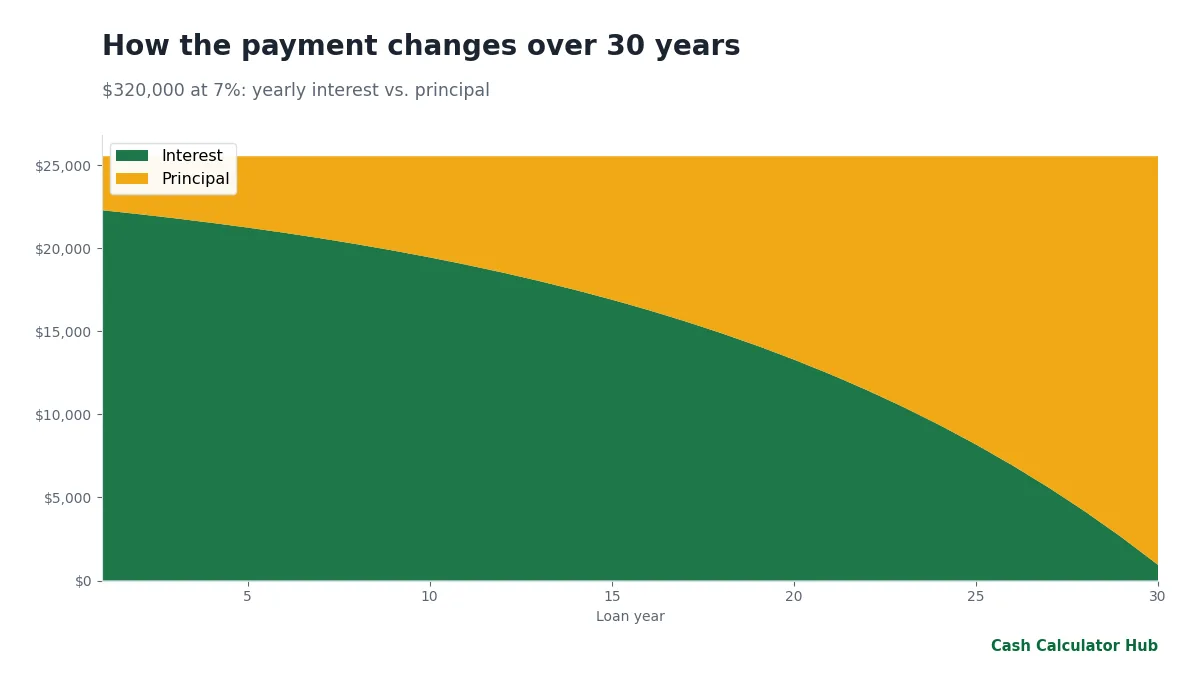
Amortization is front-loaded by design. You can see every month of it in the amortization calculator, and if you want to attack the interest early, the guide to paying off a mortgage early shows what extra payments do on this exact kind of loan.
15-year versus 30-year on $320,000
A 15-year loan has a higher payment and far less interest. Short-term mortgages usually price below 30-year loans, so here is the trade (using 6.3% for the 15-year and 7.0% for the 30-year, roughly the gap Freddie Mac’s weekly survey has shown recently):
| Loan | Monthly P&I | Total interest |
|---|---|---|
| 30-year at 7.0% | $2,129 | $446,428 |
| 15-year at 6.3% | $2,752 | $175,447 |
The 15-year costs $624 more a month and saves about $270,982 in interest. Whether that is worth it depends on whether the higher payment crowds out retirement saving. If it does, take the 30-year and make extra payments when you can; that keeps your flexibility.
The same loan at nearby prices
If $400,000 is not exactly your target, here is the full monthly cost (principal, interest, 1.1% tax, $2,100 insurance, no PMI at 20% down) at a 7% rate:
| Home price | Loan (20% down) | Monthly total | Income needed at 28% |
|---|---|---|---|
| $300,000 | $240,000 | $2,047 | $87,717 |
| $350,000 | $280,000 | $2,359 | $101,086 |
| $400,000 | $320,000 | $2,671 | $114,456 |
| $450,000 | $360,000 | $2,983 | $127,825 |
| $500,000 | $400,000 | $3,295 | $141,195 |
Each $50,000 step adds about $312 a month. That is a handy number to carry around when you are deciding whether the next listing up is worth it.
Find your own number
- Enter $400,000 as the price, your down payment and your rate in the mortgage calculator.
- Replace the tax and insurance defaults with your real quotes.
- Check the total against your budget. Use the house affordability calculator to see whether it fits your income, or read how much house you can afford on a $100K salary.
- If the monthly payment is tight, test a bigger down payment or a lower price before you test a longer loan.
More tools are in the mortgage and real estate category.
Three ways to bring the payment down without a cheaper house
Buy the rate down. One discount point costs 1% of the loan, which is $3,200 here, and typically lowers the rate by about a quarter point. Going from 7.00% to 6.75% saves $53 a month, so the point pays for itself in about 60 months (5.0 years). If you expect to keep the loan longer than that, it is worth considering. If you may sell or refinance sooner, it is not.
Put more down. Going from 20% to 25% down on this house removes $20,000 from the loan and about $133 from the monthly payment. That is helpful, but do not drain your emergency savings to get there.
Shop the escrow items. Insurance quotes for the same house can differ by $600 a year or more. That is $50 a month, and it costs you an hour to compare.
Questions worth asking your lender
- Is the rate locked, and for how many days? Lock extensions cost money.
- What are the total closing costs, line by line, and which are fixed?
- Is there a prepayment penalty? (Most conventional loans do not have one.)
- Will my escrow payment change at the first annual review? Property tax reassessment after you buy is common.
What income do I need for a $400,000 house?
With 20% down at 7%, the total payment is about $2,671. At the 28% rule that needs roughly $114,456 a year of gross income.
How much is the down payment on a $400,000 house?
20% is $80,000, 10% is $40,000, and 5% is $20,000. Add 2% to 5% for closing costs.
Is a 30-year mortgage on $400,000 worth it at 7%?
It is workable, but you pay more in interest than the loan itself over 30 years ($446,428 on a $320,000 loan). Many buyers take it for the lower payment and refinance or prepay later.
Can I deduct mortgage interest?
Only if you itemize, and only on up to $750,000 of acquisition debt. Many households take the standard deduction instead, so the interest deduction often saves nothing.
Sources and further reading
How the numbers were made: Every figure on this page was calculated from the formulas and assumptions stated above and rounded. Rates, limits and rules are for 2026 unless noted; confirm current figures with the sources listed before acting.
Keep reading
- Pay Off Your Mortgage Early: What Extra Payments Really Save
- How Much House Can I Afford on a $100K Salary?
- Debt-to-Income Ratio for a Mortgage: What Lenders Allow
- Mortgage Refinance Break-Even Point: Is It Worth It?
- Rent vs Buy: How Long Until Buying a Home Wins?
- 15-Year vs 30-Year Mortgage: Which Costs Less Overall?
This guide is general information, not financial, tax or legal advice. Figures use stated assumptions and 2026 rules and will differ from your situation; check current rules and talk to a licensed professional before you decide. Full disclaimer.