Quick answer: When your existing mortgage rate is far below today’s rates, a cash-out refinance reprices the whole balance and usually costs more than borrowing only what you need. On a $250,000 loan at 3.5%, getting $50,000 with a cash-out refinance at 7.25% adds $795 a month; a HELOC at 9% adds $375 interest-only; a home equity loan adds $492.
A cash-out refinance replaces your mortgage with a larger one and hands you the difference. A HELOC or home equity loan adds a second loan and leaves the first alone. Which is cheaper depends almost entirely on the rate on your current mortgage.
The scenario: you owe $250,000 at 3.5% with 25 years left, and you need $50,000 for a renovation. Today’s rates are 7.25% for a new first mortgage, 9% for a HELOC and 8.5% for a fixed home equity loan.
Key takeaways
- Current payment: $1,252 on $250,000 at 3.5%.
- Cash-out refinance on $300,000 at 7.25% (30 years): $2,047, plus about $9,000 in closing costs.
- Keep the first mortgage and add a home equity loan: $1,744 total, or a HELOC: about $1,627 interest-only.
- Reprice only the cash you need when your current rate is much lower than today’s.
- If your current rate is higher than market, a cash-out refinance can win.
The comparison
| Cash-out refi | Home equity loan | HELOC (interest-only draw) | |
|---|---|---|---|
| New debt | $300,000 at 7.25% | $250,000 at 3.5% + $50,000 at 8.5% | $250,000 at 3.5% + $50,000 at 9% |
| Upfront cost | about $9,000 (3%) | $500 to $2,000 | $0 to $500 |
| Monthly payment | $2,047 | $1,744 | $1,627 |
| Change from today’s $1,252 | +$795 | +$492 | +$375 |
| Rate type | Fixed | Fixed | Variable |
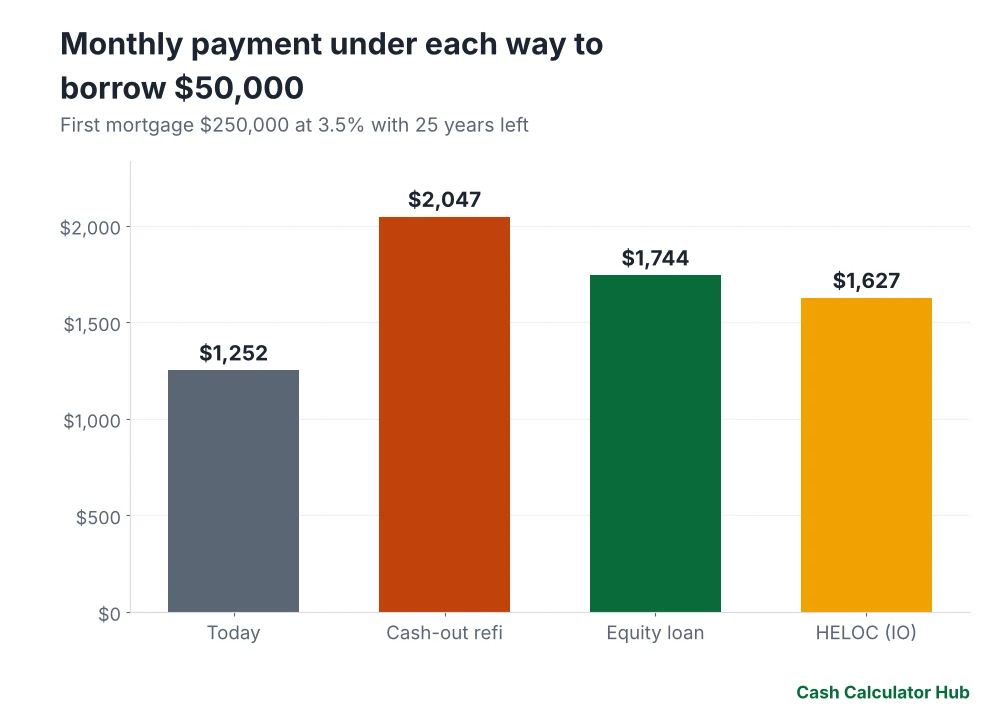
The cash-out refinance raises your rate on all $250,000 from 3.5% to 7.25% in order to borrow $50,000. That is where the extra payment comes from, not from the $50,000 itself.
Interest over the next ten years
Counting only interest in years 1 through 10:
| Option | Interest paid in 10 years |
|---|---|
| Keep old loan, no extra borrowing | $75,259 |
| Cash-out refinance | $204,515 |
| Old loan + home equity loan | $108,342 |
| Old loan + HELOC (interest-only) | $120,259 |
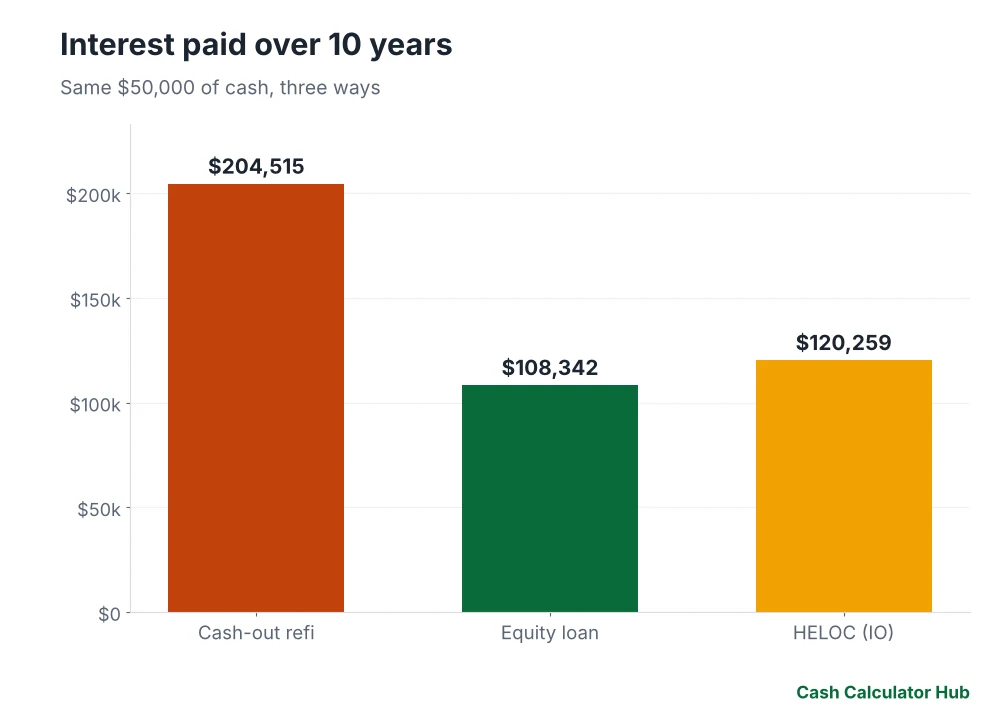
The cash-out refinance costs about $96,172 more in interest over a decade than the home equity loan, before counting closing costs. Interest-only HELOC payments look cheap but do not reduce the principal; after the draw period you must pay it off at a possibly higher rate.
When the cash-out refinance wins
- Your current rate is above today’s market rate, so refinancing lowers it.
- You need a large amount, and a fixed payment on one loan fits your budget.
- You also want to remove mortgage insurance or change terms. Compare costs with the refinance break-even guide.
When a second loan wins
- Your current rate is far below market, as in this example.
- You need a smaller sum and can repay it quickly.
- You want flexibility: a HELOC lets you draw only what you need. See HELOC versus home equity loan.
Limits and qualifying
Lenders generally allow total borrowing up to 80% of the home’s value on a cash-out refinance and up to 80% to 85% CLTV on second loans. You will need adequate income, credit and equity. See how much equity you can use.
Risks to weigh
- Your home secures the debt.
- HELOC rates are variable and can rise.
- A longer term lowers the payment but increases lifetime interest.
- Borrowing for consumption, not investment, makes the cost harder to justify.
Run both
Use the refinance calculator for the new first mortgage, then compare with the HELOC calculator and the home equity loan calculator. Combine your results with the amortization calculator. More: mortgage tools.
Frequently asked questions
Is a cash-out refinance better than a HELOC?
Only if your current mortgage rate is higher than the new rate or you need a very large sum. If your current rate is low, a HELOC or home equity loan usually costs less.
How much can I take out in a cash-out refinance?
Typically up to 80% of the home’s value in total loans, depending on the lender and loan type.
Are cash-out refinance rates higher?
Usually slightly higher than a standard refinance, because the lender takes more risk.
What are the closing costs on a cash-out refinance?
Often 2% to 5% of the new loan amount. HELOCs and home equity loans usually cost less to open.
Can I use a HELOC to pay off a first mortgage?
You can, but a variable HELOC rate on a large balance is risky. Most people keep a fixed first mortgage and use the HELOC for smaller needs.
Sources and further reading
How the numbers were made: Every figure on this page was calculated from the formulas and assumptions stated above and rounded to the nearest dollar. Rates, limits and rules are for 2026 unless noted; confirm current figures with the sources listed before acting.
Keep reading
- HELOC vs Home Equity Loan: How to Choose
- Mortgage Refinance Break-Even Point: Is It Worth It?
- Home Equity: How It Builds, How Much You Can Borrow and When to Use It
- How Your Credit Score Changes Your Mortgage Rate and Payment
- The Hidden Costs of Buying a Home: A First-Year Budget
- Mortgage Escrow Account Explained: Why Your Payment Changes
This guide is general information, not financial, tax or legal advice. Figures use stated assumptions and 2026 rules and will differ from your situation; check current rules and talk to a licensed professional before you decide. Full disclaimer.