Quick answer: A mortgage escrow account is a holding account your servicer uses to pay your property taxes and homeowners insurance. Each month you pay one-twelfth of the annual bills; on $5,200 of tax and $1,800 of insurance that is $583. The amount is re-analyzed once a year, so your total payment can change even on a fixed-rate loan.
Most borrowers with less than 20% down are required to have an escrow account, and many with 20% or more choose one. It spreads two big annual bills into twelve small ones.
The catch is that your lender, not you, controls the timing and the amount. Understanding the yearly escrow analysis explains almost every surprise payment change.
Key takeaways
- Escrow covers property tax, homeowners insurance and sometimes mortgage insurance and flood insurance.
- With $7,000 of yearly bills your escrow payment is $583 a month.
- Servicers may keep a cushion of up to two months of escrow charges.
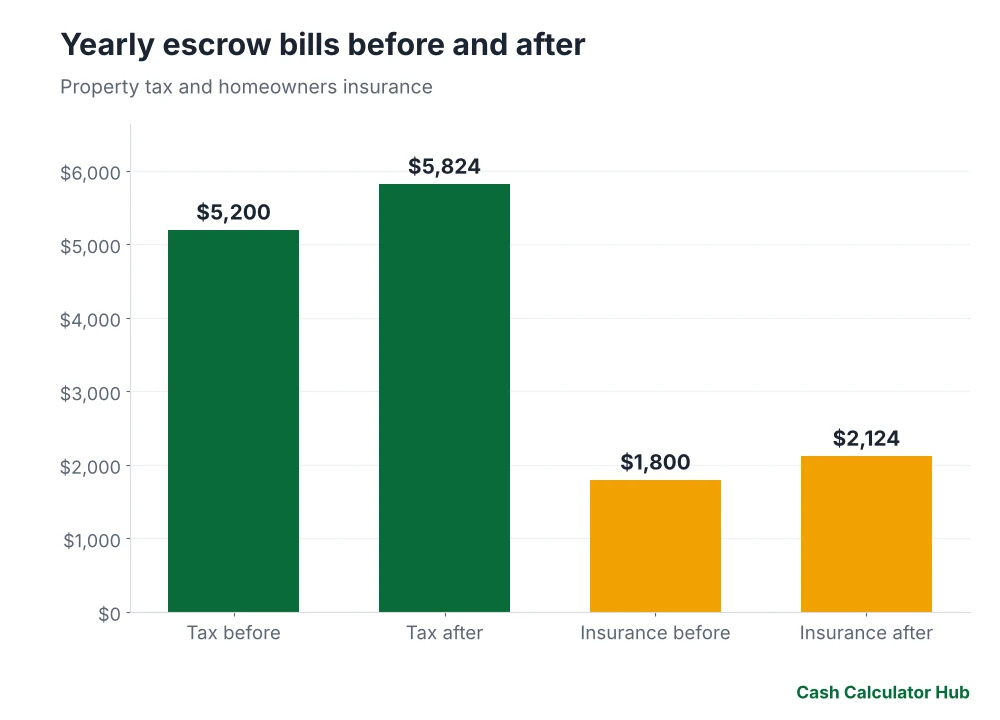
- If taxes rise 12% and insurance 18%, the yearly bills climb $948 and the escrow payment goes up by $79 a month.
- You can often waive escrow with 20% or more equity, but you must then budget for the bills yourself.
How escrow works
- At closing you fund an initial deposit, typically a few months of taxes and insurance.
- Each month your payment includes a share of the annual bills.
- The servicer pays the tax authority and the insurer when they are due.
- Once a year the servicer does an escrow analysis: it compares what it collected with what it paid and projects the next 12 months.
Your total payment is PITI: principal, interest, taxes and insurance.
| Part of the payment | Example | Changes? |
|---|---|---|
| Principal and interest | $2,183 | Fixed on a fixed-rate loan |
| Property tax ($5,200 a year) | $433 | Yes, as assessments or rates change |
| Homeowners insurance ($1,800 a year) | $150 | Yes, at each renewal |
| Total payment | $2,766 | Yes |
What happens when bills go up
Say property tax rises 12% to $5,824 and the insurance renewal rises 18% to $2,124. The yearly bills grow by $948. At the next analysis, the servicer does two things:
- Raises your monthly escrow from $583 to $662, a difference of $79.
- If the account is short because bills rose before the analysis, asks you to cover the shortage, either in one payment or spread over 12 months.
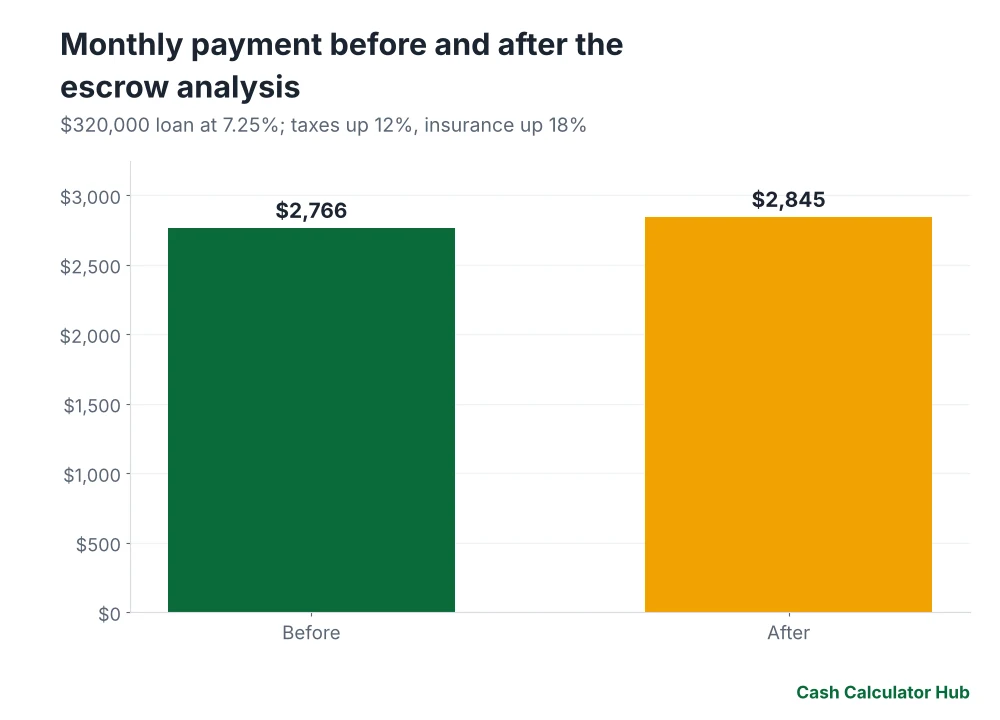
Your payment goes from $2,766 to $2,845 (plus any shortage repayment) without any change to the loan itself. That is why a fixed-rate mortgage is fixed only in its principal-and-interest part.
The cushion
Federal rules let a servicer hold a cushion of up to one-sixth of the year’s escrow charges, or two months. On these bills the cushion could be up to $1,167. If your balance would fall below the cushion at any point, it counts as a shortage, so the servicer collects more.
Shortage, deficiency and surplus
| Term | Meaning | What happens |
|---|---|---|
| Shortage | Balance is projected to dip below the required cushion | Pay in a lump sum or over 12 months |
| Deficiency | Balance is negative (servicer advanced money) | Repay over time |
| Surplus | You paid more than needed, above $50 | Refunded within 30 days |
Do you have to use escrow?
Lenders require it for most FHA, VA and USDA loans, and for conventional loans with less than 20% down. With 20% or more, you may be able to waive it for a fee or a slightly higher rate. Without escrow you must save for the bills yourself: set aside $583 a month in a separate account so the tax bill does not take you by surprise.
How to avoid payment shocks
- Shop insurance every year. Premiums have been rising in many regions. A new quote can offset an increase.
- Check the tax bill. If it looks too high, see the appeal steps in the property tax guide.
- Pay a shortage in full if you can. Spreading it makes the monthly payment higher for a year.
- Read the annual statement. Confirm that the servicer used the correct amounts.
- Budget for ownership, not the loan. See the hidden costs guide.
Escrow errors
Servicers sometimes pay the wrong tax amount or miss a change of insurer. If you suspect an error, send a written request for information; federal rules require a response within a set time. Keep your own copy of the tax and insurance bills.
Work it into your plan
Use the mortgage calculator with tax and insurance included for a PITI estimate, and the house affordability calculator to set a price ceiling. More: mortgage tools.
Frequently asked questions
What is included in escrow?
Typically property tax and homeowners insurance, plus mortgage insurance premiums and flood insurance where required.
Why did my mortgage payment go up if I have a fixed rate?
Probably because your escrow rose when taxes or insurance increased. The principal-and-interest part is what stays fixed.
Can I get rid of my escrow account?
Often, if you have at least 20% equity and a good payment history. Lenders may charge a fee or require you to pay the bills on time on your own.
How much cushion can a lender hold in escrow?
Up to two months of escrow payments under federal rules.
What happens to my escrow if I refinance?
The old servicer refunds the balance, usually within a few weeks, and the new loan has a new initial escrow deposit.
Sources and further reading
How the numbers were made: Every figure on this page was calculated from the formulas and assumptions stated above and rounded to the nearest dollar. Rates, limits and rules are for 2026 unless noted; confirm current figures with the sources listed before acting.
Keep reading
- Property Tax and Your Mortgage Payment: How Much It Adds
- Mortgage Payment on a $400,000 House: Real Numbers
- Closing Costs Explained: What You Pay and How to Lower It
- How Your Credit Score Changes Your Mortgage Rate and Payment
- Cash-Out Refinance vs HELOC: Which Costs Less for $50,000?
- Home Equity: How It Builds, How Much You Can Borrow and When to Use It
This guide is general information, not financial, tax or legal advice. Figures use stated assumptions and 2026 rules and will differ from your situation; check current rules and talk to a licensed professional before you decide. Full disclaimer.