Quick answer: How much can you borrow against your home, and which product is safer?
You have built equity in your home and you want to use it for a renovation, a consolidation of high-rate debt or a big expense. The two mainstream choices are the home equity loan (HEL) and the home equity line of credit (HELOC). They are cousins, not twins, and the difference shows up in how your payment behaves.
How much can you actually borrow?
Lenders cap your combined loan-to-value (CLTV), usually at 80% to 85% and sometimes higher. The formula is: maximum new borrowing = home value × CLTV limit − current mortgage balance.
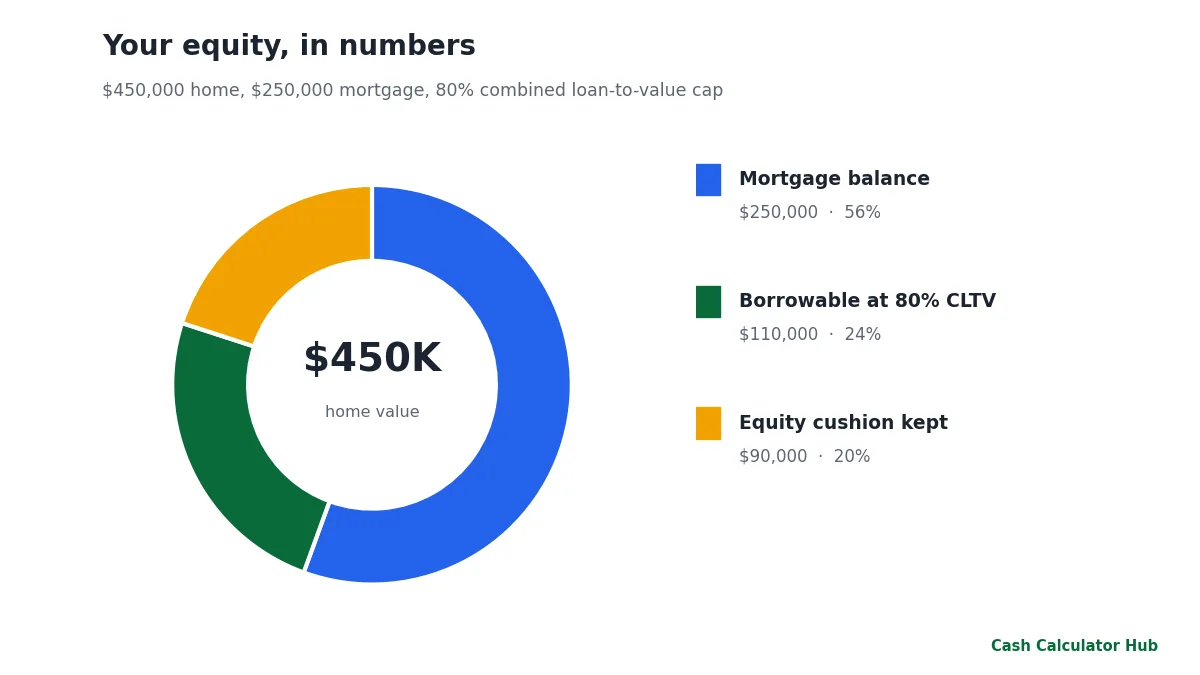
On a $450,000 home with a $250,000 mortgage and an 80% cap, you can borrow up to $110,000. At 85% it would be $132,500. Remember that the higher the CLTV, the higher the rate and the thinner your cushion if prices dip.
What each product is
Home equity loan. A lump sum, usually with a fixed rate and a fixed term (5 to 30 years). Your payment is level and your rate is locked. You pay interest on the whole amount from day one.
HELOC. A revolving line you draw on as needed. It typically has a draw period (often 10 years) when you can borrow and make interest-only payments, followed by a repayment period (often 10 to 20 years) when you pay principal and interest. The rate is usually variable, tied to the prime rate plus a margin.
A side-by-side on $50,000
Suppose you borrow $50,000 and the lender offers an 8.5% fixed-rate loan over 15 years or an 8.25% variable HELOC with a 10-year draw and a 20-year repayment:
| Home equity loan | HELOC | |
|---|---|---|
| Rate | 8.5% fixed | 8.25% variable |
| Payment, years 1-10 | $492 | $344 (interest-only) |
| Payment, after repayment starts | $492 | $426 |
| If the rate rises 2 points | unchanged | up to $491 |
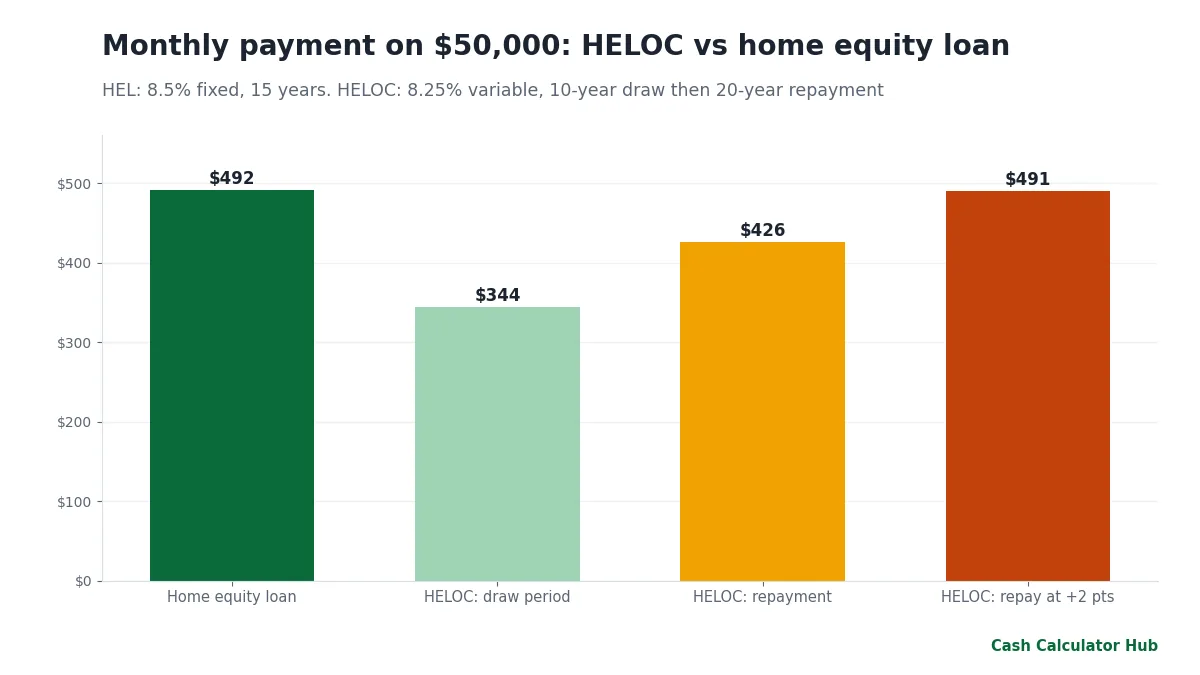
The HELOC’s low interest-only payment is appealing, and it is also the trap. You are not paying down the balance during the draw period. When repayment begins, the payment jumps from $344 to $426 or more, and if rates rose in the meantime it jumps further. Borrowers who treat the interest-only payment as the “real” payment are the ones who get surprised.
When each one fits
Pick a home equity loan if: – You know the amount you need (a roof, a one-time debt consolidation, tuition). – You want a predictable payment for budgeting. – Rates are rising. A fixed rate gives you a hedge. Both mortgage rates and short-term rates have been moving up recently, so the fixed rate is worth real money.
Pick a HELOC if: – Your costs are spread over time, like a multi-phase renovation. – You want a standby line for emergencies and will rarely use it. – You can handle a payment that could rise, and you plan to repay quickly.
Costs and details people skip
- Closing costs. Some HELOCs have low or no closing costs. Home equity loans often charge 2% to 5%. Compare the total, not just the rate.
- Annual fees and minimum draws. Check for inactivity fees.
- Rate caps and conversion options. Some HELOCs let you lock part of the balance at a fixed rate.
- Your home is the collateral. A missed payment can put your house at risk. That is a very different risk from a credit card.
- The tax rule. Interest is deductible only if the money is used to buy, build or substantially improve the home that secures the loan, and only if you itemize. Using it for debt consolidation or a car does not qualify.
Should you use equity to pay off credit cards?
It can lower the interest rate dramatically, from about 22% on a card to 8% to 9% on a home equity product. The danger is that you convert unsecured debt into debt secured by your house, and if the cards fill up again you have doubled your exposure. Run a comparison in the debt consolidation calculator and read our guide to whether debt consolidation is worth it.
Compare it with the alternatives
If your first mortgage has a low rate, taking out a second loan can be better than refinancing the entire balance at a higher rate. Test that in the refinance calculator and see the refinance break-even guide. A personal loan avoids putting your house up, at a higher rate.
Do your own math
The home equity loan calculator shows how much you can borrow and the fixed payment. The HELOC calculator models the draw and repayment periods with a rate you can change to stress-test. Explore the rest in the mortgage and real estate calculators.
Is a HELOC or a home equity loan better right now?
With rates rising, many borrowers prefer a fixed-rate loan for predictability. A HELOC makes sense if you only need money gradually and will repay quickly.
Can I lose my house with a HELOC?
Yes. It is secured by your home, so default can lead to foreclosure.
Does a HELOC hurt my credit?
Opening one triggers a hard inquiry. A large drawn balance relative to the limit can lower your score, similar to a credit card.
What credit score do I need?
Lenders vary, commonly 620 to 680 as a minimum, with better rates above 720.
Sources and further reading
How the numbers were made: Every figure on this page was calculated from the formulas and assumptions stated above and rounded. Rates, limits and rules are for 2026 unless noted; confirm current figures with the sources listed before acting.
Keep reading
- Is Debt Consolidation Worth It? A $18,000 Credit Card Example
- Mortgage Refinance Break-Even Point: Is It Worth It?
- How Much House Can I Afford on a $100K Salary?
- Mortgage Recast vs Refinance: Which Lowers Your Payment Better?
- Closing Costs Explained: What You Pay and How to Lower It
- ARM vs Fixed-Rate Mortgage: What a 5/1 ARM Really Costs
This guide is general information, not financial, tax or legal advice. Figures use stated assumptions and 2026 rules and will differ from your situation; check current rules and talk to a licensed professional before you decide. Full disclaimer.