Quick answer: Besides the down payment, expect closing costs of 2% to 5%, moving and setup costs, repairs, and yearly maintenance of about 1% of the home’s value. On a $400,000 home with 10% down, the first year can require roughly $73,900 in cash, of which $33,900 is not the down payment.
Mortgage calculators answer one question: what is the monthly payment? Owning a home creates a longer list of costs, some one-time, some yearly, and some that arrive without warning.
Here is a planning budget for a typical $400,000 purchase with 10% down. Adjust each line for your market and the age of the house.
Key takeaways
- Cash needed in year one can be 18% of the price once all costs are counted.
- Maintenance averages about 1% of the home’s value per year; older homes cost more.
- Property tax, insurance and utilities usually rise over time.
- An emergency fund for repairs matters more for homeowners than for renters.
- Include these costs when you decide how much to spend.
The first-year cash list
| Item | Estimate |
|---|---|
| Down payment (10%) | $40,000 |
| Closing costs (3%) | $12,000 |
| Moving and setup | $3,500 |
| Immediate repairs and fixes | $4,000 |
| Furniture and appliances | $5,000 |
| First-year maintenance (1% of price) | $4,000 |
| Utilities beyond a rental (extra) | $2,400 |
| HOA dues, if any (per year) | $3,000 |
| Total first-year cash | $73,900 |
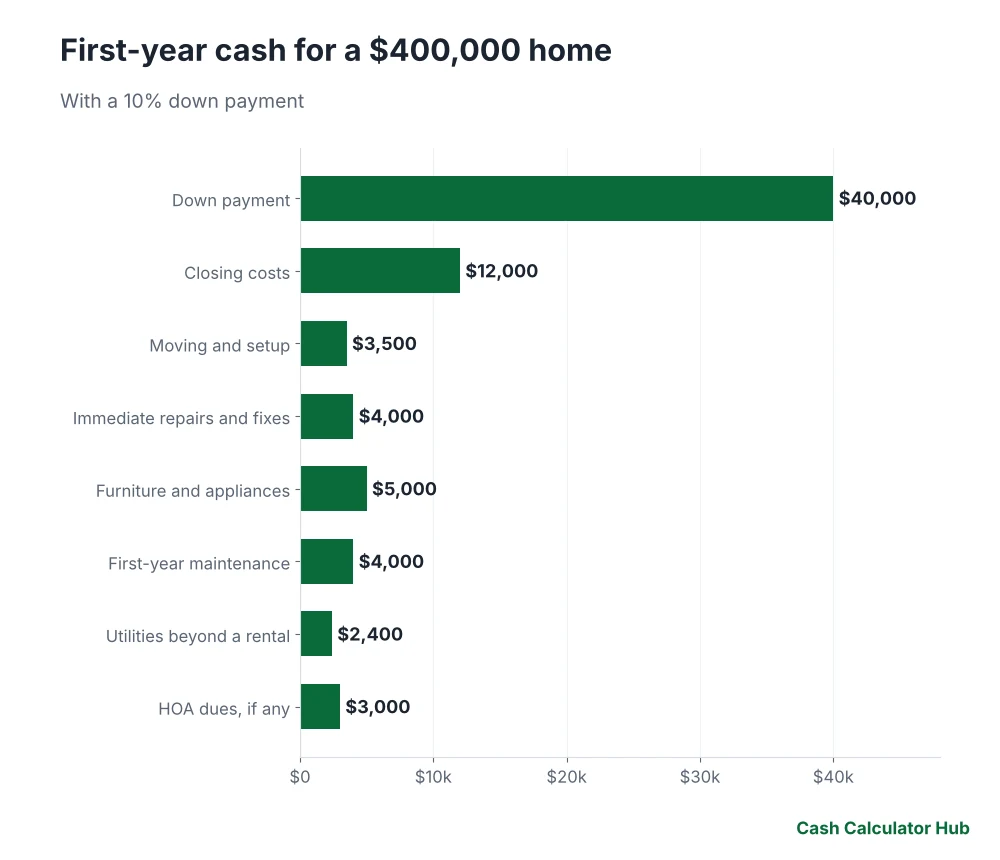
Only the first two lines happen at closing. The rest arrive over the following months. See what closing costs are made of for the second line.
The 1% rule for maintenance
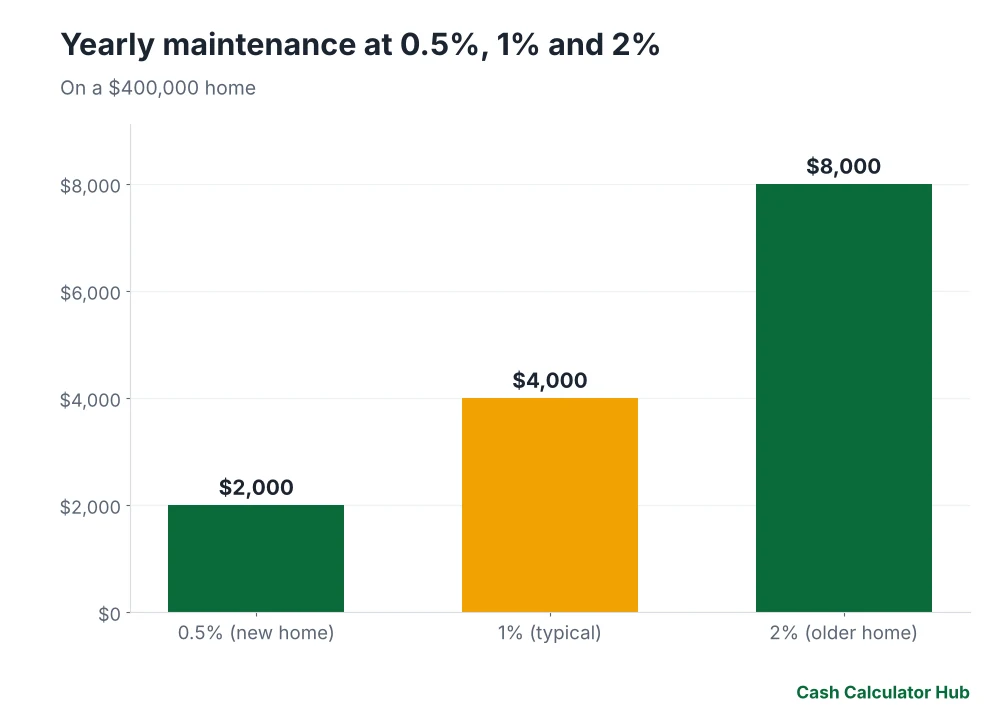
A common planning rule is to set aside 1% of the home’s value each year for maintenance and repairs. For a $400,000 house that is $4,000 a year, or $333 a month. Newer homes may need less in the first few years. Houses over 30 years old can need 2% or more. Big-ticket items show why:
| Item | Typical replacement cost | Typical lifespan |
|---|---|---|
| Roof | $9,000 to $25,000 | 20 to 30 years |
| HVAC system | $7,000 to $15,000 | 15 to 20 years |
| Water heater | $1,200 to $3,000 | 8 to 12 years |
| Exterior paint | $4,000 to $10,000 | 7 to 10 years |
| Appliances (each) | $600 to $2,500 | 10 to 15 years |
Costs are rough and vary widely by region and house. The point is that large repairs are predictable in kind and unpredictable in timing.
Recurring costs that surprise new owners
- Utilities. Larger spaces and a yard usually raise electricity, gas, water and trash bills.
- Insurance changes. Premiums can reset at renewal, and some regions require separate flood or wind coverage.
- Property tax resets. Your bill can rise after reassessment; see the property tax guide.
- HOA and special assessments. Dues rise, and a one-time assessment can run thousands.
- Lawn, snow, pest and security services if you pay someone else.
Own versus rent: include everything
When you compare the two, count mortgage interest, taxes, insurance and maintenance, but not principal (it builds equity). A rent comparison that ignores the 1% rule makes owning look cheaper than it is. The rent versus buy guide runs the full comparison and the rent vs buy calculator does it with your inputs.
How to build a home-repair reserve
- Open a separate savings account for home maintenance.
- Fund it with $333 a month, which is 1% of the price spread over a year.
- Keep another 3 to 6 months of expenses in the general emergency fund.
- Spend from the reserve on repairs and replace it before upgrades.
Reduce the shock
- Get a thorough inspection and use the report to plan, not only to negotiate.
- Ask for the age of the roof, HVAC and water heater, and the utility bills for the past year.
- Buy a home warranty only after reading what it excludes.
- Budget for the first year as if every number above were 20% higher.
Check the plan
Use the real estate calculator to see ownership costs next to the mortgage payment, and the house affordability calculator for the price you can carry. For a longer plan, see mortgage and home calculators.
Frequently asked questions
How much should I save for home maintenance?
A common rule is about 1% of the home’s value each year. For a $400,000 home that is around $4,000 a year, more for older homes.
What are the biggest hidden costs of buying a house?
Closing costs, immediate repairs, moving and furnishing, higher utilities, and recurring maintenance. Property tax and insurance can also rise.
How much cash do I need beyond the down payment?
Plan for 2% to 5% closing costs plus several thousand dollars for moving and repairs, and keep an emergency fund of three to six months of expenses.
Is it cheaper to rent than to buy once all costs are counted?
It depends on how long you stay and local prices. Owning usually wins over longer periods; renting often wins for short stays.
Does a home warranty cover repairs?
It covers listed systems and appliances under its terms, but has exclusions, service fees and caps. Read the contract before you buy.
Sources and further reading
How the numbers were made: Every figure on this page was calculated from the formulas and assumptions stated above and rounded to the nearest dollar. Rates, limits and rules are for 2026 unless noted; confirm current figures with the sources listed before acting.
Keep reading
- Rent vs Buy: How Long Until Buying a Home Wins?
- Closing Costs Explained: What You Pay and How to Lower It
- How Much Down Payment Do You Really Need for a House?
- How Your Credit Score Changes Your Mortgage Rate and Payment
- Cash-Out Refinance vs HELOC: Which Costs Less for $50,000?
- Home Equity: How It Builds, How Much You Can Borrow and When to Use It
This guide is general information, not financial, tax or legal advice. Figures use stated assumptions and 2026 rules and will differ from your situation; check current rules and talk to a licensed professional before you decide. Full disclaimer.