Quick answer: How long to recoup refinance costs? A 0.75-point drop on a $320,000 loan saves $205 a month but takes about 3.9 years to break even.
Everybody has heard the “refinance when rates drop a full point” rule. It is a decent shortcut and a bad decision tool, because it ignores your closing costs, how long you will stay and how much time is left on your current loan. The real question is simple: how many months of savings does it take to pay back what the refinance cost you?
The formula
Break-even months = total closing costs ÷ monthly payment savings
If the number is shorter than the time you plan to keep the loan, the refinance probably wins. If not, skip it. Everything else is a refinement of that.
A worked example
You owe $320,000 at 7.25% with 28 years left. A lender offers 6.50% on a new 30-year loan with closing costs around 3% of the balance, which is $9,600.
- Current payment: $2,228
- New payment: $2,023
- Monthly savings: $205
- Break-even: $9,600 ÷ $205 = 47 months (3.9 years)
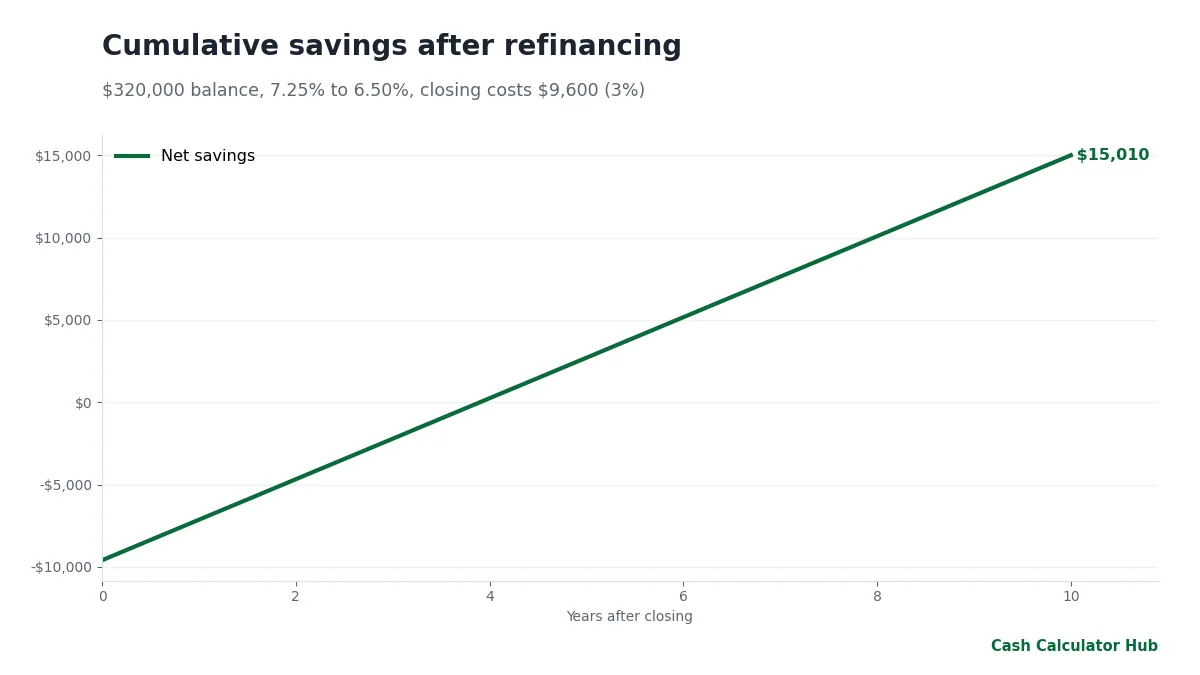
If you stay seven years, you keep roughly $7,627 after costs. If you move in two, you lose about $4,678.
The trap: restarting the clock
In that example the new loan is a fresh 30 years, but you only had 28 left. Your monthly payment drops partly because you are spreading the balance over two more years. That inflates the “savings.”
To measure fairly, compare against a new 28-year loan at 6.50%. The payment would be $2,070, a saving of $157 a month, and the break-even stretches to 61 months (5.1 years).
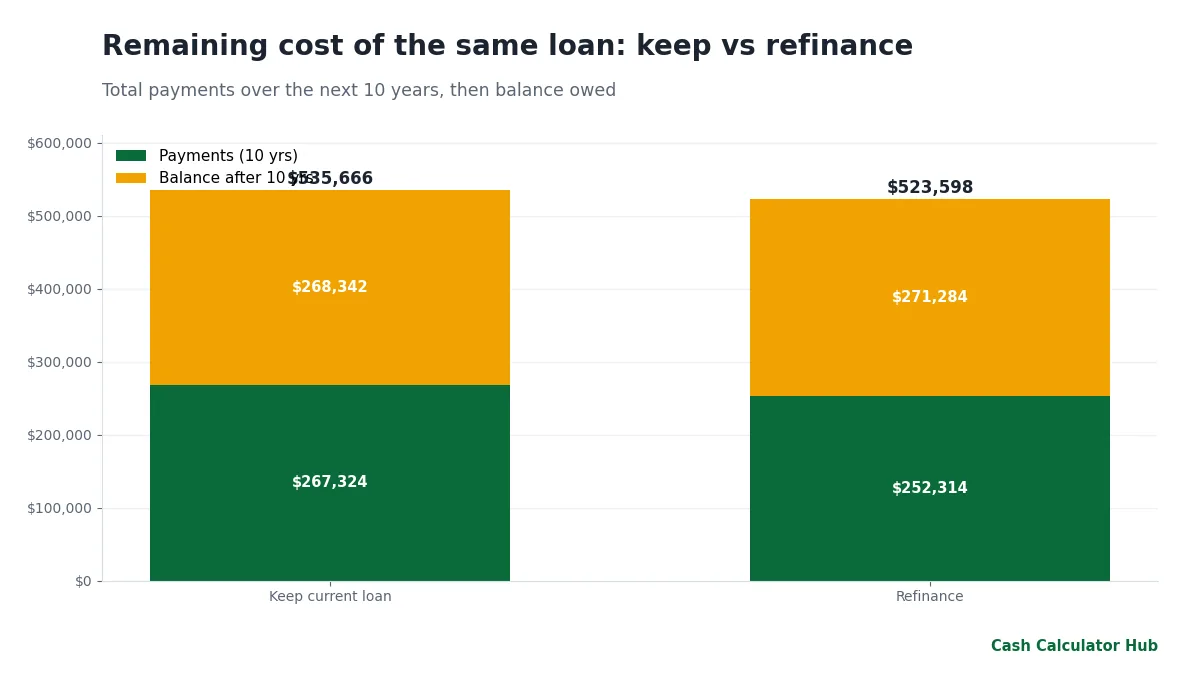
A good habit is to ask for the loan estimate at the same term as your remaining term, or to keep paying the old payment amount after refinancing. If you do that you capture the lower interest without extending the debt.
Total interest, not just the payment
Lower payments feel like wins, but extending the term can cost you more interest overall. Run the whole life of the loan using the refinance calculator, which compares total payments over your time horizon and shows net savings. The APR calculator helps if the new loan includes points, since points are paid up front and change your true cost of borrowing.
Checklist before you apply
- List every cost. Origination, appraisal, title, recording and prepaid items. Some are rolled into the loan; that increases your balance.
- Estimate how long you will stay. Be honest. Job changes and growing families shorten timelines.
- Compare the same term. Use your remaining years for apples-to-apples.
- Check PMI. If your home has appreciated, a new appraisal may remove PMI, a bonus saving.
- Skip cash-out unless you need it. Pulling equity at a higher rate than your current mortgage raises the cost of your whole balance. A HELOC or home equity loan can be cheaper when your first mortgage rate is low.
No-cost refinance: what the lender is not telling you
“No closing cost” refinances are real, but the lender recovers the costs through a higher rate (often 0.25 to 0.5 points). That can be smart if you may move within a few years, and not smart if you stay long. Run both versions and compare break-even.
When refinancing is clearly worth it
- You drop your rate by more than 1 point and expect to stay at least five years.
- You can remove PMI.
- You are switching from an adjustable rate to a fixed rate before a reset.
- You want to shorten the term and the payment stays comfortable.
For the numbers behind the new loan, run the mortgage calculator with the proposed rate, and read our guide on what a $400,000 mortgage costs each month to see how rate changes translate to payments. All tools live in the mortgage and real estate category.
Break-even months by rate drop and closing costs
To save you the arithmetic, here is the break-even (in months) for a $320,000 balance at 7.25% with 28 years left, when you refinance into a new 28-year loan:
| Rate drop | Costs 1.5% ($4,800) | Costs 3% ($9,600) | Costs 4.5% ($14,400) |
|---|---|---|---|
| 0.5 points | 46 mo | 91 mo | 137 mo |
| 0.75 points | 31 mo | 61 mo | 92 mo |
| 1.0 points | 23 mo | 46 mo | 69 mo |
A full-point drop with low costs pays back in under two years. A half-point drop with high costs takes more than eleven years. That one table explains why the “refinance at one point lower” rule works for some people and fails for others: it quietly assumes mid-range costs and a long stay.
What to do when rates are moving up
Mortgage rates rose through the fall of 2026, so the refinance window that many borrowers waited for may not reappear soon. Two practical takeaways. First, if you took out a loan in the last few years at a higher rate and rates are still higher today, a refinance will not pencil out and you can stop researching it. Second, if you have PMI or an adjustable rate approaching a reset, you may still have a good reason to act, because those are about removing a cost, not chasing a headline rate. Run the proposal through the numbers either way rather than guessing.
How much lower should the rate be to refinance?
There is no magic number. A drop of 0.5 to 0.75 points can pay off when closing costs are low and you stay a long time. Use break-even instead of a rule of thumb.
Can I refinance with less than 20% equity?
Often yes, with PMI. FHA and VA have streamline options in some cases.
Does refinancing hurt my credit?
A hard inquiry and a new account cause a small, temporary dip. Rate shopping within a short window is counted as one inquiry for most scoring models.
What if rates are currently rising?
Waiting for a lower rate is a bet. If you are in an adjustable loan or have PMI you can cancel, act on today’s math instead.
Sources and further reading
How the numbers were made: Every figure on this page was calculated from the formulas and assumptions stated above and rounded. Rates, limits and rules are for 2026 unless noted; confirm current figures with the sources listed before acting.
Keep reading
- HELOC vs Home Equity Loan: How to Choose
- Mortgage Payment on a $400,000 House: Real Numbers
- How Much House Can I Afford on a $100K Salary?
- Pay Off Your Mortgage Early: What Extra Payments Really Save
- What Is PMI and How Do You Remove It? Costs and Timeline
- Mortgage Discount Points: When Is Paying for a Lower Rate Worth It?
This guide is general information, not financial, tax or legal advice. Figures use stated assumptions and 2026 rules and will differ from your situation; check current rules and talk to a licensed professional before you decide. Full disclaimer.