Quick answer: Home equity is your home’s market value minus what you owe. On a $400,000 home bought with 10% down at 7.25%, equity grows from $40,000 to about $226,849 after 10 years if prices rise 3% a year. Lenders typically let you borrow up to 80% to 85% of the home’s value in total, including your first mortgage.
Equity is the largest asset many households own. It builds through two engines: paying down the loan and, usually, price growth. In the early years of a 30-year mortgage the second engine often matters more.
This guide shows how both engines work with real numbers and how lenders decide how much of your equity you can use.
Key takeaways
- Equity = current market value − total loan balances.
- Early mortgage payments are mostly interest, so equity grows slowly at first unless prices rise.
- At 3% yearly appreciation equity is $123,946 after 5 years and $226,849 after 10.
- Lenders cap combined loan-to-value (CLTV) at about 80% to 85% on home equity loans and HELOCs.
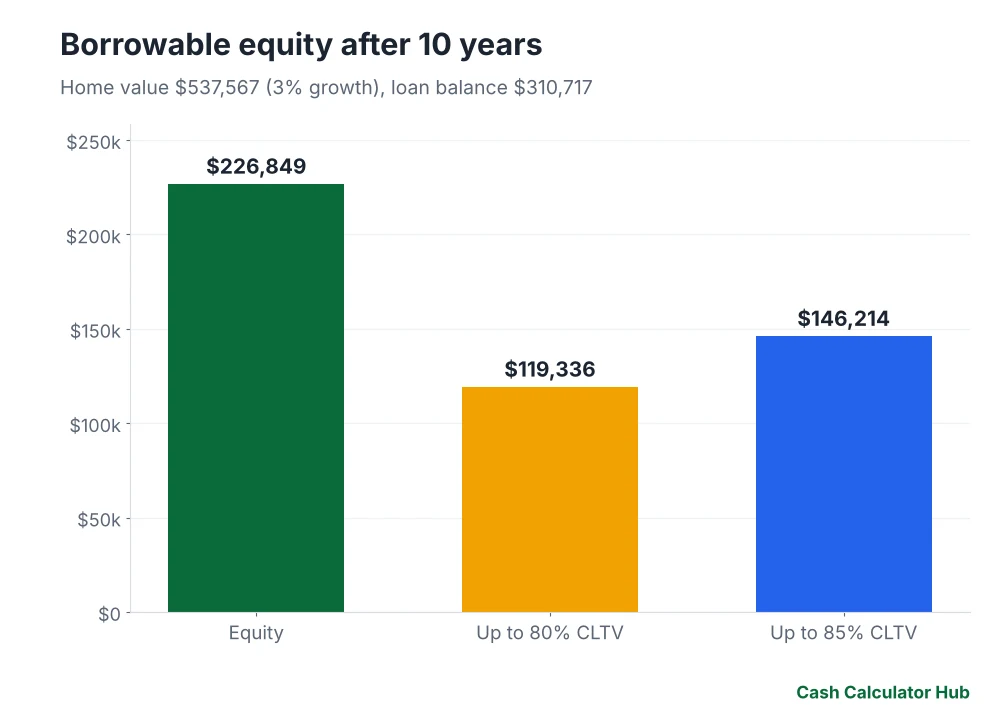
- After 10 years at 3% growth you could borrow about $146,214 total while staying under 85% CLTV.
The two engines
- Principal paydown. Every payment reduces the balance by the principal portion. On a $360,000 loan at 7.25%, the first payment sends about $300 to principal and the rest to interest. By year 10 the monthly principal portion is more than twice that.
- Appreciation. If the home’s value rises, equity rises with it, even without extra payments. If prices fall, equity falls too.
Equity at three growth rates, for a $400,000 purchase with 10% down ($360,000 loan at 7.25%):
| Year | 0% growth | 3% growth | 5% growth |
|---|---|---|---|
| 1 | $43,484 | $55,484 | $63,484 |
| 5 | $60,236 | $123,946 | $170,749 |
| 10 | $89,283 | $226,849 | $340,841 |
| 15 | $130,974 | $354,161 | $562,546 |
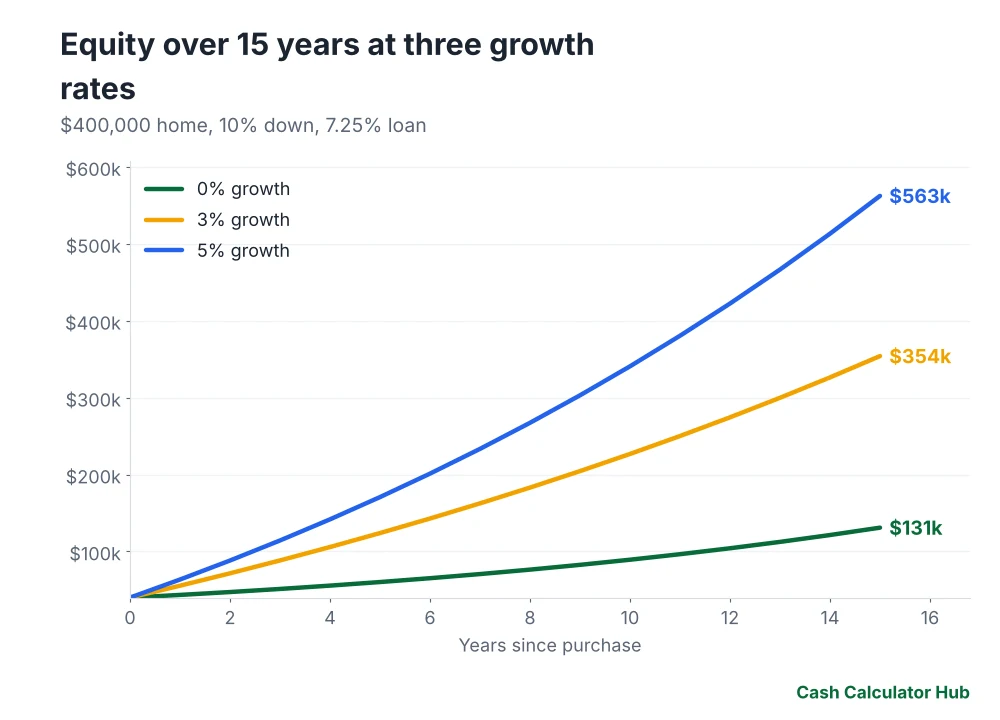
With no price growth you have only $60,236 of equity after 5 years, most of it your original down payment. With 5% growth the same five years add $110,513. This is why timing and market conditions matter for short holding periods, and why the rent versus buy comparison favors staying longer.
How much can you borrow against your equity?
Lenders use combined loan-to-value (CLTV): all loans on the home divided by its value. Most cap CLTV at 80% to 85%.
Borrowable equity = value × max CLTV − current mortgage balance.
For a $400,000 home that has grown to $537,567 after 10 years at 3%, with a balance of $310,717:
| Max CLTV | Total loans allowed | Available to borrow |
|---|---|---|
| 80% | $430,053 | $119,336 |
| 85% | $456,932 | $146,214 |
Ways to use equity
| Tool | How it works | Best for |
|---|---|---|
| HELOC | Revolving line, variable rate | Ongoing or uncertain costs |
| Home equity loan | Lump sum, fixed rate | One-time, known costs |
| Cash-out refinance | New first mortgage for more than you owe | When rates are below your current rate |
| Sale | Realize the equity | Moving or downsizing |
See HELOC versus home equity loan and cash-out refinance versus HELOC to compare costs.
When using equity makes sense
- Improvements that add value or reduce costs, such as a roof or an efficiency upgrade.
- Consolidating high-interest debt, if you stop adding new debt. See is debt consolidation worth it?
- Education or a business with a clear return.
When to be careful
Your home secures the loan. If you cannot repay, you risk foreclosure. Using equity for vacations or depreciating assets is a poor trade, because you will pay interest long after the benefit is gone. A drop in prices can also leave you owing more than the home is worth.
Build equity faster
- Make a larger down payment. Each extra 1% down is $4,000 of equity on day one.
- Pay extra principal. Even small monthly extras compound; see what extra payments save.
- Choose a shorter term if the payment fits. The 15-year loan builds equity much faster; see the 15 versus 30 comparison.
- Remove PMI sooner so more of the payment builds equity. See how to remove PMI.
Calculate yours
The home equity loan calculator and HELOC calculator show payments on what you borrow. The amortization calculator shows principal paydown by year. More: mortgage tools.
Frequently asked questions
How do I calculate my home equity?
Subtract all mortgage and home loan balances from your home’s current market value. For example, a $480,000 home with a $330,000 mortgage has $150,000 of equity.
How much equity do I need to borrow against my home?
Most lenders want at least 15% to 20% equity left after the new loan, meaning a CLTV of 80% to 85% at most.
Does equity grow if I only make minimum payments?
Yes, slowly at first, since early payments are mostly interest. Price growth can add much more than paydown in the early years.
Is home equity the same as cash?
No. It is only accessible by borrowing against it or selling the home, and borrowing adds debt.
Can I lose equity?
Yes. If home prices fall, equity falls, and you can end up with negative equity if the value drops below the loan balance.
Sources and further reading
How the numbers were made: Every figure on this page was calculated from the formulas and assumptions stated above and rounded to the nearest dollar. Rates, limits and rules are for 2026 unless noted; confirm current figures with the sources listed before acting.
Keep reading
- HELOC vs Home Equity Loan: How to Choose
- Pay Off Your Mortgage Early: What Extra Payments Really Save
- Rent vs Buy: How Long Until Buying a Home Wins?
- Cash-Out Refinance vs HELOC: Which Costs Less for $50,000?
- How Your Credit Score Changes Your Mortgage Rate and Payment
- The Hidden Costs of Buying a Home: A First-Year Budget
This guide is general information, not financial, tax or legal advice. Figures use stated assumptions and 2026 rules and will differ from your situation; check current rules and talk to a licensed professional before you decide. Full disclaimer.