Quick answer: FHA or conventional? A $350,000 example shows monthly payment, mortgage insurance and 7-year cost for a 680 and a 760 credit score.
FHA loans have a reputation as the “easy” mortgage and conventional loans as the “better” one. Neither label survives contact with a spreadsheet. Which costs less depends mostly on your credit score and how long you keep the loan, so let us look at both.
How each loan charges for being low-down-payment
FHA loans are insured by the Federal Housing Administration. You can put as little as 3.5% down with a credit score of 580 or higher (10% down for scores between 500 and 579). You pay two kinds of mortgage insurance premium (MIP):
- An upfront premium of 1.75% of the base loan, usually added to the loan balance.
- An annual premium (about 0.50% to 0.55% for most 30-year loans with small down payments) billed monthly.
On the standard 30-year loan, if you put down less than 10% the annual MIP lasts for the life of the loan. With 10% or more down it runs 11 years. The only way to get rid of it earlier is to refinance.
Conventional loans follow Fannie Mae and Freddie Mac rules. Down payments can be as low as 3% on some programs. Private mortgage insurance (PMI) is priced by your credit score and down payment, roughly 0.3% to 1.5% of the loan per year. You can ask to cancel it at 80% loan-to-value, and it ends automatically at 78%.
The comparison, with numbers
Take a $350,000 home with 5% down and a 30-year term. The rates below are illustrative; use your own quotes.
| Borrower with a 680 score | Borrower with a 760 score | |
|---|---|---|
| FHA rate / conv. rate | 6.75% / 7.25% | 6.75% / 6.875% |
| FHA monthly (P&I + MIP) | $2,333 | $2,333 |
| Conventional monthly (P&I + PMI) | $2,545 | $2,295 |
| Conv. PMI rate assumed | 1.00% | 0.40% |
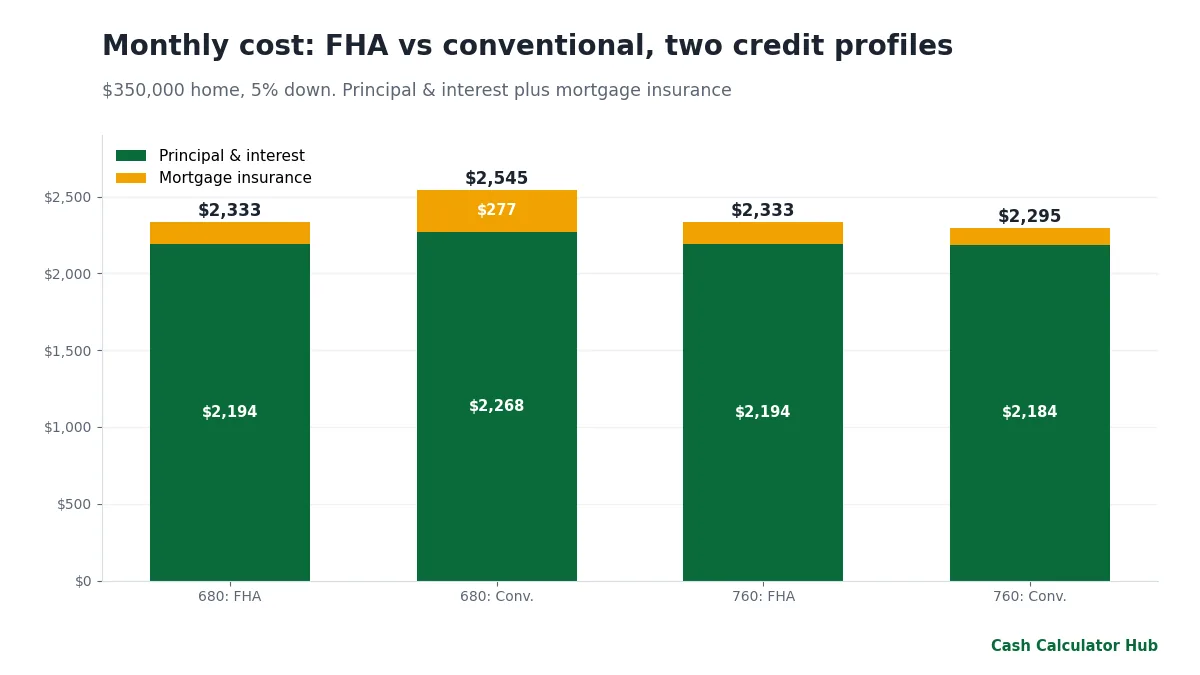
The FHA loan also starts with a bigger balance because the upfront premium is financed: $338,319 compared with $332,500. That matters when you add everything up over several years:
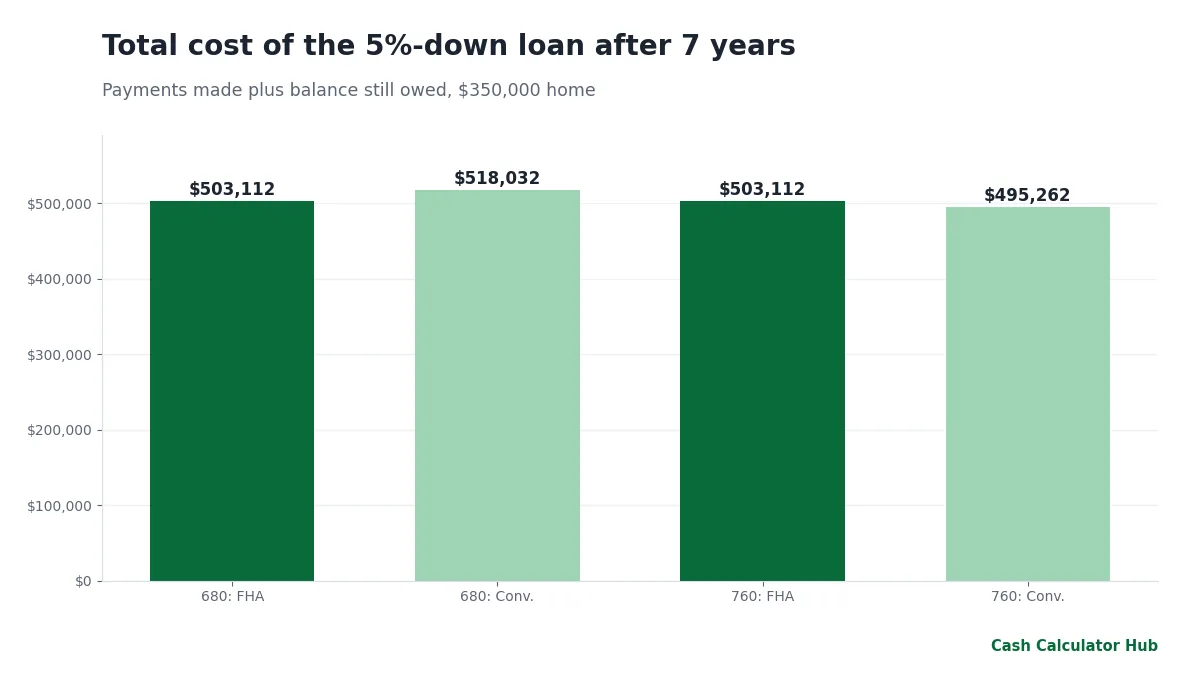
For the 680-score borrower, FHA costs about $14,920 less after seven years. For the 760-score borrower, conventional is about $7,851 cheaper. Same house, same down payment, opposite answer.
Quick rules for deciding
- Score under about 680 with a small down payment: FHA often wins. Conventional PMI gets expensive for lower scores.
- Score 740 or above: conventional is usually cheaper because PMI is low and cancels.
- Planning to stay more than 10 years: remember FHA MIP can last the life of the loan if you put down less than 10%. The cost of that adds up; plan to refinance into a conventional loan once you have 20% equity.
- A high debt-to-income ratio: FHA tolerates it better than most conventional lenders. Check where you stand with the guide to debt-to-income ratio for a mortgage.
Other differences worth knowing
- Property standards. FHA appraisals check condition and safety. A house with peeling paint, a broken railing or a failing roof can stall the loan.
- Loan limits. Both have county-by-county limits that vary widely. Check your county before house hunting.
- Seller concessions. FHA lets sellers pay a higher share of closing costs (up to 6%) than some conventional options.
- Occupancy. FHA is for primary residences only. Conventional can also finance second homes and investment properties.
- Assumable loans. FHA loans can be assumed by a qualified buyer, which could matter if your rate is far below the market when you sell.
Run it yourself
Use the FHA loan calculator to add the upfront and annual MIP to the payment, and the mortgage calculator to model the conventional loan with PMI and an extra payment plan. Then check the monthly total against your income in the house affordability calculator. If you are still deciding how much to put down, read how much down payment you need. VA-eligible buyers should also test the VA mortgage calculator, since VA loans have no monthly mortgage insurance. All tools are in the mortgage category.
Mistakes borrowers make with this choice
- Choosing by rate alone. FHA’s insurance and upfront premium can make the lower rate more expensive than it looks.
- Assuming FHA is for “bad credit” only. Borrowers with strong credit but small down payments also use it, and the numbers sometimes favor it.
- Forgetting the exit plan. If you plan to refinance into a conventional loan after building equity, the upfront FHA premium is a sunk cost; if you plan to stay, the ongoing premium keeps charging.
- Skipping the appraisal rules. A house that needs repairs may need a renovation loan or a different loan type.
- Not asking about both. Many lenders offer both, and the same borrower can see very different quotes. Ask for a side-by-side Loan Estimate.
What credit score do I need for an FHA loan?
580 for the 3.5% down payment option, and 500 to 579 with at least 10% down. Individual lenders usually set higher minimums, often 620 or above.
Is FHA mortgage insurance forever?
On a standard 30-year loan with less than 10% down, yes, unless you refinance. With 10% or more down it lasts 11 years.
Can I get a conventional loan with 3% down?
Yes, through first-time-buyer programs from Fannie Mae and Freddie Mac. Income limits and homebuyer education often apply.
Does FHA cost more overall?
For high-score borrowers, usually. For borrowers below about 700, often not. Compare real quotes.
Sources and further reading
How the numbers were made: Every figure on this page was calculated from the formulas and assumptions stated above and rounded. Rates, limits and rules are for 2026 unless noted; confirm current figures with the sources listed before acting.
Keep reading
- Debt-to-Income Ratio for a Mortgage: What Lenders Allow
- How Much Down Payment Do You Really Need for a House?
- How Much House Can I Afford on a $100K Salary?
- What Is PMI and How Do You Remove It? Costs and Timeline
- Credit Score Factors: What Moves Your Score and by How Much
- Mortgage Recast vs Refinance: Which Lowers Your Payment Better?
This guide is general information, not financial, tax or legal advice. Figures use stated assumptions and 2026 rules and will differ from your situation; check current rules and talk to a licensed professional before you decide. Full disclaimer.