Quick answer: Private mortgage insurance (PMI) is a fee on conventional loans with less than 20% down. It typically costs 0.3% to 1.5% of the loan per year. You can ask to cancel it once your balance reaches 80% of the home’s original value, and it ends automatically at 78%.
PMI is one of the most misunderstood lines on a mortgage estimate. It does not protect you if you miss payments; it reimburses the lender. You pay for it because a small down payment makes the loan riskier for them.
The good news is that, unlike FHA mortgage insurance, PMI on a conventional loan has an end date you can influence.
Key takeaways
- PMI applies to conventional loans when your down payment is under 20%.
- Typical cost is 0.3% to 1.5% of the loan per year, set mostly by credit score and down payment.
- You can request cancellation at 80% loan-to-value; the servicer must drop it automatically at 78% if you are current.
- On a $380,000 loan, PMI at 0.75% costs about $238 a month, or roughly $31,588 before it can be cancelled.
- Extra principal payments or a higher appraisal can end PMI sooner.
How much does PMI cost?
Lenders price PMI as an annual percentage of the loan, then divide it into monthly payments. Higher credit scores and bigger down payments pull the percentage down. The table uses 0.5% (strong credit) and 1.0% (weaker credit) as examples.
| Home price | Down payment | Loan | PMI at 0.5% a year, per month | PMI at 1.0% a year, per month |
|---|---|---|---|---|
| $300,000 | 5% | $285,000 | $119 | $238 |
| $300,000 | 10% | $270,000 | $112 | $225 |
| $400,000 | 5% | $380,000 | $158 | $317 |
| $400,000 | 10% | $360,000 | $150 | $300 |
| $500,000 | 10% | $450,000 | $188 | $375 |
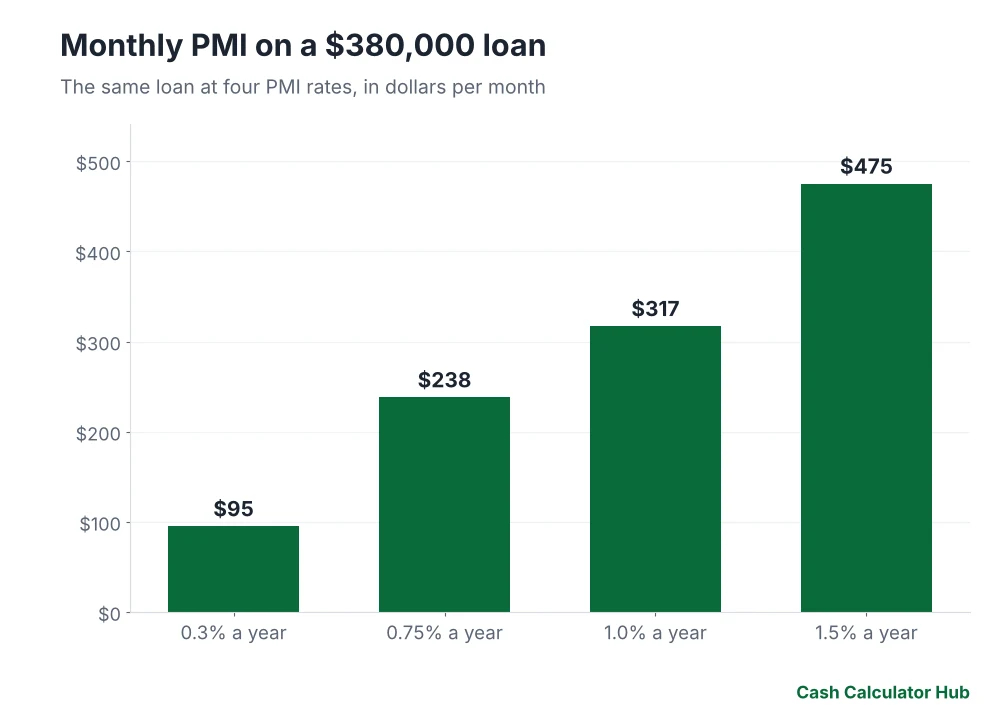
A 5% down payment and a middling credit score can put PMI at $250 or more a month on a $400,000 home. That is on top of principal, interest, taxes and insurance, so include it when you test affordability in the house affordability calculator.
How PMI is removed: the 80% and 78% rules
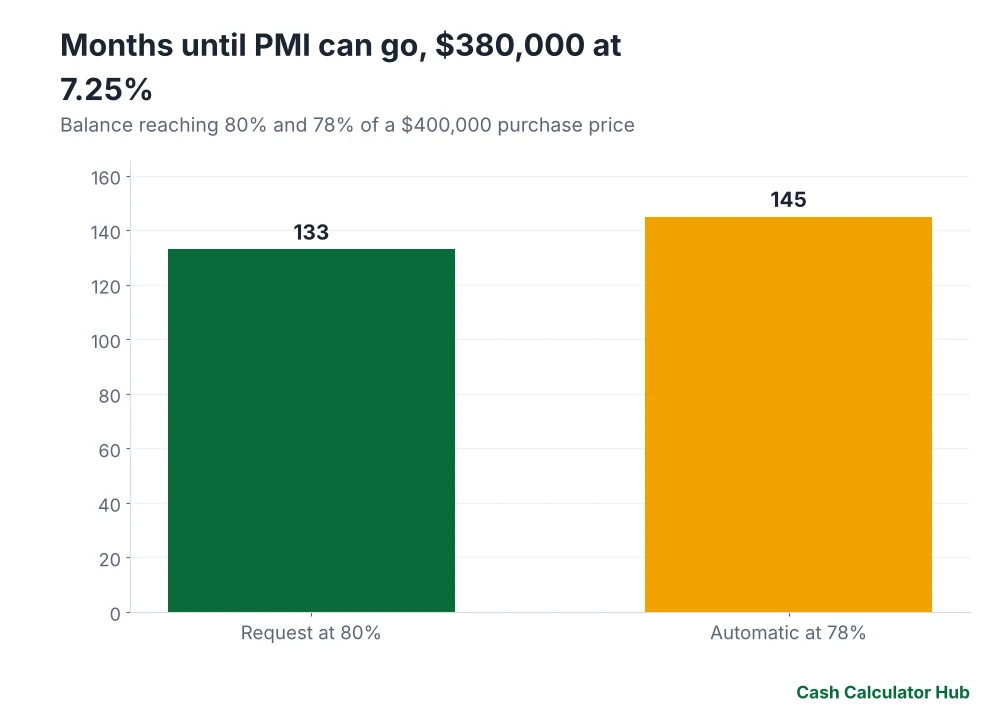
The Homeowners Protection Act sets two dates for conventional loans on a primary home. First, you may ask the servicer in writing to cancel PMI once your balance reaches 80% of the home’s original value (the lower of the purchase price or appraised value at closing), if you are current and have no second liens. Second, the servicer must end it automatically when the scheduled balance reaches 78%. A final backstop ends it at the midpoint of the loan term.
Example: you buy a $400,000 home with 5% down ($380,000 loan) at 7.25%. The balance reaches 80% of $400,000 ($320,000) after about 133 months (11.1 years) of regular payments, and 78% ($312,000) after 145 months (12.1 years). On a pure payment schedule you pay PMI for more than 11 years.
Ways to drop PMI sooner
- Pay extra principal. Even $200 a month cuts years off the PMI period. Model it in the mortgage payoff calculator.
- Ask for a new appraisal. If prices rose, your loan may already be below 80% of today’s value. Many servicers allow cancellation on current value after a seasoning period, often two to five years.
- Refinance. If you have 20% equity and the rate works, a new loan carries no PMI. Test it with the refinance break-even guide.
- Add value you can document. Improvements only help if the appraisal reflects them, so do not spend money just to remove PMI.
PMI options at a glance
| Option | How it works | Trade-off |
|---|---|---|
| Monthly PMI | Added to each payment | Cancelable; no upfront cost |
| Single-premium PMI | One payment at closing | Not refundable if you sell or refinance early |
| Lender-paid PMI | Built into a higher interest rate | The higher rate lasts for the life of the loan |
| Piggyback (80-10-10) | A second loan covers part of the down payment | The second loan has its own rate and terms |
PMI versus FHA mortgage insurance
FHA loans charge an upfront premium of 1.75% and an annual premium of about 0.55% for most borrowers. With less than 10% down, the annual premium lasts for the life of the loan; with 10% or more it lasts 11 years. If you plan to stay a long time, a conventional loan with cancelable PMI is often cheaper. Compare them in FHA versus conventional loans.
Is it worth paying PMI to buy sooner?
Sometimes. If waiting to save 20% means prices or rents climb faster than your savings, paying PMI for a few years can cost less than waiting. If you are close to 20% already, the PMI price is a clear signal to keep saving a little longer. See how much down payment you really need.
Tax treatment
Mortgage insurance premiums were not deductible for tax years 2022 to 2025. Legislation passed in 2025 restored the deduction for itemizers beginning with tax year 2026, with an income phase-out that starts at about $100,000 of adjusted gross income. Whether it helps depends on whether you itemize, so check current IRS guidance.
Check your numbers
Enter the price, down payment and rate in the mortgage calculator and include PMI in the monthly cost. Then use the down payment calculator to see how much more you need to reach 20%. More: mortgage tools.
Frequently asked questions
Is PMI tax deductible?
Starting with tax year 2026 the deduction for mortgage insurance premiums is available again for people who itemize, subject to an income phase-out. It was not available for 2022 through 2025. Check current IRS guidance.
Does PMI go away automatically?
Yes. If you are current on payments, the servicer must terminate PMI when the scheduled balance reaches 78% of the original value, and no later than the midpoint of the loan term.
Can I cancel PMI if my home value went up?
Often. Many servicers will cancel based on a new appraisal if the loan is under 80% of the current value, subject to a seasoning period and a clean payment history.
What credit score gets the cheapest PMI?
The best pricing generally goes to scores of about 760 and above. Each lower band raises the rate.
Does 10% down avoid PMI?
No. Conventional loans require 20% down to avoid PMI, unless you use lender-paid PMI or a piggyback loan, which have costs of their own.
Sources and further reading
How the numbers were made: Every figure on this page was calculated from the formulas and assumptions stated above and rounded to the nearest dollar. Rates, limits and rules are for 2026 unless noted; confirm current figures with the sources listed before acting.
Keep reading
- How Much Down Payment Do You Really Need for a House?
- FHA vs Conventional Loan: Which Costs Less?
- Mortgage Refinance Break-Even Point: Is It Worth It?
- Mortgage Recast vs Refinance: Which Lowers Your Payment Better?
- Closing Costs Explained: What You Pay and How to Lower It
- ARM vs Fixed-Rate Mortgage: What a 5/1 ARM Really Costs
This guide is general information, not financial, tax or legal advice. Figures use stated assumptions and 2026 rules and will differ from your situation; check current rules and talk to a licensed professional before you decide. Full disclaimer.