
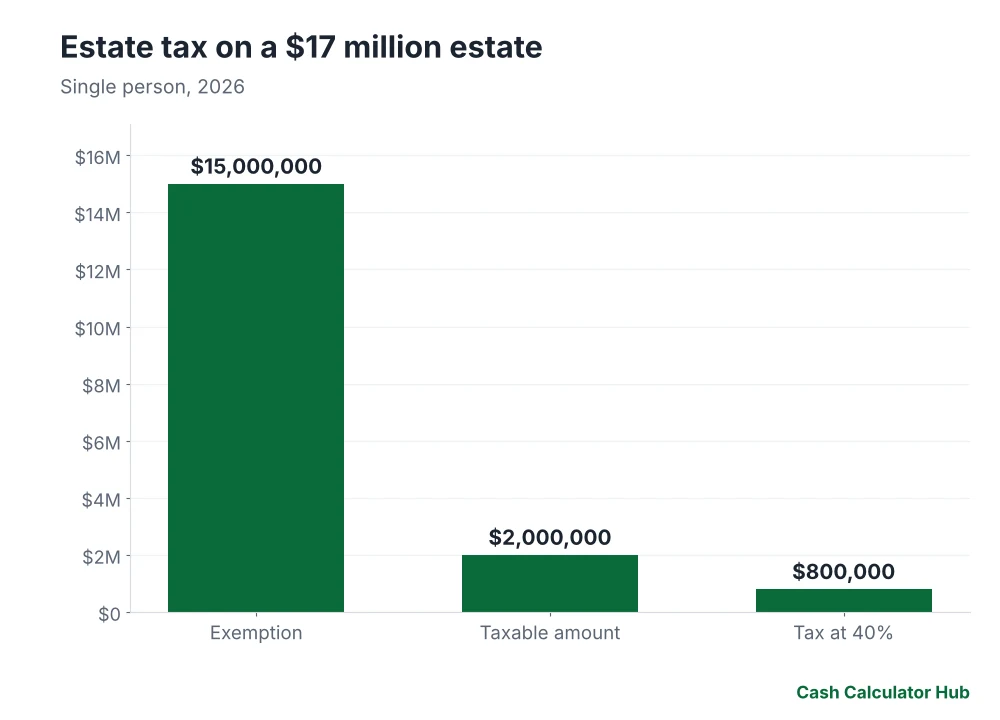
Quick answer: For 2026 you can give $19,000 per recipient per year without filing a gift tax return, and the federal estate and lifetime gift exemption is $15 million per person ($30 million for a married couple using portability). Amounts above the exemption are taxed at up to 40%: a $17 million estate would owe about $800,000.
The federal estate tax affects very few households today, but state estate and inheritance taxes can apply at much lower thresholds, and gifting rules matter for families who help children and grandchildren. This guide separates the federal rules from the state ones and shows a worked example.
Key takeaways
- Annual gift exclusion: $19,000 per recipient in 2026 ($38,000 for a married couple giving together).
- Federal estate and lifetime gift exemption: $15 million per person in 2026.
- The top rate on amounts over the exemption is 40%.
- Gifts above the annual exclusion reduce the lifetime exemption but usually trigger no tax.
- Some states have their own estate or inheritance taxes with lower thresholds.
2026 federal numbers
| Item | Amount |
|---|---|
| Annual gift exclusion (per recipient) | $19,000 |
| Lifetime exemption (estate and gift combined) | $15,000,000 per person |
| Married couple, with portability | Up to $30,000,000 |
| Top federal rate | 40% |
| Tuition and medical payments paid directly to the provider | Unlimited, not counted |
Example: a $17 million estate
| Item | Amount |
|---|---|
| Estate value | $17,000,000 |
| Exemption | −$15,000,000 |
| Taxable estate | $2,000,000 |
| Estate tax at 40% | $800,000 |
For a married couple with a $17 million combined estate, using portability (the surviving spouse inherits the unused exemption) the estate owes nothing, because the combined exemption is $30 million.
Gifting in practice
Suppose a couple gives each of their three children $38,000 a year ($19,000 each from both spouses). That moves $114,000 a year out of the estate with no gift tax return required. Over ten years that is $1,140,000 plus any growth, outside the estate.
| Years | Total moved out of the estate |
|---|---|
| 1 | $114,000 |
| 5 | $570,000 |
| 10 | $1,140,000 |
| 20 | $2,280,000 |

Gifts over $19,000 to one person require filing Form 709 but usually no tax, because they count against the lifetime exemption.
Basis step-up
Assets inherited receive a stepped-up cost basis to market value at death, which can erase capital gains; assets gifted during life carry the donor’s original basis. That makes gifting highly appreciated assets less attractive; see capital gains tax.
State taxes
A number of states levy an estate tax or inheritance tax, with thresholds as low as about $1 million to a few million dollars. Check your state’s rules; they are not tied to the federal exemption.
Other tools
Trusts, life insurance in an irrevocable trust and charitable giving can all be part of planning. Beneficiary designations on retirement accounts override the will; see inherited account rules.
Estimate
Use the estate tax calculator for a quick figure and income tax calculator for related income tax. More: tax tools. Consult an estate attorney for complex situations.
Frequently asked questions
What is the federal estate tax exemption for 2026?
$15 million per person, or up to $30 million for a married couple using portability.
How much can I gift without paying gift tax?
$19,000 per recipient per year in 2026 without filing; larger gifts count against your lifetime exemption.
What is the estate tax rate?
The top federal rate is 40% on the amount above the exemption.
Do my heirs pay tax on an inheritance?
There is generally no federal income tax on inherited cash or property, but some states have inheritance taxes, and inherited retirement accounts can be taxable.
What is portability?
A rule letting a surviving spouse use the deceased spouse’s unused estate tax exemption if an estate tax return is filed.
Sources and further reading
How the numbers were made: Every figure on this page was calculated from the formulas and assumptions stated above and rounded to the nearest dollar. Rates, limits and rules are for 2026 unless noted; confirm current figures with the sources listed before acting.
Keep reading
- 2026 Federal Tax Brackets and Standard Deduction, Explained With Examples
- Required Minimum Distributions: Age 73 or 75, and How to Calculate Yours
- 529 College Savings Plans: How Much to Save and How the Tax Rules Work
- Take-Home Pay on $50K, $75K and $150K Salaries (2026 Federal Taxes)
- Overtime and Bonus Pay: Why the Tax Looks So High and How Much You Really Keep
- HSA vs FSA: Which Health Account Is Better and What Are the 2026 Limits?
This guide is general information, not financial, tax or legal advice. Figures use stated assumptions and 2026 rules and will differ from your situation; check current rules and talk to a licensed professional before you decide. Full disclaimer.