Quick answer: Most households need an emergency fund of three to six months of essential expenses: $12,000 to $24,000 for someone spending $4,000 a month. Start with a $1,000 starter fund, then build toward three months, and aim for six or more if your income is irregular or you support others.
An emergency fund is cash for job loss, medical bills, car repairs and other costs that cannot wait. Its value is not the interest it earns; it is that you do not have to borrow at 22% when something goes wrong.
The right size depends on your expenses and how stable your income is. Use essential costs, not your full budget: housing, utilities, food, transportation, insurance and minimum debt payments.
Key takeaways
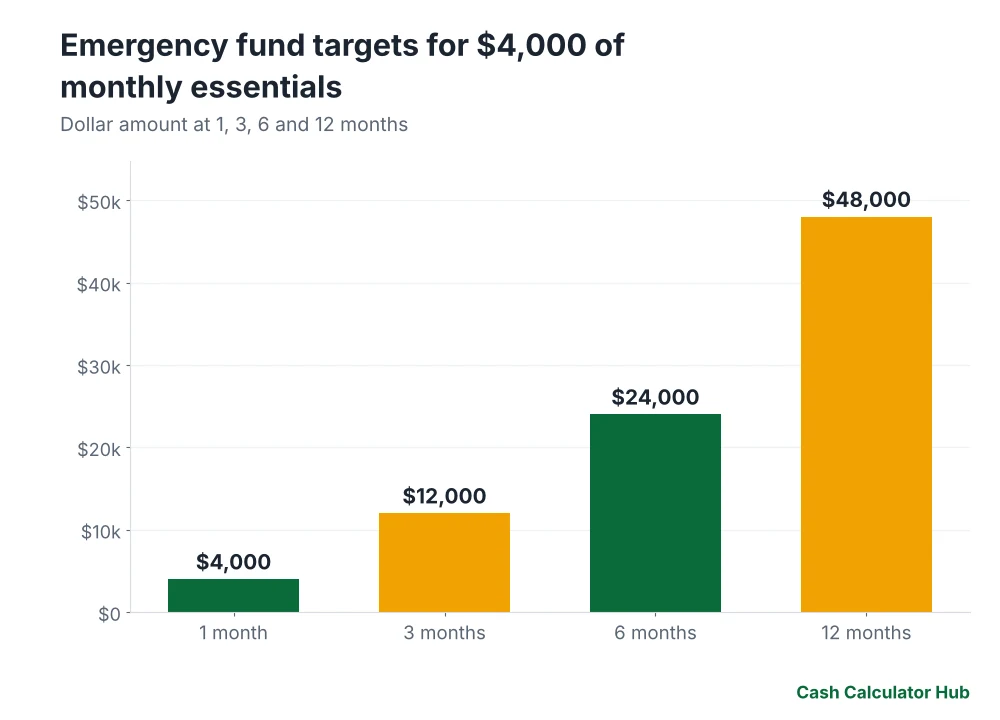
- For $4,000 of monthly essentials, three months is $12,000 and six months is $24,000.
- Start with a $1,000 starter fund, then grow it in stages.
- Keep it in a high-yield savings account or similar insured, liquid account, not in stocks.
- Without a fund, a $5,000 emergency on a 22% card paid at $150 a month costs $2,796 in interest and takes 4 yr 4 mo.
- Rebuild the fund after you use it.
How much is enough?
| Situation | Suggested months of essential expenses |
|---|---|
| Two stable incomes, no dependents | 3 |
| Single income, stable job | 3 to 6 |
| One income with dependents | 6 |
| Self-employed, commission or seasonal work | 6 to 12 |
| Near retirement, relying on investments | 6 to 12 in cash and short-term bonds |
For $4,000 a month in essentials: 3 months = $12,000, 6 months = $24,000, 12 months = $48,000.
Why essentials, not your whole budget
In an emergency you cut subscriptions, dining out and travel. Use the bare-bones number. List what you cannot skip: rent or mortgage, utilities, groceries, insurance, transportation, minimum debt payments and childcare. The 50/30/20 rule calls these your needs.
How long it takes to build
| Saved each month | Time to $12,000 | Time to $24,000 |
|---|---|---|
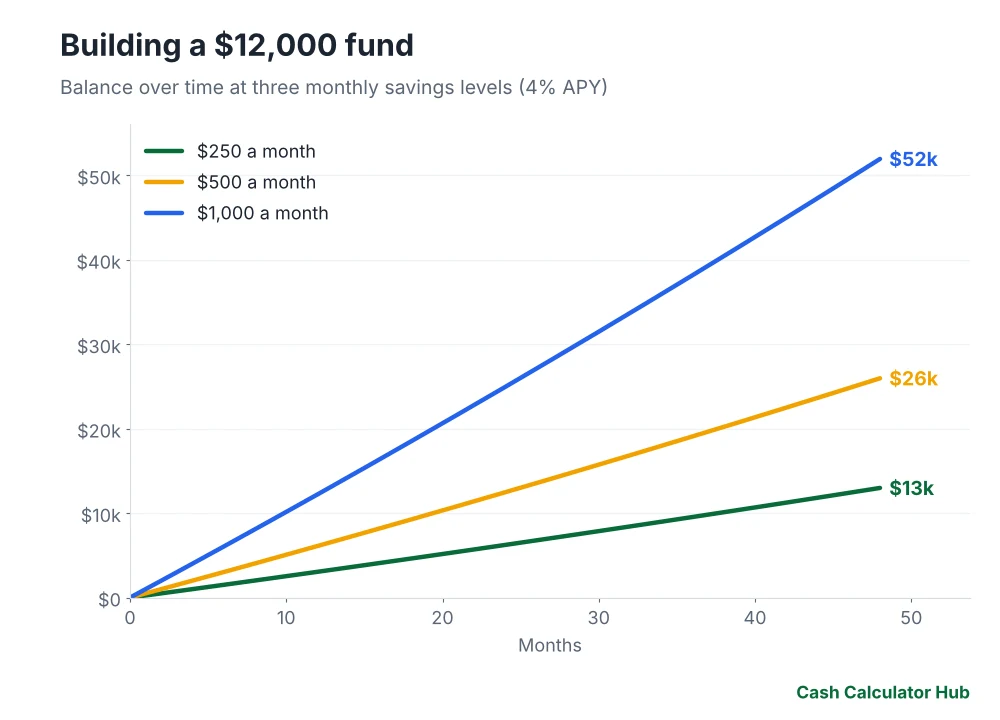
| $250 | 48 months | 96 months |
| $500 | 24 months | 48 months |
| $1,000 | 12 months | 24 months |
Interest at 4% shortens these times only slightly, but every month counts. Automate a transfer on payday so the fund builds without a decision each month.
A staged plan
- $1,000 starter fund. Covers most small emergencies and stops new card debt.
- One month of essentials. Now a car repair is not a crisis.
- Three months. The standard first target.
- Six months if your situation calls for it.
Pay down high-interest debt in parallel; see avalanche vs snowball.
Where to keep it
- High-yield savings account: FDIC or NCUA insured, easy transfers, a competitive rate. See how APY and insurance work.
- Money market account: similar, sometimes with check-writing.
- Short-term Treasury bills or CDs for the part you are unlikely to touch; see savings account versus CD.
Avoid investing the fund in stocks. A market drop and a job loss often arrive together.
What counts as an emergency
- Job loss or sharp income drop
- Medical or dental bills
- Urgent car or home repairs
- Emergency travel for family
Planned costs are not emergencies: holidays, annual insurance premiums, tuition. Cover those with sinking funds, covered in the sinking funds guide.
What it costs if you have none
A $5,000 emergency charged to a card at 22% and paid at $150 a month takes 4 yr 4 mo and costs $2,796 in interest. A $5,000 cash fund avoids it. See how long card debt lasts.
Keep the fund separate
Open a separate account so the money is not mixed with daily spending. Name it. Review the target each year or after a major life change: a new baby, a new mortgage, a change in job.
Build it
Use the savings calculator to set the monthly deposit and timeline and the budget calculator to find your essential costs. More: savings and investing calculators.
Frequently asked questions
How many months of expenses should an emergency fund cover?
Three to six months of essential expenses is the standard. Choose the upper end or more if your income is irregular, you have dependents or you are self-employed.
Where should I keep my emergency fund?
In an insured, liquid account such as a high-yield savings account or money market account. Avoid stocks for this money.
Should I pay off debt or build an emergency fund first?
Build a small starter fund first, then pay down high-interest debt while adding to savings. Without any cushion, new emergencies go on cards.
Is $1,000 enough for an emergency fund?
It is a good starting point for small surprises, but not enough for job loss. Build toward three to six months.
Do I still need an emergency fund if I have investments?
Yes. Investments can be down when you need cash, and selling can trigger taxes or penalties.
Sources and further reading
- Consumer Financial Protection Bureau
- FDIC: Deposit insurance
- MyMoney.gov: Financial literacy resources
How the numbers were made: Every figure on this page was calculated from the formulas and assumptions stated above and rounded to the nearest dollar. Rates, limits and rules are for 2026 unless noted; confirm current figures with the sources listed before acting.
Keep reading
- The 50/30/20 Budget Rule: How It Works, and How to Adjust It
- Savings Account vs CD: Which Earns More for Your Cash?
- How Long to Pay Off a Credit Card Making Only the Minimum?
- High-Yield Savings Accounts: APY, Insurance Limits and What You Really Earn
- Stocks vs Bonds: How to Choose Your Asset Allocation
- Index Fund vs ETF vs Mutual Fund: Differences, Costs and Taxes
This guide is general information, not financial, tax or legal advice. Figures use stated assumptions and 2026 rules and will differ from your situation; check current rules and talk to a licensed professional before you decide. Full disclaimer.