
Quick answer: Do you pay more tax married than single? For most couples the 2026 brackets are neutral or a bonus. The penalty shows up at very high incomes.
The marriage penalty has a scary reputation. For federal income tax it applies to far fewer people than you would guess, and many couples get a marriage bonus. Whether it applies to you depends on two things: how similar your incomes are and how high they are.
Why it happens
Federal brackets and the standard deduction are designed for three filing statuses. The standard deduction for married filing jointly in 2026 is exactly twice the single one ($32,200 versus $16,100). The 10%, 12%, 22%, 24%, 32% and 35% brackets for joint filers are also exactly twice as wide as for single filers. That means two equal earners combined pay the same tax as they would apart, up to the 35% bracket.
The differences come from two places:
- A one-earner couple (or very unequal incomes) is pushed into lower brackets by the wider joint brackets. That is a bonus.
- The top bracket (37%). Joint filers hit it at $768,700 of taxable income, but singles hit it at $640,600, so two high earners together reach it before 2 × the single limit. That is a penalty.
Five examples (2026, wages only)
| Couple | Tax as two singles | Tax married jointly | Difference |
|---|---|---|---|
| $100K + $100K | $26,340 | $26,340 | No difference |
| $150K + $0 | $24,734 | $15,340 | Bonus $9,394 |
| $250K + $250K | $102,608 | $102,608 | No difference |
| $400K + $400K | $206,268 | $206,268 | No difference |
| $700K + $700K | $418,000 | $428,250 | Penalty $10,250 |
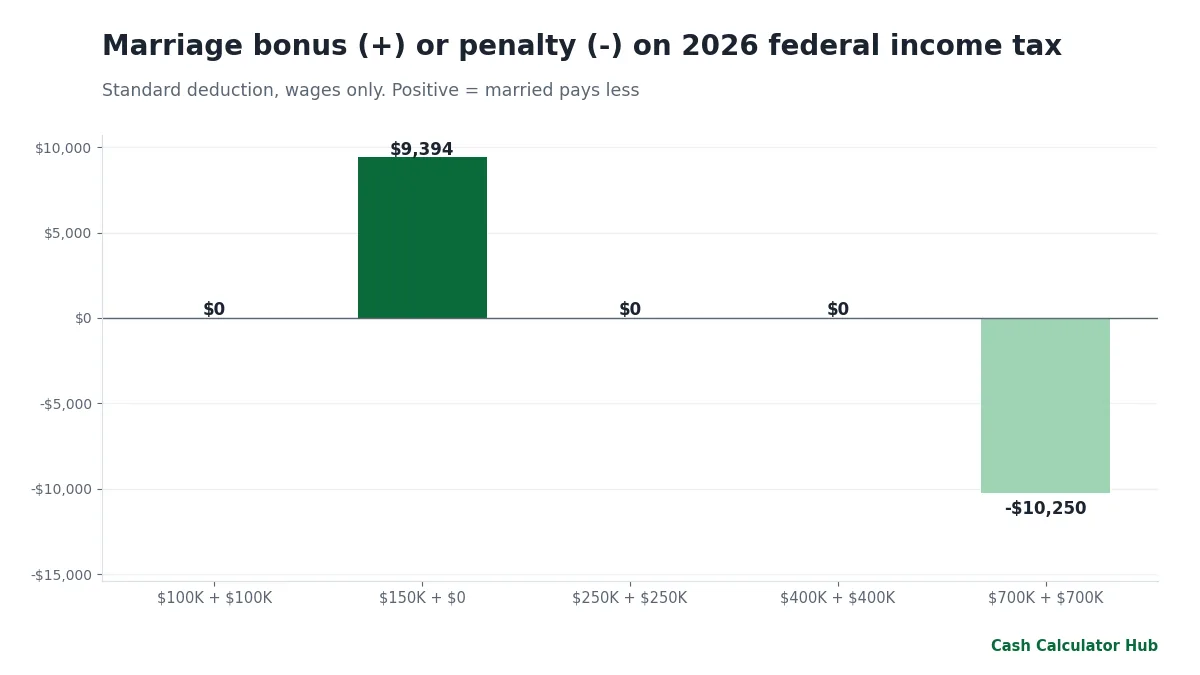
Two $100,000 earners pay exactly the same tax married or single. A couple where one spouse earns $150,000 and the other nothing saves $9,394. At $700,000 each, the couple pays $10,250 more than if they stayed single.
Penalties outside the brackets
The bracket math is only part of the story. Other rules can penalize joint filers:
- The state and local tax (SALT) deduction cap applies per return, not per person. Two single filers can each claim up to the cap; a married couple gets one cap. Check the current cap rules, which have been changing.
- The 3.8% net investment income tax has the same $200,000 threshold for singles but $250,000 (not $400,000) for joint filers.
- Additional 0.9% Medicare tax is also $200,000 single / $250,000 joint.
- Credits and deductions such as the student loan interest deduction, EITC and Roth IRA eligibility phase out at lower relative thresholds for couples.
- Income-driven student loan payments may use joint income.
- Medicaid and subsidies. Marriage can change eligibility for health insurance subsidies.
When filing separately helps
Married filing separately is occasionally beneficial: for example, when one spouse has large medical expenses, when you want to keep student loan payments tied to one income, or when one spouse has tax problems. It also loses many credits. Always run both versions.
Planning before the wedding
- Compare your two incomes using the marriage tax calculator.
- If you are close to a threshold, consider the date: marrying on December 31 counts for the whole year.
- Update your W-4 to avoid under-withholding; two earners each withholding as single can still end up owing.
- Review benefits: employer insurance, retirement match and estate planning (see the estate tax calculator for how the exemption applies to couples).
Check your own numbers
The income tax calculator has all three filing statuses, so you can run your own version of the table above, and the 2026 federal bracket guide lists each threshold. See the combined paycheck impact in the take-home paycheck calculator. More in tax tools.
Two-earner W-4 trap
Each spouse’s employer withholds as if that job were your only income. When both spouses work, the combined withholding can fall short, especially if the earners have similar pay. The result is an unexpected bill in April. Use the IRS Tax Withholding Estimator or the multiple-jobs section of the W-4 to adjust. You can also increase withholding on one paycheck.
Practical year-end review
- Compare joint and separate returns each year, especially if you have large medical bills or student loans in an income-driven plan.
- Look at the take-home paycheck calculator for both incomes together.
- If one spouse changes jobs or starts a business, rerun your estimates mid-year instead of waiting for filing season.
Does getting married lower my taxes?
Often yes if your incomes differ, and no change if they are similar and under about $640,000 each.
What is the marriage penalty threshold?
For federal income tax brackets, it affects only couples with taxable income above the 35% bracket. Other provisions can affect couples at lower incomes.
Do we have to file jointly?
No. You can file separately, though it often costs more.
Does this apply to state taxes?
Rules vary. Some states mirror federal rules; others do not.
Sources and further reading
How the numbers were made: Every figure on this page was calculated from the formulas and assumptions stated above and rounded. Rates, limits and rules are for 2026 unless noted; confirm current figures with the sources listed before acting.
Keep reading
- 2026 Federal Tax Brackets and Standard Deduction, Explained With Examples
- How Much Is a $100,000 Salary After Taxes in 2026?
- Hourly to Salary: What Is $25 an Hour Per Year?
- Student Loan Repayment in 2026: What Changed and How to Run Your Numbers
- Standard vs Itemized Deduction 2026: Which Saves You More?
- How to Read Your Paycheck: Gross Pay, Withholding and Net Pay Explained
This guide is general information, not financial, tax or legal advice. Figures use stated assumptions and 2026 rules and will differ from your situation; check current rules and talk to a licensed professional before you decide. Full disclaimer.