Quick answer: A zero-based budget assigns every dollar of your monthly income to a category (bills, spending, saving, debt) so that income minus planned spending equals zero. It does not mean spending everything; savings and debt payments are categories too. It works well for people who want precise control and for variable expenses.
Most budgets are guidelines. A zero-based budget is a plan: before the month starts, you decide where each dollar goes. It keeps small leaks from consuming money meant for goals, and it makes trade-offs visible.
Key takeaways
- Income − all planned categories = $0, including savings and debt payments.
- Plan before the month begins, then adjust as real spending shows up.
- Use sinking funds for irregular costs such as car repairs and gifts.
- Review weekly; move money between categories rather than ignoring overspending.
- It differs from 50/30/20 by being detailed and category-level.
Example: $4,500 monthly take-home
| Category | Amount |
|---|---|
| Rent | $1,500 |
| Utilities | $200 |
| Groceries | $500 |
| Transport | $350 |
| Insurance | $150 |
| Debt payments | $300 |
| Eating out | $200 |
| Fun | $150 |
| Subscriptions | $50 |
| Emergency fund | $500 |
| Retirement (Roth IRA) | $400 |
| Sinking funds | $200 |
| Total planned | $4,500 |
| Income | $4,500 |
| Left to assign | $0 |
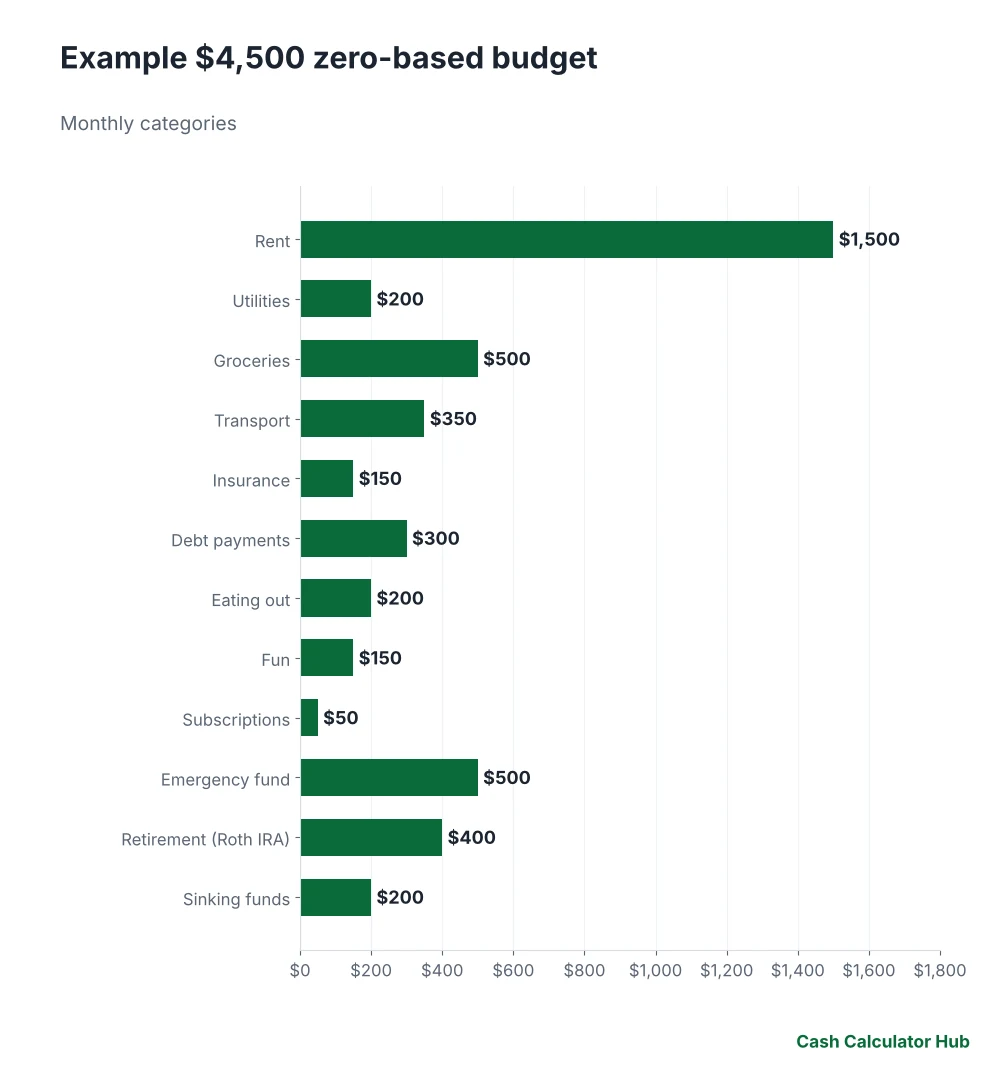
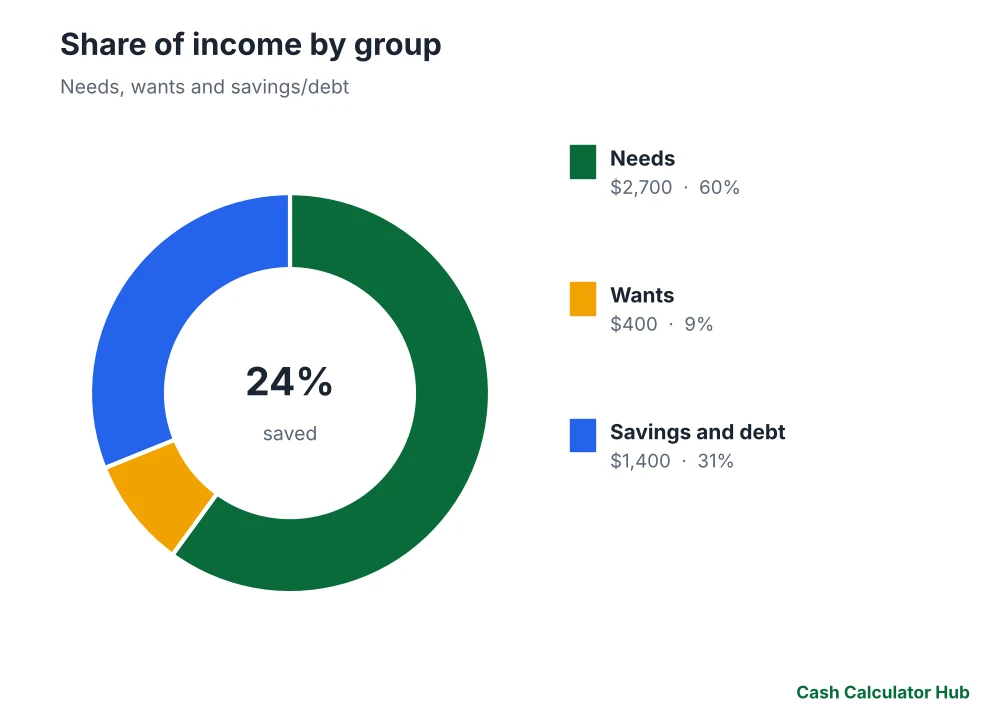
Here planned spending equals income, so the budget is zero-based. Savings categories ($1,100 a month, 24% of income) are treated the same as bills.
Steps
- Write down take-home income for the month (use the lower amount if irregular; see irregular income).
- List fixed expenses: rent, insurance, debt minimums.
- Add variable needs: groceries, gas, utilities.
- Add savings and debt goals: emergency fund, retirement, extra debt payments. See emergency fund.
- Add sinking funds for irregular costs; see sinking funds.
- Add wants.
- Adjust until income − expenses = 0.
- Track and revisit weekly.
Compared with other methods
| Method | Detail | Best for | |
|---|---|---|---|
| Zero-based | Every dollar assigned | Control, debt payoff | |
| 50/30/20 | 3 buckets | Simplicity; see [[p:50-30-20-budget-rule | 50/30/20 rule]] |
| Pay yourself first | Save first, spend the rest | Automating savings; see [[p:pay-yourself-first-how-to-automate-saving | pay yourself first]] |
| Envelope | Cash per category | Overspenders |
Handling surprises
When you overspend in one category, move money from another and note why. If a month is chaotic, the annual view with sinking funds helps. If you have extra at the end, assign it to goals.
Common mistakes
- Leaving no room for fun, which leads to quitting.
- Forgetting annual and irregular costs.
- Using gross instead of take-home income.
- Not updating after changes in income.
Tools
The budget planner and budget calculator help you build a plan. More: budgeting tools.
Frequently asked questions
What is a zero-based budget?
A budget in which income minus all planned expenses, savings and debt payments equals zero, so every dollar has a purpose.
Does zero-based mean I spend everything?
No. Savings and investing are categories, so money is assigned to them first.
How often should I update a zero-based budget?
Create it monthly and review it weekly.
Is zero-based budgeting good for irregular income?
Yes, budget from your lowest expected income and assign extra when it arrives.
What is the difference between zero-based and 50/30/20?
Zero-based assigns each dollar to a specific category; 50/30/20 uses three broad buckets.
Sources and further reading
- Consumer Financial Protection Bureau
- MyMoney.gov: Financial literacy resources
- BLS: Consumer Expenditure Surveys
How the numbers were made: Every figure on this page was calculated from the formulas and assumptions stated above and rounded to the nearest dollar. Rates, limits and rules are for 2026 unless noted; confirm current figures with the sources listed before acting.
Keep reading
- The 50/30/20 Budget Rule: How It Works, and How to Adjust It
- How Long to Pay Off a Credit Card Making Only the Minimum?
- Debt Avalanche vs Snowball: A Four-Debt Example With Real Numbers
- Pay Yourself First: How to Automate Saving So You Actually Do It
- Sinking Funds: How to Save for Irregular Expenses Without Wrecking Your Budget
- How Much Rent Can You Afford? The 30% Rule, the 40× Rule and a Better Test
This guide is general information, not financial, tax or legal advice. Figures use stated assumptions and 2026 rules and will differ from your situation; check current rules and talk to a licensed professional before you decide. Full disclaimer.