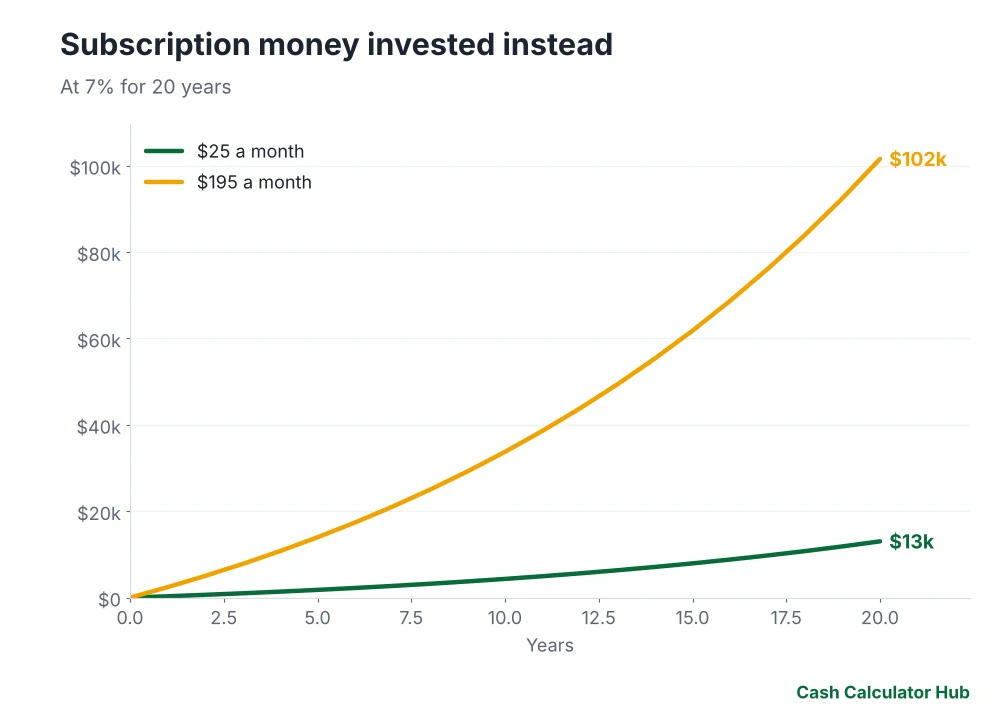
Quick answer: Seven typical subscriptions costing $195 a month total $2,340 a year. Audit by listing every recurring charge from three months of statements, rating each as keep, rotate or cancel, and cutting what you have not used in 30 days. Investing the savings of $195 a month at 7% for 20 years would grow to about $101,581.
Subscriptions are designed to be easy to start and easy to forget. Individually small, together they are a significant category. A quarterly audit takes about 30 minutes and often pays for itself immediately.
Key takeaways
- List every recurring charge from card and bank statements, not just the ones you remember.
- Decide keep, rotate or cancel; rotate streaming services month to month.
- Annual plans save money only if you will use the service all year.
- Check free trials and price increases.
- Redirect canceled amounts to savings or debt payoff.
An example inventory
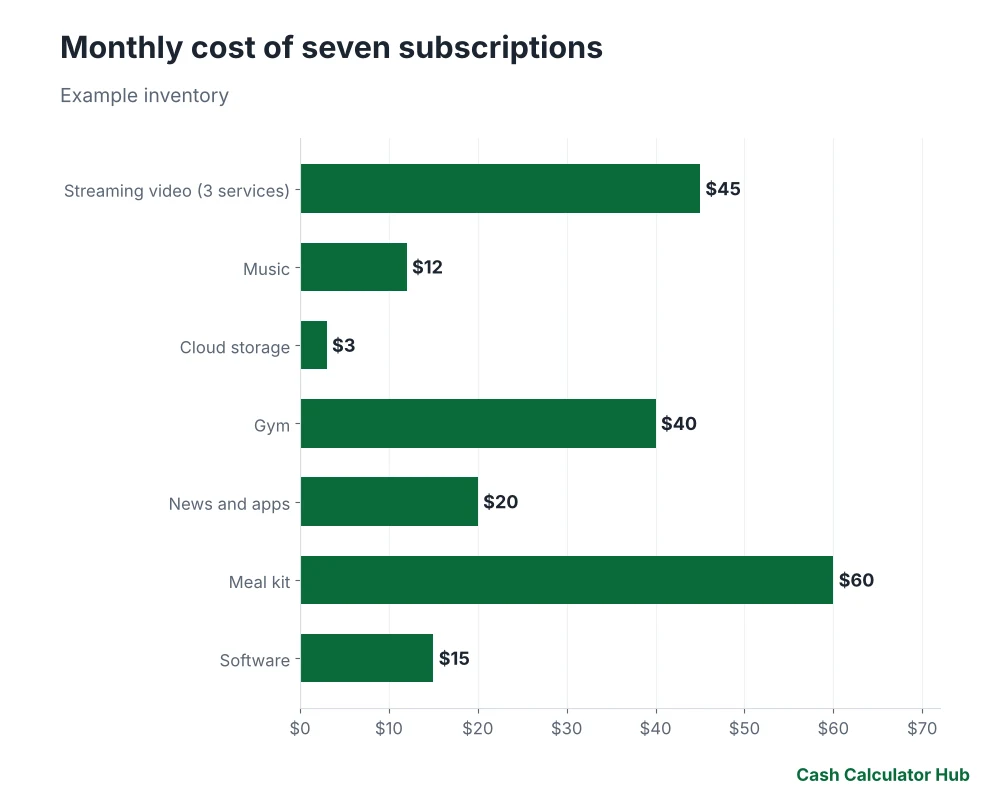
| Subscription | Monthly | Yearly |
|---|---|---|
| Streaming video (3 services) | $45 | $540 |
| Music | $12 | $144 |
| Cloud storage | $3 | $36 |
| Gym | $40 | $480 |
| News and apps | $20 | $240 |
| Meal kit | $60 | $720 |
| Software | $15 | $180 |
| Total | $195 | $2,340 |
The audit in five steps
- Collect. Pull three months of credit card and bank statements. Highlight repeating charges.
- Total. Add monthly and annual amounts. Convert yearly bills to monthly: a $120 annual fee is $10 a month.
- Rate. Mark each as use weekly, use monthly or rarely.
- Cut. Cancel those used rarely; set calendar reminders for trials.
- Redirect. Move the savings to a goal immediately so it does not disappear.
What cutting is worth
| Cut | Monthly saved | Per year | If invested 20 years at 7% |
|---|---|---|---|
| $25 a month | $25 | $300 | $13,023 |
| $50 a month | $50 | $600 | $26,046 |
| $195 a month | $195 | $2,340 | $101,581 |
Smart ways to keep what you value
- Rotate streaming services. Subscribe to one at a time.
- Share family plans where terms allow.
- Compare annual with monthly prices and note renewal dates.
- Negotiate cable, internet and phone bills annually.
- Use a separate card or virtual card for trials.
Related budget leaks
Also check bank fees, unused memberships, insurance renewal and credit card annual fees. For a full budget see zero-based budgeting and average spending.
Tools
Use the percentage calculator to compare annual and monthly prices and the investment calculator to see what the savings could become. More: budgeting tools.
Frequently asked questions
How do I find all my subscriptions?
Review three months of bank and credit card statements and look for repeating charges; many banking apps also list recurring payments.
How much do the average person’s subscriptions cost?
It varies widely; many households spend $50 to $300 a month across streaming, software, and other services.
Are annual subscriptions cheaper?
Usually, but only worthwhile if you will use the service for the full year.
How can I avoid free trial charges?
Use calendar reminders, a virtual card with a spending limit, or cancel right after signing up.
How often should I audit subscriptions?
At least every quarter.
Sources and further reading
- FTC: Consumer advice on money and credit
- Consumer Financial Protection Bureau
- MyMoney.gov: Financial literacy resources
How the numbers were made: Every figure on this page was calculated from the formulas and assumptions stated above and rounded to the nearest dollar. Rates, limits and rules are for 2026 unless noted; confirm current figures with the sources listed before acting.
Keep reading
- The 50/30/20 Budget Rule: How It Works, and How to Adjust It
- Compound Interest on $10,000: What It Becomes in 10, 20 and 30 Years
- How Long Does It Take to Save $1 Million?
- How Couples Should Split Expenses: 50/50, Proportional or Shared Pot?
- Lifestyle Creep: How Rising Spending Eats Your Raises (and How to Stop It)
- Budgeting on an Irregular Income: Freelancers, Gig Workers and Commission Pay
This guide is general information, not financial, tax or legal advice. Figures use stated assumptions and 2026 rules and will differ from your situation; check current rules and talk to a licensed professional before you decide. Full disclaimer.