Quick answer: To reach a savings goal, divide the target by the number of months, then reduce the amount a little for interest. At a 4% yield, $25,000 in five years takes about $377 a month, $50,000 in five years about $754, and $100,000 in ten years about $679.
A goal without a monthly number is a wish. Turning “I want $25,000 for a house down payment” into “I put away $380 on the first of every month” changes what happens.
The table below uses a 4% annual yield, compounded monthly, with deposits at the end of each month. Use it as a starting point and adjust for your rate.
Key takeaways
- At 4%, saving $377 a month reaches $25,000 in 5 years.
- The formula: monthly deposit = goal × r ÷ ((1 + r)^N − 1), where r is the monthly rate and N the number of months.
- Interest does little over one year but matters more over ten.
- Automate the deposit on payday so it happens before spending.
- If the monthly number is too large, extend the deadline or reduce the goal.
Monthly savings needed at 4%
| Goal | 1 year | 3 years | 5 years | 10 years |
|---|---|---|---|---|
| $5,000 | $409 | $131 | $75 | $34 |
| $10,000 | $818 | $262 | $151 | $68 |
| $25,000 | $2,045 | $655 | $377 | $170 |
| $50,000 | $4,091 | $1,310 | $754 | $340 |
| $100,000 | $8,182 | $2,619 | $1,508 | $679 |

For comparison, with no interest at all, $25,000 in 5 years would be $417 a month. At 4% it is $377, because interest supplies $2,375 of the target.
The formula
Deposit = Goal × r ÷ ((1 + r)^N − 1)
For $25,000 over 5 years at 4%: r = 0.04 ÷ 12 = 0.003333, N = 60. (1.003333)^60 = 1.2210. Deposit = 25,000 × 0.003333 ÷ 0.2210 = $377.
What interest adds
At a 4% yield, here is how much of a $25,000 goal comes from interest, by time frame:
| Time to goal | Monthly deposit | You contribute | Interest earned |
|---|---|---|---|
| 1 years | $2,045 | $24,545 | $455 |
| 3 years | $655 | $23,572 | $1,428 |
| 5 years | $377 | $22,625 | $2,375 |
| 10 years | $170 | $20,374 | $4,626 |
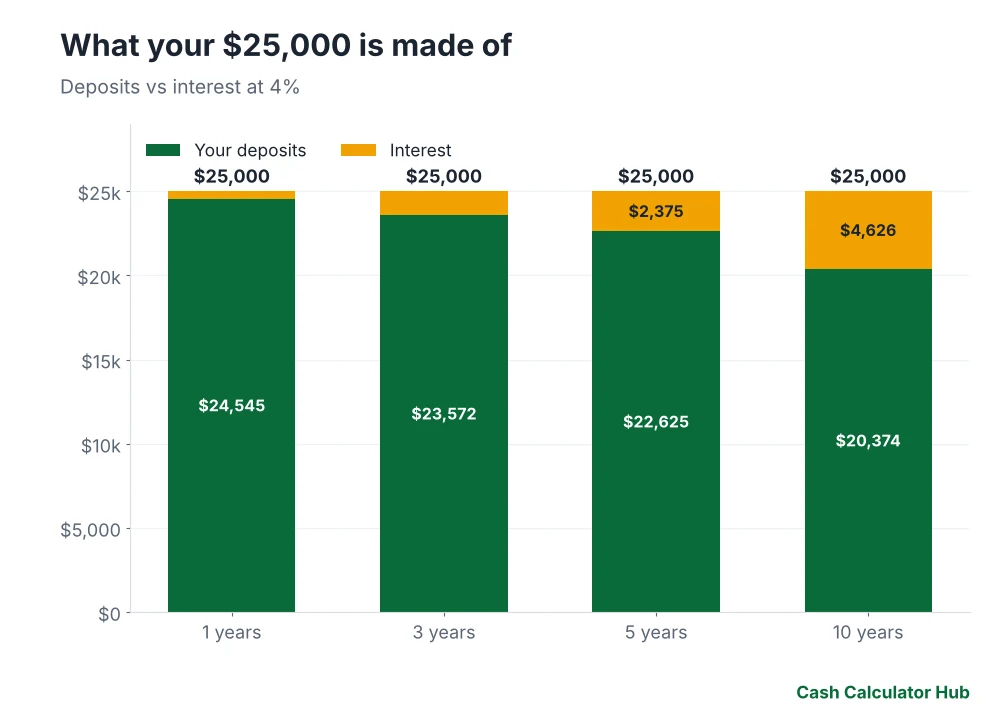
On short goals, your deposits do almost all the work, so the discipline is more important than the rate. On long goals, interest does more.
What if the number is too big?
- Extend the deadline. Moving from 3 to 5 years cuts the deposit by 42%.
- Reduce the goal. Cut the target by 20% and the monthly amount falls by 20%.
- Find the money. Review a budget with the 50/30/20 rule or zero-based budgeting.
- Add one-time deposits from a bonus or tax refund.
- Raise the yield safely. See high-yield savings accounts.
Where to keep the money
- Under 3 years: high-yield savings, money market or short-term CDs.
- 3 to 7 years: a mix of savings, CDs and short-term bonds.
- Over 7 years: consider investments with more growth, understanding they can lose value.
Match the account to the deadline. For retirement or long-term goals, see compound interest.
Several goals at once
Name each goal, set a deadline and a monthly amount. Use separate sub-accounts or buckets, often called sinking funds; see the sinking funds guide. Order: emergency fund, then goals with deadlines, with retirement running in parallel.
Calculate your own
Use the savings calculator to find the deposit for your goal and rate, the future value calculator for a starting balance and the interest calculator for specific yields. More: savings and investing tools.
Frequently asked questions
How much should I save each month for a $10,000 goal?
At a 4% yield, about $818 a month for one year, $262 for three years or $151 for five years.
How do I calculate monthly savings for a goal?
Use deposit = goal × r ÷ ((1 + r)^N − 1), where r is the monthly interest rate and N is the number of months. Or use a savings calculator.
Does interest matter for short-term goals?
Only a little. Over one year at 4%, interest adds about 2% to your deposits. Time and consistency matter more.
Where should I keep money for a goal that is 3 years away?
In a high-yield savings account, money market account or short-term CD, where the principal is not exposed to stock market losses.
What if I cannot afford the monthly amount?
Extend the deadline, lower the goal, or increase income or savings from other sources.
Sources and further reading
- MyMoney.gov: Financial literacy resources
- FDIC: Deposit insurance
- Consumer Financial Protection Bureau
How the numbers were made: Every figure on this page was calculated from the formulas and assumptions stated above and rounded to the nearest dollar. Rates, limits and rules are for 2026 unless noted; confirm current figures with the sources listed before acting.
Keep reading
- How Much Emergency Fund Do You Need? A Month-by-Month Plan
- Compound Interest on $10,000: What It Becomes in 10, 20 and 30 Years
- The 50/30/20 Budget Rule: How It Works, and How to Adjust It
- Portfolio Rebalancing: How and When to Do It
- Cap Rate vs Cash-on-Cash Return: Evaluating a Rental Property
- What Is the Average Stock Market Return? S&P 500 History in Plain Numbers
This guide is general information, not financial, tax or legal advice. Figures use stated assumptions and 2026 rules and will differ from your situation; check current rules and talk to a licensed professional before you decide. Full disclaimer.